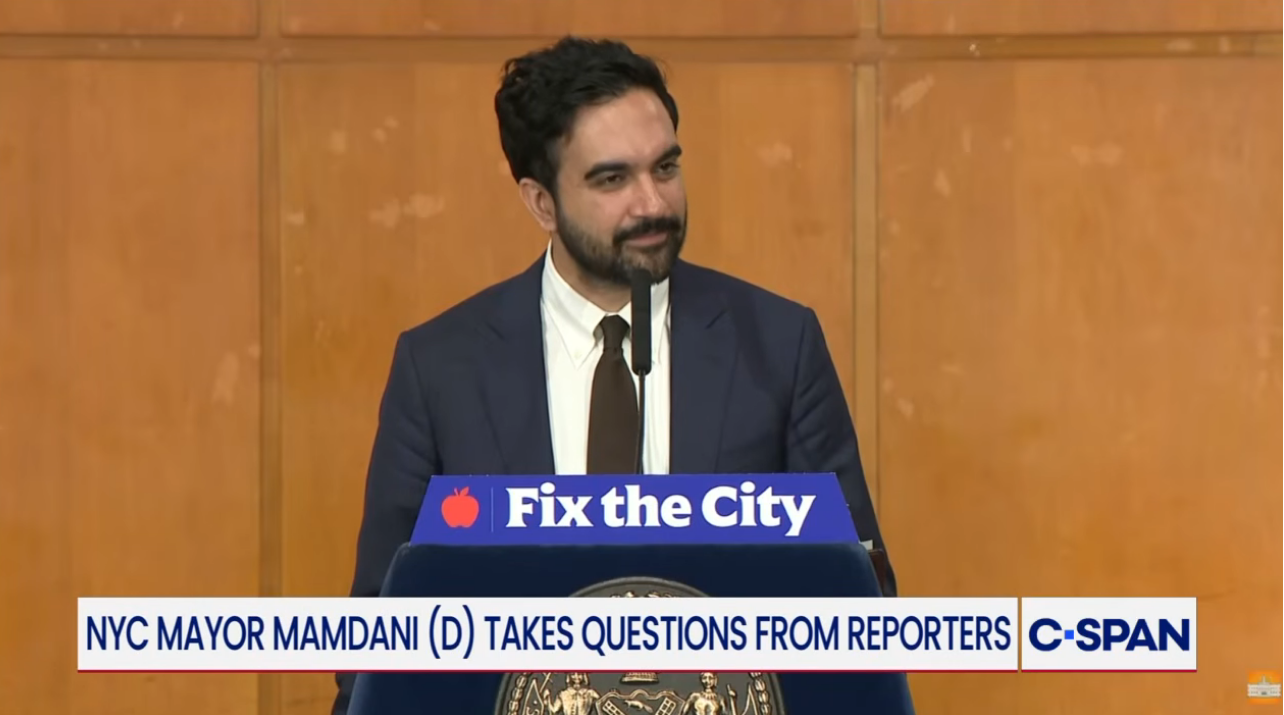
The following is a transcript of New York City Mayor Zohran Mamdani comments to the media after Tuesday’s historic midterm election.
Question: Mayor, so are you still planning on signing the bill? I mean, there was a horse carriage bill. There was a lot of testimony today, you know, raising concerns about it, especially about, you know, the worker protection aspects. I know you said you were going to come out and sign it before, but did this change your mind at all?
Mayor Zohran Kwame Mamdani: Yes, I will still be signing it. And I also just want to take a moment to speak about the workers. I had the opportunity to visit a horse stable and meet with a number of horse carriage drivers, including some of whom had testified today, and I want to emphasize my respect for them and for the work that they do.
These are drivers who should not be demonized. These are drivers who care deeply for their horses and have built their livelihoods through this work. And many of them, I know, are still in debt from buying their medallion and are deeply worried about the financial implications when it comes to this legislation. And that is why we are committed to not only hearing from them about their concerns but also in creating a fair and just and real transition for them out of this workforce.
Question: Regarding yesterday’s blue wave, could you articulate specifically the sorts of changes with regard to America’s policy toward Israel you’re hoping to see Congress enact?
Mayor Mamdani: Yeah. You know, what last night showed us is that Americans are tired of being told that their needs are unrealistic by politicians who have been bought by the wealthiest people in the country. This country has elected a new generation of leadership, a generation with a mandate to lower the cost of living, to build, not bomb, to never betray the working people who entrusted them with power.
And I hear often that the politics that we’re fighting for here in New York City are not possible outside of city limits. And what last night showed us is that working people are the majority, whether we are speaking of Austin or Ann Arbor or Astoria, and it is time to put those same people first in our politics. And last night shows us that it’s possible to do so all across the country.
Question: Are there particular things you’d like to see change [inaudible]?
Mayor Mamdani: Yes, I would like compliance with international law. I would like to see an evaluation of humanity over what we have seen for too many years.
Question: One of the reasons your politics resonated in New York City was specific promises: buses fast and free, universal Pre-K, to name a couple. What specific things should Democrats do first? For example, should one of their first acts be to vote to end the war in Iran? I’m not saying that has to be your answer, but I’m looking for that sort of specific action item you would suggest for Democrats.
Mayor Mamdani: Well, I appreciate this question because I think what it gets to, Henry, is the fact that it is not enough for us as Democrats to win power. We have to use that power to deliver change that Americans can feel in their wallets.
And to me, when you look at these campaigns, if we want to speak about James Talarico, he campaigned on a vision for universal childcare. If you want to talk about Keisha Lance Bottoms, she campaigned on a vision of cutting red tape to actually be able to build housing at the speed that’s needed. And if you want to talk about Jocelyn Benson, she campaigned on a moratorium for data centers.
These, to me, are examples of the kind of specifics. But again, what I’m excited to see now is a recognition that the work is only just starting and that this has to be delivered for working people across the country.
Question: Any recommendations on how to strike a balance between legislating and oversight with respect to President Trump? You came out of an administration, Mayor Adams was accused of a number of corrupt acts and was taken to court, and you haven’t done much sort of reckoning with that. You just sort of moved on. Do you want to see Democrats do the same thing at the federal level?
Mayor Mamdani: I think every single day should be one that we spend in a way that’s relevant to working people’s lives and their struggles. The corruption that we’ve seen come out of Washington is relevant to working people’s struggles, as is the affordability crisis. I think it is possible and it is necessary to take action on all of the above.
Question: Hakeem Jeffries is poised to be the next speaker of the House. Can you talk about what your relationship is with Hakeem Jeffries? Obviously, your predecessor had a sort of fraught relationship with him. And then, have you spoken with the DSA members you championed for Congress who are taking office about their support for him?
Mayor Mamdani: I’ve spoken to the DSA members that I’m so proud to see as our next Congresswomen here in New York City about a range of issues. And one of the things I’ve spoken to them about is the fact that I am so excited that they are now going to not just be candidates, but Congresswomen.
When we’re speaking about Claire Valdez, we’re talking about Darializa Avila Chevalier. They’re joining Alexandria Ocasio-Cortez as DSA Congresspeople representing the great people of our city. And what I know so many New Yorkers are excited by is the fact that they will be fighting not just in opposition to so much of the cruelty we’ve seen over the last few years, but also for the people of this city. And I can’t wait to count on them as partners for our affordability agenda at the federal level.
When it comes to your first question, you know, I had the opportunity to speak to Leader Jeffries last night, congratulated him on the victories across the board, and we have a good working relationship.
Question: Let me ask you about having three New Yorkers, the president and potentially the two leaders of the House and Senate, be New Yorkers. I’m wondering, how do you think that will affect the city’s agenda, and what specifically will you be asking for locally from those folks?
And my second question is, you know, neither Darializa Avila Chevalier or Claire have committed to voting for Hakeem as speaker. I’m wondering if you’re concerned if they decide not to vote for him, how that will affect the city’s relationship with the speaker?
Mayor Mamdani: You know, I’m not here to make decisions for others. I think that what we’ve seen is that they’ve been elected to make their own decisions, and the decisions that they have made thus far have been those of prioritizing working people every step of the way. I have full confidence that that’s what they’re going to continue to do.
On your first question, to me, one of the most important aspects of what comes next is the urgency. JD Vance told Americans to give him two more years. Americans cannot afford two more years when their rent is due on the first of the month. Americans cannot afford two more when they have to pay childcare for their kids. They cannot afford two more years when they had to go to the grocery store today.
And so, what we need to understand is the urgency of delivering for those same Americans that have entrusted us with this power. And that is what is so exciting to me, is —
[Crosstalk.]
I think we’ll leave it there.
Question: Specifically, will New York’s agenda be helped, and are there specific items that you want to ask for?
Mayor Mamdani: [Crosstalk.] To your question about what we are looking for, we are first looking for an end to the kind of policies that have had cruel impacts on New Yorkers’ lives. SNAP policy changes have robbed 26,500 New Yorkers of SNAP benefits, making it literally harder for them to afford food that they can put on the table for their families.
When we’re talking about H.R. 1, 900,000 New Yorkers are at risk of losing their health insurance. So first and foremost, there is the need to ensure that federal policies are not making life harder for New Yorkers. And then there’s the work that we need to do to deliver on an affirmative vision for New York. And our vision is one that requires partnership at the city level, state level and the federal level.
Question: I want to ask you, the five ballot questions that came out of your commission all passed yesterday. I wanted to get your reaction to that. And also, I wanted to ask you if you’ve called Abdul El-Sayed, have you spoken to him, and how much of this election do you think was a referendum on President Trump and what’s come out of his White House?
Mayor Mamdani: Yeah, I think this referendum was on politics at large across this country. This referendum was one of politicians telling working people that their needs were unrealistic while those same politicians were willing to do whatever it is that the wealthiest people in the country would ask them to do.
I think that this referendum — this election — is also a referendum on JD Vance asking for two more years to deliver on the things that Americans cannot afford even another day of delay on.
And I am excited because what we now have is an opportunity to ensure that we recognize our job for what it is. It is not a job to better manage a decline. It is a job to inspire our country to heights that we’ve never been to before, where the working people who built this country are the ones that are then in the centerpiece of all of our politics.
And to your question about COGE, it is what we saw last night: New Yorkers voting for a government that moves as fast as they do. We saw New Yorkers vote by significant margins, whether to speed up the process of outdoor dining and save small businesses money, or accelerate street safety improvements, or ensure that nonprofits could actually have their contracts paid on a better timetable, or even to cohere the way in which we build affordable housing and strengthen our savings.
And to me, what is so exciting to see is that this is now an opportunity for New Yorkers to have a government that moves as fast as they do. And I also just want to take a moment to acknowledge Jimmy, who’s here, who has worked tirelessly, as have a number of others on our team at City Hall, in ensuring that we met the state requirement of public education around these ballot proposals. It would not be possible without that kind of work.
Question: And calling Abdul, did you call him at all? Have you congratulated him?
Mayor Mamdani: I haven’t spoken to him yet. I’m sure he is quite busy. I’ve had the privilege of speaking to him in the past, and I have to say that his election is one that means so much to so many. And to see that victory in the face of all that he had to reckon with over the course of that campaign, whether in terms of the extraordinary amount of money spent to oppose him or the racism and slander that he was met with on a daily basis, it is incredibly exciting to see, as he said last night, that the good guys won.
Question: I wanted to follow up on Jeff’s question about the New Yorkers running the country. So, you’ve got Hakeem, you’ve got Schumer, you got Trump, all from New York. Does any of that matter? You’ve had experience having the president at Gracie Mansion, a building he likes. Did that lead to anything tangible? And do you think the background of Jeffries and Schumer being from New York will lead to anything tangible?
Mayor Mamdani: I think that having leaders in Washington be from our city and of our city is of incredible importance to our city. Because for them, the struggles of New Yorkers are not intellectual concerns or ones that are being mediated through the prism of media or politics. It is one that they experience and hear from their constituents about every single day.
And when it comes to the president, I’ve said time and again that we have significant policy disagreements, and yet we look to work together on the areas that we can agree on. And one of those very limited number of areas is the welfare of the city as a whole.
And it is through those conversations that we’ve been able to secure the release of a New Yorker who was detained by ICE. It’s through those conversations that we were able to secure a visa for J Javits Frimpong’s mother to ensure that she can be here for the burial of her child. It’s through those conversations that we can always make sure there’s an avenue to make an ask for the benefit of working New Yorkers. And I look forward to continuing to explore every option to deliver for this city.
Question: So, since the governor stopped the civilian fare enforcement teams on the buses and the NYPD hasn’t written bus tickets in quite a while, do you see that as you’ve achieved your goal of making the buses free? And if not, how do you interpret yesterday’s result as either moving toward or away from your goal of taking the buses free?
Mayor Mamdani: Thank you very much for your question, Nicole. I don’t see it as the fulfillment of that goal because a key part of that goal is ensuring that we make the MTA whole as a result of making those buses free. That’s why it’s not just a policy goal but also a fiscal goal, which would cover the fare revenue that the MTA would otherwise make, as opposed to telling them to find another way to make ends meet, because that is the history of New York politics is putting policy goals on the MTA, not providing them with the financial support, and then asking ourselves, why did services suffer as a result? So, there is much more of it to be won.
And in terms of your other question, yesterday what we also saw here in New York was not just the passage of these five ballot proposals. We also saw the governor, the attorney general, Democrats up and down the ballot winning at margins that we haven’t seen in quite some time.
And especially the governor and the attorney general, I think it was a 21-point margin the last time that I saw, which is incredible considering so much of the campaign was spent hearing Bruce Blakeman talk about how it was going to be 52-48, and I don’t even know if he won Nassau.
Question: You kind of touched on this, but I’m just kind of following up. What was it like watching the blue wave last night? All the wins from New Yorkers and so many firsts, and also specifically, what is your plan that translates last night’s wins to helping everyday New Yorkers?
Mayor Mamdani: It was incredible to see the blue wave and to say words that I never thought would be together in a sentence: South Carolina, Kansas, Iowa. The races that are still yet to be called, that these are even in question — it speaks to the fact that this entire country is ready for a politics that means something to their lives and to their struggles.
And what we saw Democrats running on across the country was an ambition for what government could do, as opposed to a sense that our job is simply to describe working people’s struggles. Our job is to deliver on those struggles.
And the commonality between working people in Austin and Ann Arbor and Astoria across this country is one that should inspire also a commonality of purpose for what we do with this power, because I see in that the true reflection of what the American people want, which is change they can feel in their wallets.
Question: [Inaudible.]
Mayor Mamdani: It means that we can go from being on the defensive to being on the offensive. The defensive means trying to prevent as many New Yorkers as possible from losing their SNAP benefits or losing their health insurance. That’s a reflection of the policies that Republicans have pursued for the last few years.
The offensive is delivering to make life more affordable for them. That’s what we’ve been focused on here in New York City, and that’s what we could do so much more of if we had federal partners across the board. And now we’re seeing the election of many of them.
Question: Are you planning to, I guess, walk across the aisle with the Republican leaders who may be a little disgruntled with the wins of last night, or in general?
Mayor Mamdani: I’m willing to work with anyone, no matter what party they’re a part of, so long as us working together can deliver for working people. That’s how I see my job. That’s what New York has elected me to do. And that’s what we have to measure success by: the results.
Question: There’s considerable momentum in the left flank of the Democratic Party. Do you think the left should continue to —
Mayor Mamdani: Can you say that one more time?
Question: There’s a lot of momentum in the — do you think the left should continue to kind of press its foot down on the gas? Or is there a risk of too much feuding, fracturing the party ahead of an important presidential cycle?
Mayor Mamdani: Foot on the gas. This is the moment where we are seeing people across this country vote for a politics that will mean something. For a long time, politics has felt like a hobby only some people can afford. We want politics to mean the deliverance of dignity into working people’s lives.
And to look at the victories not just last night, but even in the primaries going through yesterday evening, it’s a realization that it’s a new dawn in America. It’s a new day in America, and I cannot wait to see what we do with this opportunity because it is one that we now must deliver on.
Question: But do you worry about rifts? Or do you think it’s the time for unity? Or, like, how do you?
Mayor Mamdani: I think it’s a time for delivery. I think it’s a time for dignity. I think it’s a time for understanding that power is not something you just fight to have. It’s something that you use to deliver for the working people who’ve been robbed of it for too long.
Question: And just one more. The WFP line grew its share of votes in the governor’s race. Do you think that gives you more leverage in your push to raise taxes in Albany?
Mayor Mamdani: I think what it does is show that the constituency that is fighting for working people is only growing, and we’re excited to grow that coalition every single day.
Question: Given last night’s election results, do you expect the governor to be more open to left-wing priorities such as increasing taxes on the wealthy, or do you think she’s going to use her mandate to push more to the center and quash any progressive agenda items?
Mayor Mamdani: What I’ve found from the governor is a commitment to a productive working relationship, no matter what month it is or what year it is. And I am confident that that is going to continue, because what New Yorkers have shown is that they prefer life when all of their elected representatives understand their jobs are to work together to deliver for them. And that’s what we’re going to do.
It was a pleasure to campaign with the governor. It was exciting to see that margin run up yesterday evening. A race was called at 9:02 p.m. There were people still online at 9:02 p.m. And to me, that’s a reflection of all that we’ve been able to do and all that we still have yet to get done.
Question: When was the last time you’ve talked to the governor about increasing taxes on the wealthiest, and what was the conversation like?
Mayor Mamdani: I can tell you the last time I talked to the governor was last night. It’s been quite some time since we’ve talked about anything other than the election because that’s really been the focus. I did congratulate her on finishing the Van Wyck, though. That’s something that means a lot to a lot of New Yorkers. Thank you, guys.