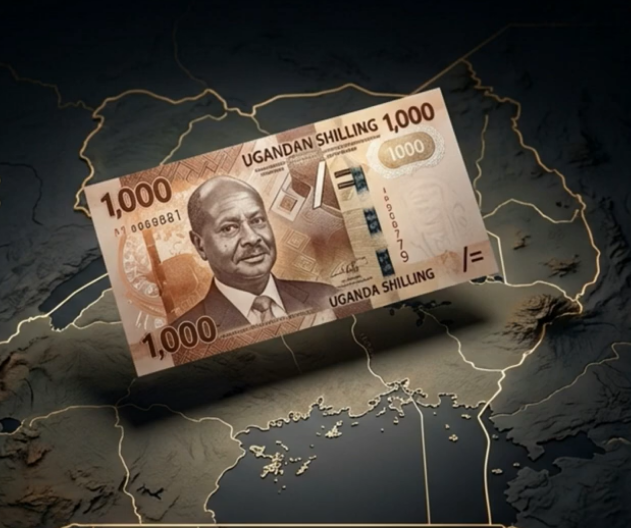
The Uganda Shilling or UGX’s depreciation continues. It is back past 4,000 to the dollar. In fact, as of October 18, the UGX traded at 4,136.46 against the US Dollar, or USD.

But the unanswered question now is whether the Central Reserve—Bank of Uganda (BoU) will ‘defy’ its appointing authority, Gen. Yoweri Museveni and touch the reserves! Addressing the nation on the country’s 64th Independence Anniversary on October 9, Museveni said he vehemently rejected BoU Governor’s proposal to inject the national foreign reserves to save the rapidly plummeting local currency. So far analysts say all dollar owners are starting to bet again the UGX as of October 16 following BoU’s intervention on October 14. The strength of the UGX is measured against the USD.
As the USD boomed, the shilling has weakened from roughly UGX3,620 to the USD at the onset of 2026 to the low of UGX 4,143; recording the weakest plunge ever since 1993. This presents a slide of about 11-14% with the biggest slip recorded at the dusk of August. Local commodity prices have subsequently spiked in response to the local currency’s fall.
Clarifying on the October 14 Monetary Policy Statement (MPS), a culmination of an urgent sessional meeting of the Monetary Policy Committee, BoU said on October 16: “This follows the increase in the Cash Reserve Requirement (CRR) to 13.5% on 24 September 2026. Both measures aim to contain rising inflation risks and keep prices stable. Why did the Bank act now, and what lies ahead for inflation and growth? Our Monetary Policy Statement at a glance sets out the decision, the latest projections and the factors that could shape Uganda’s economic outlook. Answer the questions from why the Committee met early to how a higher CBR [of 12%] may affect borrowers, savers and businesses.”
The CBR is a crucial tool used by central banks to regulate monetary policy and influencing interest rates across the economy. The CRR, meanwhile, is the ratio of deposits commercial banks need to keep with the Central Reserve.
Senior Economist and academic, Dr Fred Muhumuza, while appearing on Kampala’s Capital Radio’s premium program, The Capital Gang on October 17, said that the BoU MPS intervention “is neither curative nor preventive, but rather impulsive…Money supply drives inflation. 9.75% CBR was already too high. Money is leaving the economy because of a political distortion.” He was, however, guarded on which ‘political distortion’ is to blame but most likely he had the arbitrary suspension of Non-Governmental Organization (NGO)s’ operations in the country and the freezing of their bank accounts, in mind.
Commercial bank interest was already very high; now it is going to be much higher with the CBR at 12%, he said. Government borrows in USD and pays with interest in USD. Uganda imports in USD with about 70% of commodities used in the country being imports.
And whereas government is bent on defending itself on the plunging local currency leaning on the war in the Middle East which has spiked fuel prices, some schools of thought have contrary views on the worst state of UGX’s ill-health.
“URA [the statutory tax body, Uganda Revenue Authority] is busy harassing landlords of NGOs over rental tax, fully aware that the government illegally suspended these NGOs and frozen their bank accounts, crippling their operations. URA reported losses in the last quarter [July-August-September 2026], yet it lacks the courage to tell the political leadership the truth: a toxic political environment is bad for business, undermines economic activity and ultimately hurts revenue collection. You cannot feed a cow on rocks and expect it to produce milk the next day,” constitutional lawyer and Executive Director of the Kampala, Uganda-headquartered East and Horn of Africa’s Constitutional watchdog, Center for Constitutional Governance (CCG), Dr Sarah Bireete, fumed on October 16. CCG offices in Uganda’s capital, Kampala, were closed and its operations suspended on January 9.
Closed NGOs with their bank accounts frozen used to pump money into the Ugandan economy and even employed more Ugandans than the government does. The UK and EU countries’-funded umbrella of NGOs, the Democratic Governance Facility, for instance, is said to have had US$500 million in its accounts before its eventual closure in January 2021.
“If you think of it in terms of economics; if you have less NGOs, then you will have less [foreign] inflows,” Dr Kenneth Egesa, BoU Director of Communications said on the local Radio One’s program, Spectrum on October 15: “I think this is the time to be judicious; no more extra expenditure; no more unnecessary borrowing.”
Yet again; “The continued depreciation of the Uganda shilling against the US dollar should prompt the government to reconsider policies that may be restricting foreign exchange inflows and undermining investor confidence. Among the issues deserving urgent attention is the prolonged suspension of Non-Governmental Organizations (NGOs) operating in the country…Restrictions on civil society organizations,” Uganda’s independent Weekend Monitor editorial argued on October 17, “alongside the enactment of the controversial Sovereignty Bill…have featured in discussions about the pressures on the economy and the country’s investment climate. The government must, therefore, examine whether its continued suspension of NGOs is serving the public interest or inadvertently worsening the economic challenges facing ordinary Ugandans.
“Behind every closed [NGO] office are employees whose livelihoods have been disrupted, families whose incomes have diminished and communities that may have lost access to essential services.”
According to the paper’s editor, the contribution of NGOs to Uganda’s social and economic development is substantial. The editor then quotes a 2021 blueprint study examining the intervention of 419 NGOs across 66 districts that found that the organizations had reached approximately 12.4 million direct beneficiaries, while indirect beneficiaries were estimated at 32 million.
“The amount was equivalent to approximately 18 percent of the National Budget for the Financial Year 2016/2017. These figures illustrate the scale of the sector’s contribution to service delivery, employment and economic activity,” Weekend Monitor Editorial said on October 17.
Fuel prices shot up by $55 from $70 per barrel to about $125 since the US/Israel attacked Iran on February 28. Rising fuel prices together with falling tourism receipts due to Ebola outbreak in May hit Uganda’s balance of payments. Uganda has so far been declared Ebola-free anyway. “[But] as inflation increases,” said Egesa, “people also make expectations; there are higher expectations that prices will increase.” The UGX depreciated between August and September into the second week of October.
As of October 17, oil prices rose to touch around $110 per barrel; the first such increase in oil prices recorded in May. Oil market analysts say the current price increase indicates that any increased risk of aggression against Iran once again will force Iran—-which now allows only 25% shipments through the Strait of Hormuz—with a push of a single button, to raise the oil prices to $150-$200 per barrel if it chooses to completely close the Strait 100%.
Uganda’s current account Trade and Services deficit has worsened, according to Ugandan economist, lawmaker and NGO head, Dr Patrick Wakida. “The country’s trade deficit grew sharply, rising by US$1.4 billion to reach US$4.6 billion. This was mainly because of weaker prices for key exports like coffee and cocoa, lower tourism earnings and higher oil costs.
“The goods deficit went up from US$2.4 billion in August 2025 to US$2.8 billion in August 2026,” Dr Wakida said on October 16, “while the services deficit expanded from US$2.2 billion to US$3.3 billion, driven by more expensive freight charges. The primary income deficit also increased, moving from US$1.4 billion to US$1.7 billion. On the positive side, secondary income improved from US$2.7 billion to US$3.1 billion, supported by stronger remittance inflows.”
Massive capital flight is said to have triggered the UGX hemorrhage as Uganda experienced an estimated $200 million offshore capital flight. This was coupled with rising US bond yields and global investor withdrawals severely draining local dollar liquidity.
Again a surge in import demand meant a heavy demand for dollars by local importers—particularly to pay for expensive fuel, manufacturing inputs and medicines—heavily outweighed incoming dollar flows; NGO closures notwithstanding.