By Black Star:
Spurred on by a quickly warping national economy and the fastest-plunging currency—the Uganda Shilling—the Government of Uganda has apparently bowed to the economic pressures occasioned by the arbitrary closures of Non-Governmental Organizations (NGOs) in the country. The Government has now announced the lifting of the ban on 10 NGOs that were shutdown days to the January 15 presidential elections. NGOs pump foreign inflows into the economy; thereby effectively weighing and equalizing the Balance of Payments in the national economy. The shortage of foreign financial inflows tightened the demand for the US Dollar in Uganda so much so that the local currency hit a 33-year-low depreciating by almost 16% in October when the exchange rate kissed 4,500 per dollar.
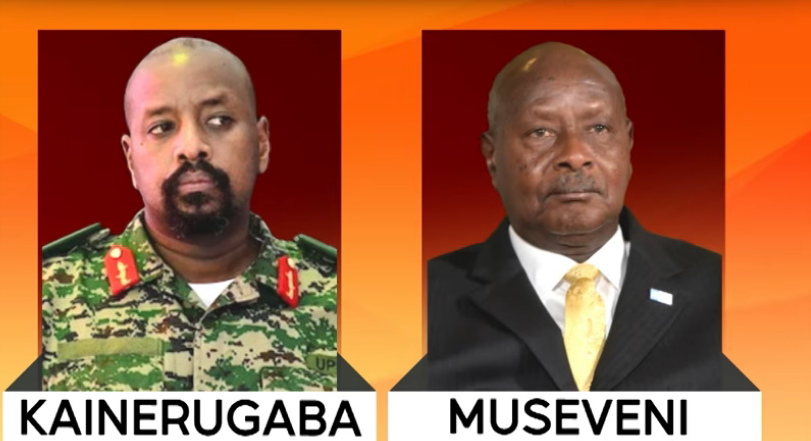
“To the public, this is [a] magnanimous act by [Gen Yoweri] Museveni’s NRM [ruling party; the National Resistance Movement] after reflection. The truth [is that] the ban on 10 CSOs/NGOs was lifted simply for urgently needed dollar inflows to ease pressure on the shilling amidst shrinking [foreign] inflows,” Business Leader, Jimmy Kiberu, claims on November 11.
Commodity prices have so far shot up over the roof as fuel prices continue to rise. Importers who pay in dollars are counting loses as imports become expensive yet their sales are transacted in the rather weaker shilling.
In yet another dimension, the Sovereignty Act promulgated in May, according to Social Justice Lawyer, Yvonne Mpambara, is being compared to the anti-Asian law by President Idi Amin. “There are suggested amendments to the NGO Act that will throw NGOs back into the trenches, too. Ugandan leaders need to become smarter for their populations to survive. This greed and focus on State expansion without consideration for the well-being of citizens is choking the country,” Mpambara thundered on November 11. The largely unpopular Sovereignty Act is a law that chokes foreign funding of entities and individuals in Uganda, and it is widely seen as a drawback to the Balance of Payments in the economy in the name of “national security”. In August 1972, then Ugandan President Amin gave Asians of Indian origin 90 days to leave the country. Indians had established themselves in trade and commerce and their expulsion back-pedalled Uganda’s economic architecture for years.
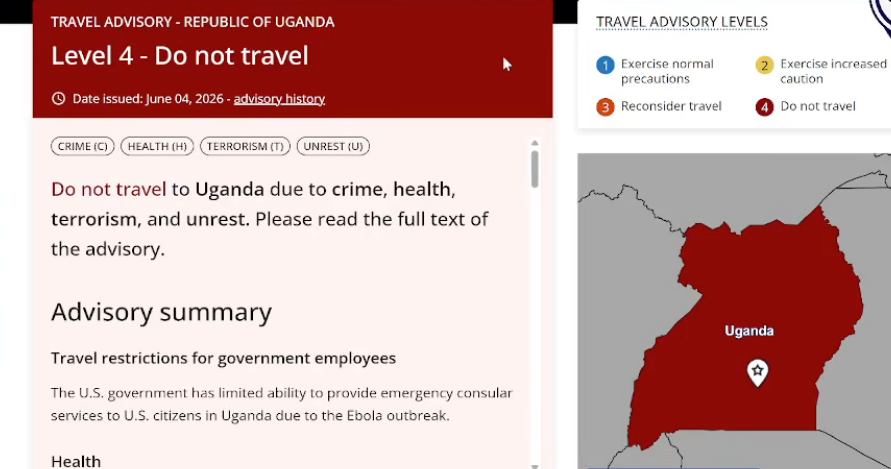
The US, meanwhile, keeps Uganda in war-zone category Travel Advisory. In the November 9 issuance, the US State Department said: “We issue Travel Advisories with levels 1-4. Level 4 means DO NOT TRAVEL. We assign Level [4] based on local conditions and/or our limited ability to help Americans there. These places are dangerous. Do not go for ANY reason,” the US State Department declared in a statement. Germany maintains Uganda on Level 3 and Italy dangles the East African country on Level 2.
“This [November 9] latest US Government travel advisory has predictably rattled many tail feathers mostly in Uganda government. Anyone unable to read and decipher the message is a surface thinker. Uganda needs deep, honest conversations beyond the unholy ‘trinity’ to put our nation to order,” Kiberu seeks to preach.
Uganda was raised to Level 4 in May due to an Ebola outbreak in neighboring Democratic Republic of Congo (DRC). WHO, however, declared Uganda Ebola-free on August 26.
“Uganda—LEVEL 4 (Do Not Travel). We are in the [war-zone] category of DRC, Sudan, CAR, Niger, Somalia, Burkina Faso, Chad, Libya and South Sudan in Africa. Globally, we feature with Yemen, Syria, North Korea, Iran, Iraq, Belarus, Afghanistan, among others,” says constitutional lawyer, Dr Sarah Bireete; she whose Center for Constitutional Governance, is among the 10 closed NGOs set to re-open soon.
But most astonishingly, Uganda’s eastern neighbor—Kenya—which contracted Ebola after Uganda, is not included in the US Travel Advisory.