By Black Star News
Photos: YouTube|Facebook
The government of Uganda has beat a strategic retreat in its earlier policy reversing decades-long practice of paying medical interns every financial cycle. In August 2024, Gen. Yoweri Museveni said that his government did not have money for paying all medical interns churned out by both government and private medical schools across the country’s universities. According to the President of the Uganda Medical Association (UMA), Dr. Frank Asiimwe, there are now 14 medical schools which have gone through the process of licensing.
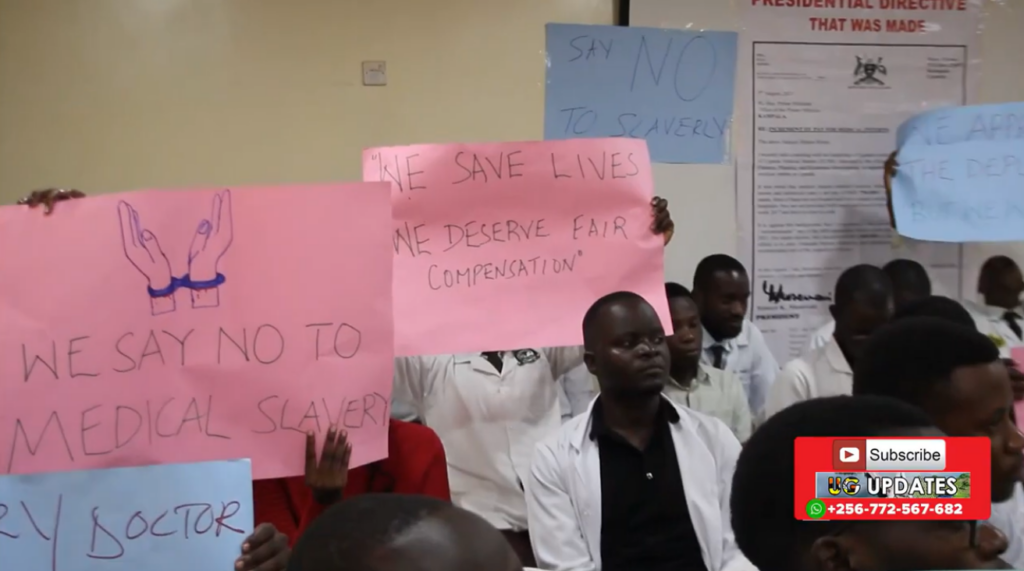
Health minister, Dr. Chris Baryomunsi then revealed to the august House plenary sitting on August 18, after months of outcry, thus; “Cabinet recommended that we suspend that provision on facilitation and pay them as it has been. The current cohort of interns will all receive a net pay of Shs1 million (about US$278),” Dr. Baryomunsi told Parliament on August 18. It has been a long-held tradition that government pays all medical interns but a new proposal had been passed that “we distinguish those who were sponsored by government at university training from those who were privately-sponsored. This has been giving interns discomfort,” Baryomunsi said.
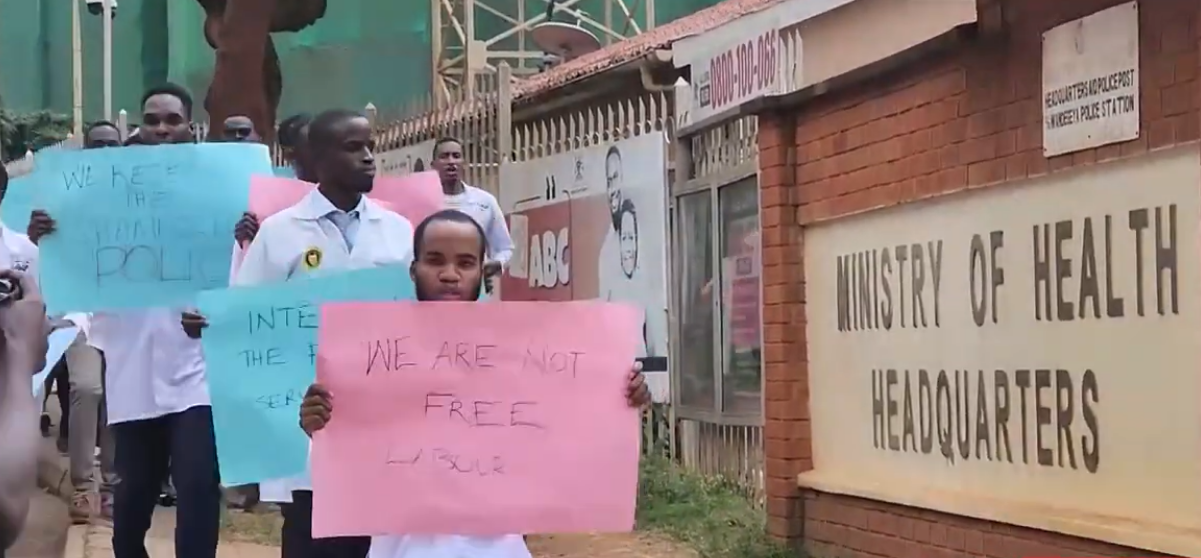
Medical interns are vehemently opposed to the provisions contained in the National Education and Training for Health Policy. Eight medical interns were arrested on August 12, arraigned before court and charged with a common nuisance on a public road two days later and remanded to Prison. They were bailed out on August 17. The prosecution alleges that they were carrying placards bearing messages crying: “Say No to NET Policy,” “No Pay, No Reporting,” and “For the Good of All Ugandans Pay All Medical Interns.”
“The policy is shambolic and it’s draconian,” Dr. Asiimwe said on local Radio One Spectrum Program on August 14. The contentious policy dictates that government-sponsored interns would continue receiving the full allowance whereas their privately-sponsored counterparts would only receive support for meals.
According to Dr. Asiimwe, 4,500 doctors under UMA had gathered and declared laying down their tools if the intern matter was not resolved within 14 days. “If there is no salary in the first place, then the rest has no meaning…We should know our deficit and surplus,” he counseled. Dr. Baryomunsi has now told Parliament that government has expanded the number of internship centers to 77 and deployed 2,490 medical interns including doctors, pharmacists, dentists, graduate nurses and midwives. Each intern will now receive about US$278 a month to cater for accommodation, transport, meals and other human amenities.
Medical interns received about Shs 2.4 million (about US$667) per month initially before the allowance was slashed to Shs 1 million (approximately US$278). Critics argue that scrapping the allowance altogether amounts to exploitation given the demanding nature of internship workload.
Medical interns are known to work for donkey hours in shifts lasting between 36 and 48 hours while providing essential services in health facilities. “You cannot say that you have Shs 158 billion (over US$43,888,889) to purchase cars for Members of Parliament and then you claim you do not have Shs 28 billion (nearly US$7,777,778) to pay medical interns’ allowances, with the excuse that it would crush the economy…senior doctors are rarely in hospitals. It is the medical interns who are everywhere doing the donkey work,” Church of Uganda Archbishop, Stephen Kaziimba Mugalu wondered while celebrating a Sunday Service in June.
The new National Education and Training for Health policy introduces several reforms, including integrating a one-year supervised internship into academic degree programs and enforcing a mandatory “no internship, no graduation” requirement, effectively extending the duration of medical training. Medical interns are qualified doctors, pharmacists, dentists, midwives and nurses on apprenticeship so as to be enrolled and registered by their various professional bodies in the country.
But just as medical interns were being remanded to prison over pay, MPs were busy grumbling to their Clerk to Parliament that their Shs315 million (about US$87,500) car allowance was paid less by Shs15 million (roughly US$4,167). Yet there are 106,000 vacancies in Uganda’s health sector with the fill-up gap of only 31% staffing level. Moreover, another 4,000 duly-qualified medical doctors are said to be jobless.
“So, only 120 million shillings (roughly US$33,333) and we shall be home and dry,” Dr. Frank Asiimwe said on Spectrum Extra, August 14. The current cohort of medical interns are 2,417.
The health sector is allocated only 7% of the required amount in the 2026/2027 national budget that took effect on July 1. The National Referral Hospital in Mulago, Kampala operates at 10% of its budget. Other Regional Referral Hospitals like Mbarara are given a measly 5% of their annual budget.
According to Dr. Asiimwe, medical supplies run out within one week after which patients must buy so as to be treated in a government health facility like Mulago.