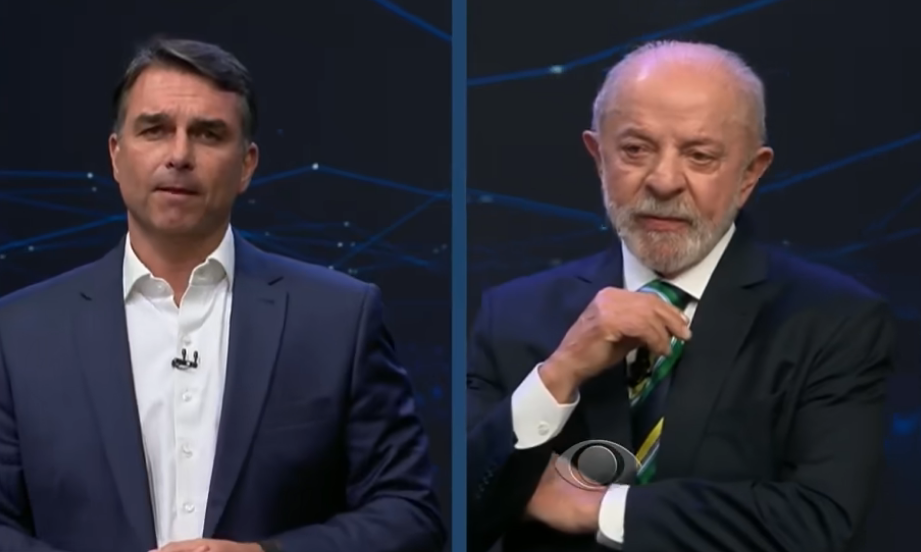
By Vanessa Barbara:
Last year, Senator Flávio Bolsonaro said in an interview that Brazil’s next president would have to commit to pardoning his father, former President Jair Bolsonaro, who is under house arrest for having attempted a coup d’état in 2022. And more: When the Supreme Court ruled the pardon unconstitutional, as it inevitably would, he said that president would have to push it through regardless, even if it meant interfering in the judiciary with “the use of force”.
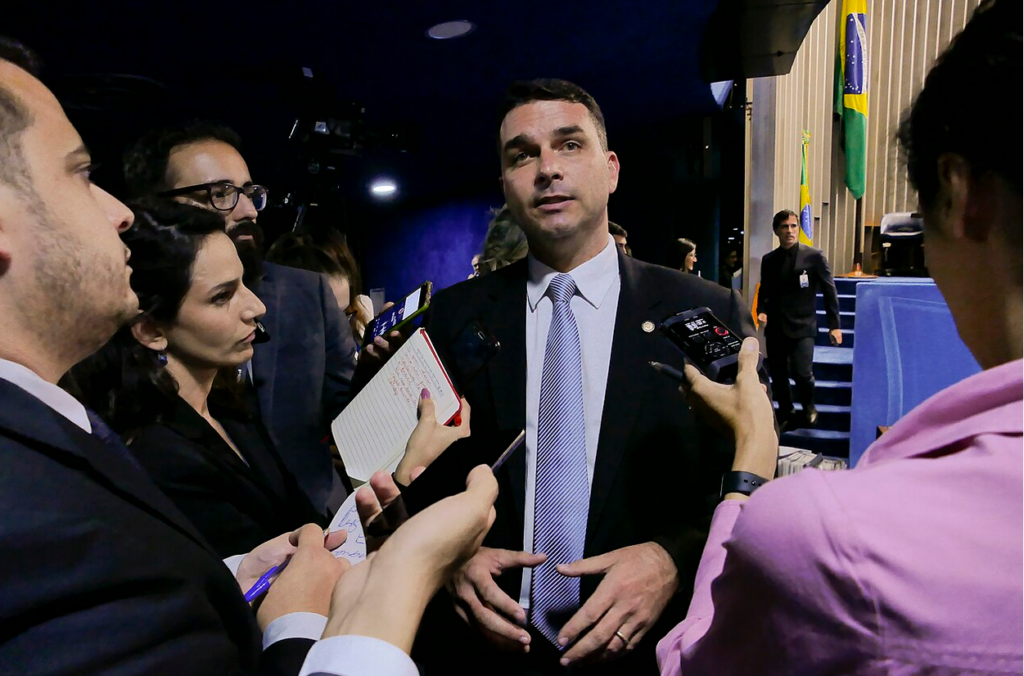
Well, it looks as if this might actually happen: Flávio Bolsonaro himself is currently the front-runner heading into the presidential runoff on Oct. 25.
The eldest son of Jair Bolsonaro, Flávio became a state congressman in 2003 at the age of 21, and later won a seat in the Senate. His brothers, Eduardo and Carlos, are also politicians. Their father entered Brazilian politics in 1989 and served seven terms as a federal congressman, during which, according to The Economist, he was “an obscure congressman whose main talent was causing offense”. The magazine also called the future president “anti-gay, pro-gun, and an apologist for dictators who tortured and killed Brazilians between 1964 and 1985”.
Apparently, Flávio is even more nefarious.
At 19, he already held a 40-hour-per-week position at the Chamber of Deputies in Brasília, despite attending full-time law school and a twice-weekly internship in Rio de Janeiro – some 580 miles away. Later, as a state congressman, he was accused of skimming his aides’ salaries in a kickback scheme. He hired a host of parliamentary aides, including his grandfather, nine relatives of his then-stepmother and a few of his father’s domestic employees. (These cases were ultimately dropped after key evidence was annulled by the courts.)
There’s a laundry list of scandals connected to his name, making it hard to pick the most outrageous. He owns a $1.2 million mansion in Brasília, which he paid for in seven installments, sparking an investigation into the transaction. Months ago, federal police seized spreadsheets connecting regional politicians to organized crime syndicates (such as the Comando Vermelho faction), which exposed a network of Flávio’s political allies, including former Governor Cláudio Castro and former state assembly president Rodrigo Bacellar.
Flávio is currently under investigation for corruption, money laundering and tax evasion over receiving $12 million from Daniel Vorcaro, a banker at the center of a massive corruption scandal. At first, he denied even knowing the banker, but later described the transaction as “private funding” to produce a film about his father.
And that was not the worst. For years, Flávio Bolsonaro employed the wife and mother of Adriano da Nóbrega, a former special forces police captain who became a militia leader and head of a notorious contract-killing gang known as “The Crime Bureau”. Nóbrega was widely considered Rio’s most feared hitman. In 2003, when Nóbrega had not yet been expelled from the police, Flávio honored him in Rio’s legislative assembly with a motion of praise, commending his “exceptional conduct” and his “dedication, sagacity, and grandeur” in the line of duty. Two years later, Flávio awarded him the Tiradentes medal, the highest honor of the legislature. He visited the prison with his father to present the award, given that Nóbrega was facing charges for the murder of a man who had reported his police battalion for torture and extortion.
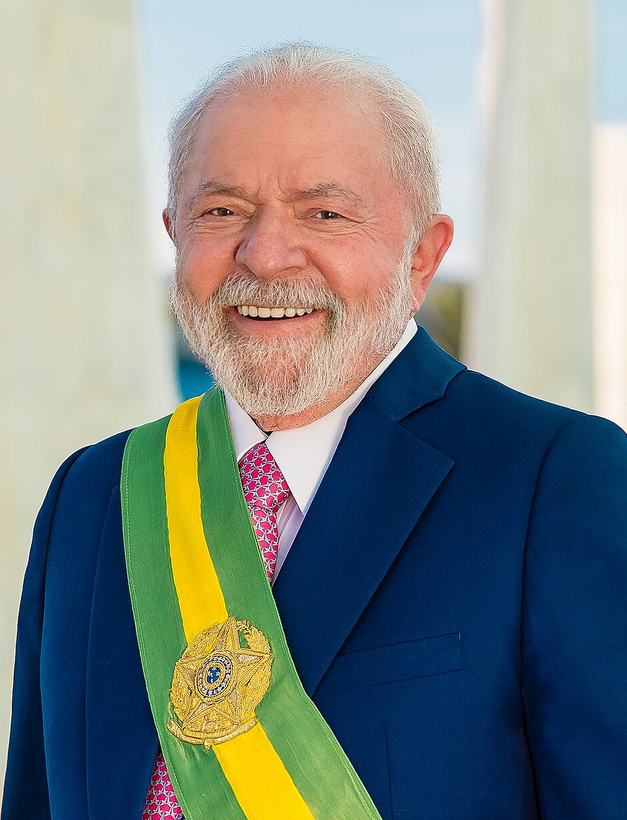
On the other side in this presidential race is Luiz Inácio Lula da Silva, one of the most prominent political figures in Latin America’s history – a center-left politician and former metalworker who has governed the country for three non-consecutive terms. Between 2018 and 2019, Lula spent 580 days in prison over a corruption case involving a triplex apartment in the city of Guarujá. (No ties to hitmen, as far as we know.) His convictions were later annulled for lack of jurisdiction. He was then released and elected president again in 2022.
Lula is committed to democracy and has no intention of returning the country to military rule. There are no public records of him saying that “one cannot simply stigmatize militia groups” or referring to them as “a new type of policing” – as Flávio did two decades ago in the legislative assembly. To the best of our knowledge, Lula never employed relatives of militia members on his staff.
Yet, a recent poll gave Flávio Bolsonaro a 51% to 49% lead over Lula. I immediately remembered a famous quote by U.S. author David Sedaris, who, in 2008, imagined a flight attendant asking: “Can I interest you in the chicken? Or would you prefer the platter of shit with bits of broken glass in it?” Sedaris writes: “To be undecided in this election is to pause for a moment and then ask how the chicken is cooked.”
I get the impression that many Brazilians want a change in government – any change. It doesn’t matter that Jair Bolsonaro (the father) ran a catastrophic administration four years ago, then tried to remain in power by plotting political assassinations and a military coup. Some people do see Flávio as a conservative man who’s upright and decent, despite all evidence to the contrary. They call Lula a “thief”, even though, after four decades in politics, all there is to show against him is the supposedly kickback-linked apartment in Guarujá.
Making matters worse, U.S. President Donald Trump is seeking to throw his weight behind the Bolsonaro family in the runoff. He knows that, should Flávio win, Brazil’s national interests would be subordinated to Washington’s agenda, at the expense of our sovereignty.
The fact is, Brazilians are leaning towards the conservative ticket this time, with the middle class tipping the scales. Captivated by individualistic, meritocratic myths, they harbor a fierce resentment against Lula’s state aid to marginalized groups. They look up the ladder and aspire to financial success and more protection against everyday crime. Democracy is a welcome bonus, but if they have to discard it, so be it.
In the end, it looks as if most Brazilians really don’t care what they’ll have to eat, as long as it’s not chicken.
Vanessa Barbara is a Brazilian journalist and author and the editor of the literary website ‘A Hortaliça’.
Source: Zeteo