By Dr. Theogene Rudasingwa
Photos: Wikimedia Commons
For thirty years, the world has been told a story about Rwanda.
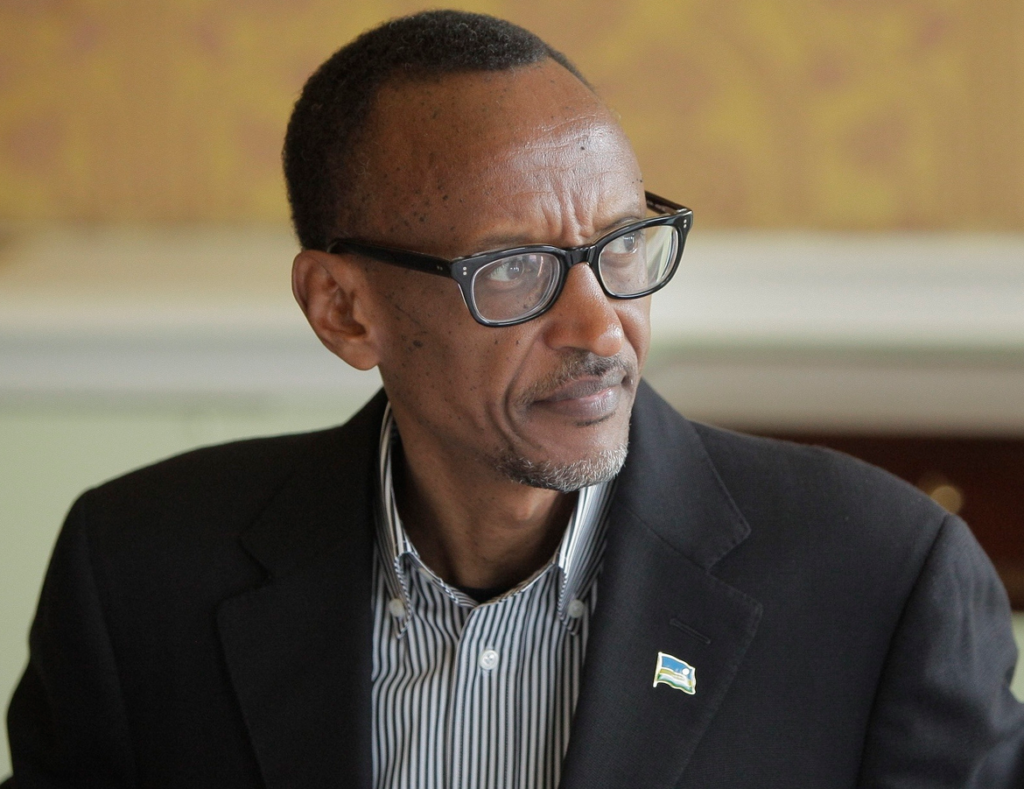
It is the story of a disciplined strongman who rescued a shattered nation, restored order after the Rwandan Genocide, and built an African miracle from the ashes. Western governments, international institutions, and a chorus of admirers repeated this narrative so often that it hardened into orthodoxy. Rwanda became the poster child of post-conflict recovery; its president, General Kagame, the indispensable architect of stability and progress.
But narratives are not reality. And today, that carefully constructed image is beginning to unravel.
Behind the glossy brochures and international conferences lies a far harsher truth: a country where the overwhelming majority of citizens remain poor peasants cultivating tiny fragments of land on crowded hillsides. Rwanda’s rural families struggle daily against soil erosion, land scarcity, and the fragile economics of subsistence agriculture. Millions live one failed harvest away from hunger.
Yet towering above this fragile rural world stands a ruling elite whose wealth and power have grown extraordinary.
External estimates have placed President Paul Kagame’s personal fortune in the hundreds of millions of dollars. Around the presidency has emerged an economic empire spanning construction, aviation, telecommunications, logistics, and real estate, built through business structures closely linked to the ruling party. In a nation where peasants measure their wealth in sacks of beans and cassava harvests, the concentration of such vast riches at the summit of power raises an unavoidable question: how was this wealth accumulated?
Part of the answer lies beyond Rwanda’s borders.
For nearly three decades, Rwanda has been repeatedly involved in wars in the Democratic Republic of the Congo, a land whose forests conceal some of the richest mineral deposits on earth—coltan, cobalt, gold, cassiterite, and other resources that power the global technology economy. The conflicts that have ravaged eastern Congo have created one of the most lucrative war economies in modern Africa.
Investigations by the United Nations Group of Experts on the Democratic Republic of the Congo have documented networks through which minerals from Congo moved through regional supply chains while armed groups, military actors, and political elites benefited from the trade. In such environments, war itself becomes a form of accumulation—a system in which violence and commerce intertwine.
For the people of Congo, this economy has brought devastation: displacement, massacres, and the looting of national wealth. For Rwanda’s rulers, it has been part of a broader political economy of power.
Meanwhile, the emperor travels.
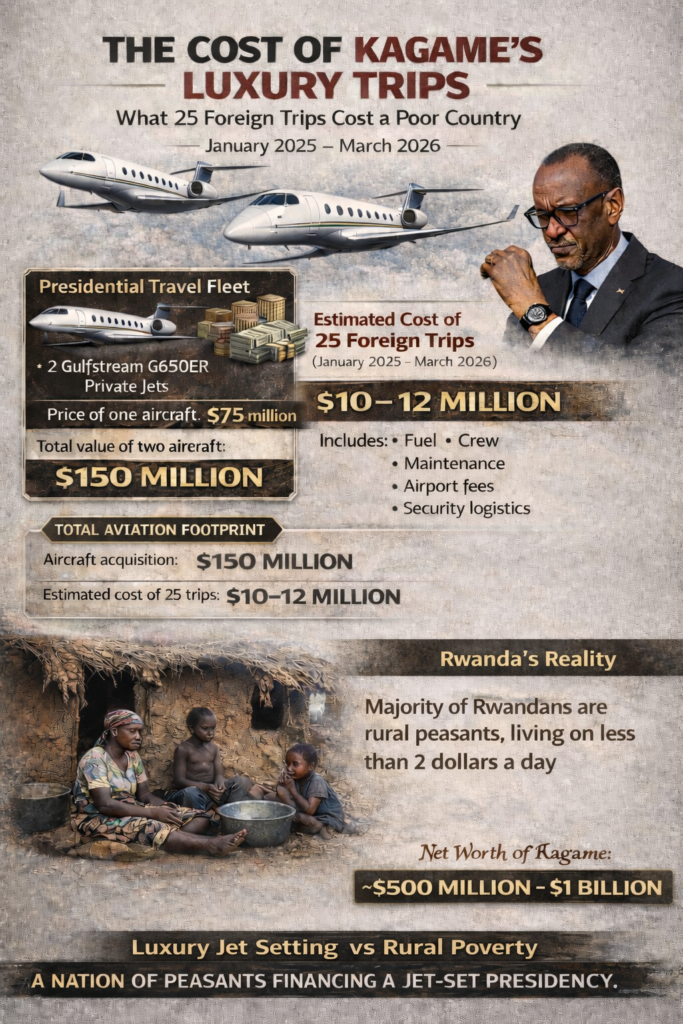
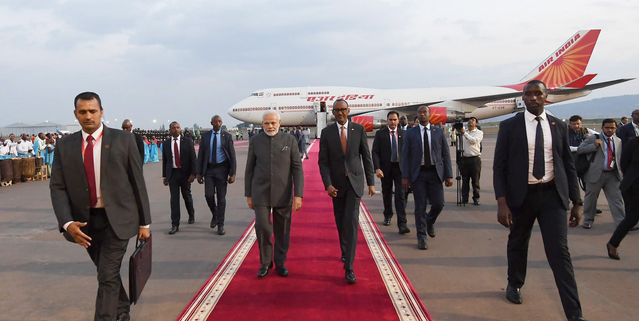
Between January 2025 and March 2026 alone, President Kagame undertook at least twenty-five foreign trips across four continents. Heads of state travel, of course; diplomacy demands it. But the destinations and symbolism of some of these journeys tell their own story.
Rwandans have watched their president fly to London to attend matches of Arsenal F.C. while the government spends tens of millions of pounds sponsoring the club through the “Visit Rwanda” campaign. He has appeared in Paris at Paris Saint-Germain F.C. games under a similar tourism branding arrangement. He traveled to Los Angeles for the NBA All-Star Game, one of the most glamorous spectacles in American professional sport. He has attended major African football finals abroad while presenting Rwanda as a global sports destination.
This is marketed as “sports diplomacy.” But to Rwanda’s peasants, it looks very different.
What does sports diplomacy mean to the poor peasants and unemployed youth of Rwanda? What does it mean to the young graduate in Rwanda searching desperately for work? What does it mean to rural communities where land has been divided and subdivided until survival itself becomes uncertain?
For them, the jets, stadium appearances, and celebrity photographs belong to a different world entirely.
Another shift is quietly taking place beyond Rwanda’s borders. For nearly three decades, President Kagame enjoyed the steady diplomatic backing of powerful Western allies, particularly the United States and the United Kingdom. That support was sustained in part by the moral shadow of 1994 and by Rwanda’s reputation as a disciplined development partner. But the political winds are changing. The British government under Keir Starmer moved to terminate the controversial multimillion-pound scheme that would have deported asylum seekers to Rwanda. In Washington, the U.S. government has imposed sanctions on elements of the Rwanda Defence Force and senior military officials in response to Rwanda’s alleged role in the renewed conflict in eastern Congo and the collapse of the Rwanda–DRC peace process. At the same time, international media outlets that once amplified the dominant narrative of Rwanda’s success are becoming increasingly skeptical. The tone of global coverage is shifting from admiration to scrutiny.
At home, the space to ask such questions hardly exists. Rwanda today operates under one of the most tightly controlled political systems on the African continent. Independent opposition parties face severe restrictions. Civil society organizations function within narrow boundaries. The press is not free. Critics who challenge the ruling order risk imprisonment, exile, or worse. Even beyond Rwanda’s borders, dissent is pursued through patterns of transnational repression that have alarmed governments and human rights organizations around the world.
Under such conditions, the official narrative of success becomes almost impossible to challenge.
Yet Rwanda remains a society marked by deep trauma. The genocide left wounds that reach across generations. Genuine healing requires truth, pluralism, and open dialogue. Instead, the country has been governed through fear, silence, repression and closure of political space to ensure the dominance and survival of General Kagame’s regime.
Fear and repression can enforce order for a time. It cannot create a durable nation.
For many years, the international community preferred not to confront these contradictions. The guilt of 1994 created a moral shield around Rwanda’s leadership. Western governments were reluctant to challenge a regime that claimed to embody the lessons of their own failure to stop genocide.
But moral capital eventually expires.
Today, that protective aura is fading. The world is beginning to look more closely at the political and economic realities behind Rwanda’s carefully curated image. As scrutiny grows, the myth of the benevolent strongman is becoming harder to sustain.
Hans Christian Andersen’s parable of The Emperor’s New Clothes tells of a ruler who parades before his subjects in imaginary garments while everyone pretends not to notice the obvious truth. The illusion persists only because fear and conformity silence those who see clearly.
Rwanda now stands at a similar moment. General Kagame is the Naked Emperor of Rwanda.
The illusion of unquestioned authority is beginning to crack. The narrative that sustained it—of miraculous development under a visionary strongman—is losing its power. Behind the spectacle of international travel, sports sponsorships, and global conferences lies a country where peasants remain poor, political freedoms remain absent, and wealth is concentrated in the hands of a narrow Tutsi elite.
The future of Rwanda cannot be built on propaganda, repression, and war economies.
It must be built on truth, freedom, the rule of law, shared prosperity, peace, and security in the Great Lakes region.
That means opening political space so citizens can speak without fear. It means dismantling systems of repression at home and abroad. It means confronting the political economy of regional conflict and ensuring that the wealth of the Great Lakes region benefits its people rather than its warlords.
Above all, it means restoring the fundamental principle that power exists to serve the people—not to enrich those who hold it.
The naked emperor can rule only as long as the people remain silent.
History shows that silence never lasts forever.

Dr. Theogene Rudasingwa formerly held positions of RPF Secretary General (1993-1996), Ambassador of Rwanda to the United States (1996-1999), and Chief of Staff for President Paul Kagame (2000-2004). He has testified before French Judges Marc Trevidic and Natalie Poux in the investigation of the shooting down of the President Habyarimana plane in 1994, as well as before the Spanish Judge Fernando Andreu Merelles in the case in which General Karenzi Karake and others are indicted. He has authored “Healing A Nation” and “Urgent Call.”