By Michael Waldman|Brennan Center
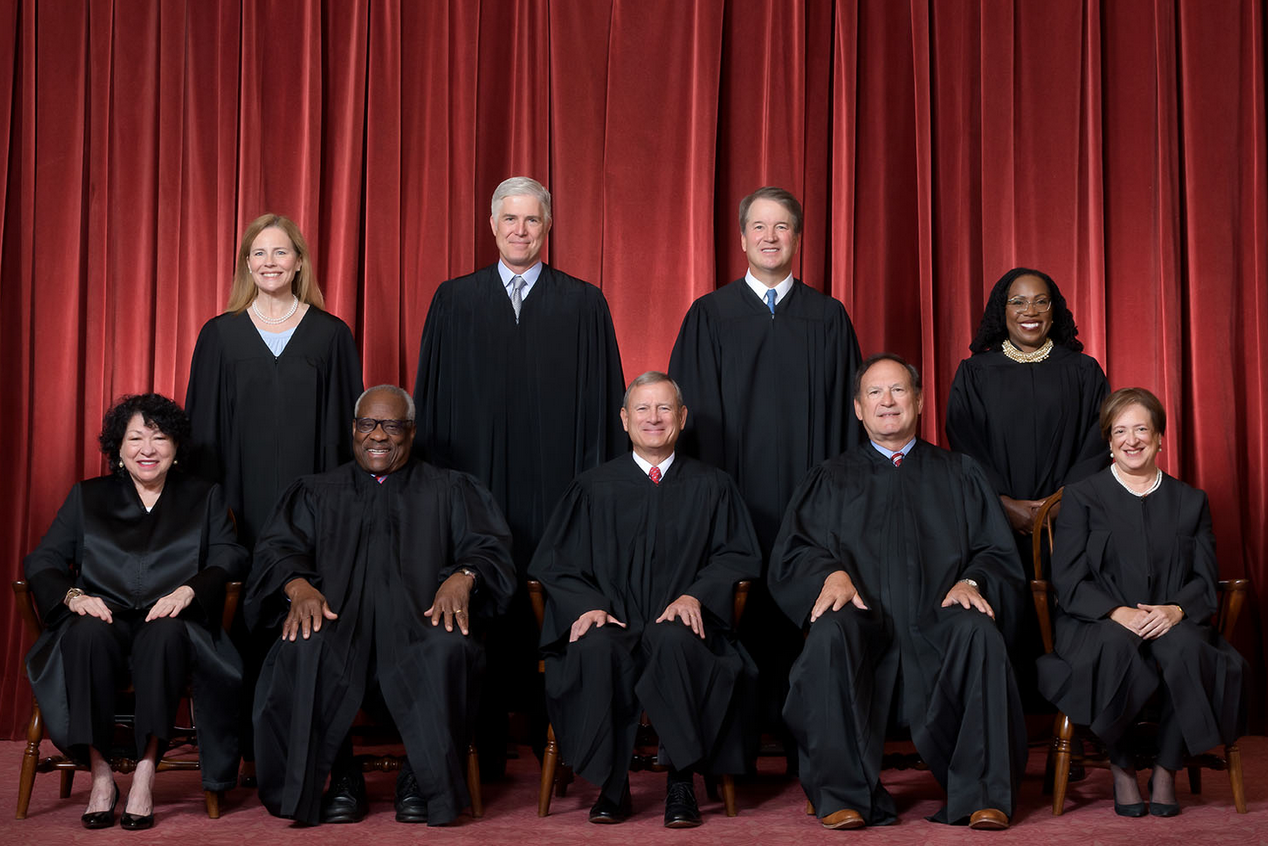
Photos: Wikimedia Commons
An “ideas primary” is underway. What will be the next generation of reform?

Last week, House Democratic Leader Hakeem Jeffries told the National Association of Black Journalists that “dramatic Supreme Court reform is necessary.”
His words rumbled loudly throughout political circles. One reason is the growing expectation that Democrats will likely win at least one house of Congress next year. Nate Silver puts the odds at 87 percent, and the Polymarket betting, oops, “prediction” market says 88 percent. These are just forecasts, of course. (Remember President Hillary Clinton?)
But voters often form firm views months before Election Day. In 2026, citizens want to shake things up. Jeffries’s embrace of Court reform is more than just speechifying. It recognizes that our democracy needs repair and that the branch of government that gutted voting rights, ushered in unlimited money in politics, and greenlit gerrymandering must be part of the solution.
What would such reform look like? Jeffries told NBC’s Meet the Press that Rep. Jamie Raskin (D-MD), now ranking member on the House Judiciary Committee, would take the lead in sorting out options. This comes as Rep. Joe Morelle (D-NY) oversees a broader effort focused on tackling corruption in all three branches of government, including reforms at the Court.
We have argued that term limits, set by statute with justices transitioning to senior status after 18 years, are the best workable reform to bring the Supreme Court into alignment with the country it serves. It could help cure the collapse of public trust in the high court, now at the lowest level ever recorded. A guarantee of a nomination every two years could drain poison from the confirmation process.
One version, introduced by Rep. Hank Johnson (D-GA), now has 85 cosponsors. Momentum is growing within Congress. After the egregious Louisiana v. Callais decision finally interring the Voting Rights Act, the Congressional Black Caucus declared it “our mission to aggressively advance Supreme Court reform. We will work to establish term limits for justices to help restore independence, neutrality, and legitimacy to the Court.”
Never lose sight of this fact: Supreme Court term limits have wide popular support. The most recent Fox News poll shows 78 percent support, a finding confirmed by the Brennan Center in our own polling. That’s lots of Republicans and independents as well as Democrats. Few issues garner as much enthusiasm. Far from a fringe idea, term limits are already at the center of the mainstream.
It’s a time of ferment. Raskin, for example, has suggested adding seats so that each judicial circuit throughout the country is represented. Congress indeed has the power to expand the Court, as it has done other times throughout history. Expansion would offer an immediate reset. It has far less public support, though, and could produce a retaliatory spiral, with Republican and Democratic presidents each adding new justices. Even President Franklin D. Roosevelt, at the height of his power, with the justices poised to strike down Social Security and the rest of the New Deal, ran up against a fierce public backlash.
At the Brennan Center, we’ve published Six Solutions to Fix the Supreme Court. They include a binding ethics code and a fast track for Congress to respond to unwise rulings, as well as a reining in of “shadow docket” abuse and other needed reforms. It’s part of our series, Solutions for a Stronger Democracy.
Lawmakers should be creative, but not waste time. President Trump would not sign any court reform passed by a Democratic Congress. But that should not deter action. Often legislation germinating in one congressional term becomes the early agenda in the next. When President Bill Clinton entered office, for example, Congress quickly passed and he signed the National Voter Registration Act and the Family and Medical Leave Act. Both bills had been vetoed by his predecessor, President George H.W. Bush.
Those who might seek to be president must weigh in, too. Kamala Harris, Pete Buttigieg, and others have called to expand the Court. Josh Shapiro demands “radical” reform. Late in his time in office, President Joe Biden endorsed term limits, placing it squarely in the mainstream. Vice President JD Vance, for his part, veers between defending and attacking the Court. When he was a senator, Marco Rubio proposed a constitutional amendment to cap the number of justices at nine. And Tucker Carlson has denounced Court expansion as “radicalism.” (But I digress.)
Public support for term limits derives not only from anger over rulings such as Dobbs overturning Roe v. Wade, or Citizens United. It flows from a core sense of democratic accountability: Nobody should have too much power for too long. It is emphatically proper for the role and tenure of the Court to be at the center of political debate.
Term limits would ensure that judges “would not lose all touch with reality through decades of ivory tower existence.” That’s what John Roberts said long before he joined the Court. Wise words.