
By Daniel Levy
Photos: Wikimedia Commons
Another October 7 anniversary is being observed in jarringly discordant ways across the small strip of land formerly British Mandatory Palestine, and far further afield. At home in London on that weekend three years ago, seemingly irreconcilable emotional attachments demanded sustenance. The weekend passed speaking to friends in Israel as they awaited news of those potentially missing. Many spent the following days attending funerals of colleagues, pals, and loved ones killed during the assault; many then campaigned for the release of those Israelis held in Gaza.
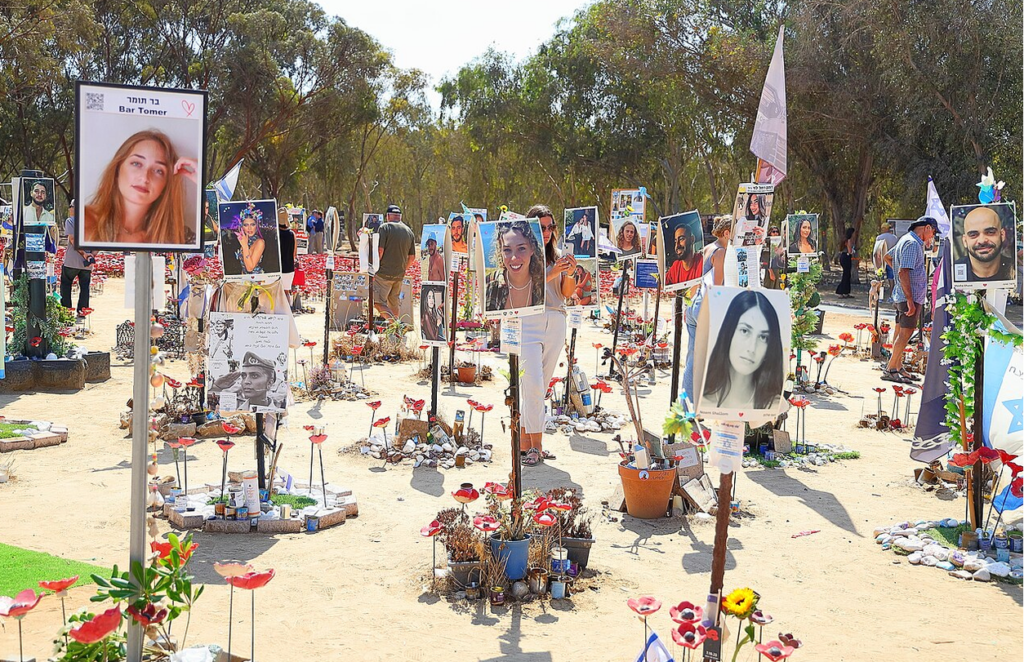
Israelis killed during Re’im music festival massacre.
As that Saturday bled into Sunday, the chilling rhetoric of Israel’s leadership was impossible to ignore – threatening to collectively punish the entire civilian population of Gaza. Knowing the source of those threats, and the history of the state’s actions, the sense of foreboding was gripping. Palestinian colleagues were also on the end of the phone that weekend: ‘What should we say?’ Even as the enormity of what was unfolding became clear, there was still hope the worst could be prevented. But there was to be no such respite.
Within less than 100 days, I would sit sobbing quietly, listening to the testimonies of the remarkable legal team assembled by the government of South Africa presenting their case at the International Court of Justice in The Hague to prevent and punish crimes of genocide being committed by Israel in Gaza. As Blinne Ní Ghrálaigh, Adila Hassim, Tembeka Ngcukaitobi and Max du Plessis, among others, detailed the ongoing actions being undertaken by a state claiming to carry the imprimatur of Jewish continuity, born out of the Holocaust, the impact was at times overwhelming.
Now, on this third anniversary of October 7, Israel is preparing for its first election since those events, to be held in three weeks’ time. New revelations are swirling about warnings Israel’s leadership may have received at the time regarding an impending attack. The timing of these new exposés – a call from the UAE leader, a hurried visit from the Egyptian intelligence chief – is more than a little suspect in the context of the fevered election campaign. It seems that even for Israel’s most ardent regional collaborators, the penchant of the current coalition for bloodthirsty rhetoric and action has become inconvenient.
The problem with all of this reportage is that it continues to ask the wrong question.
The “who knew what and when” lens for looking at October 7 implies that by applying a tweak to intelligence and operational procedures, all could have then, and in future will, be okay. Benjamin Netanyahu has insisted on evading calls for an independent State Commission of Inquiry. Nevertheless, Israel’s military and intelligence branches have published their own investigations into what went wrong, as well as some 40 army probes into individual incidents on that deadly day – at kibbutzim such as Be’eri, Nir Oz, and Kfar Aza, and the Nova Festival among others.
What is common to this genre of investigation and reporting is the exclusive focus on the minute hand. There have been endless debates in Israel about when Netanyahu was awoken and how he responded, whether the Israeli military was excessively deployed in the West Bank while neglecting the Gaza periphery, and whether warnings by the Israeli military’s female spotters were ignored. And the list goes on.
What is conspicuously absent in the thousands of pages of Israeli introspection is a glance at the hour hand – of what Israel expected decades of occupation, siege, and cruelty toward Palestinians to produce? To recognize this is not to excuse the horror that happened on Oct. 7. The killings of civilians led the International Criminal Court to issue arrest warrants for both Israeli and Hamas leaders (albeit the latter have since been assassinated by Israel).
The recent materials that have come to light again show that Hamas had continued pursuing political understandings with Israel via different mediators right up to the eve of October 2023. Israel scuppered those, and staggeringly, Netanyahu then rejected a Hamas offer made via Qatari mediators to immediately return all civilian hostages (defined by Hamas as women, children, and non-military aged males) taken on Oct. 7 with no demand for reciprocal Palestinian prisoner releases or conditions. But even these considerations remain in the realm of the tactical. The neglect of the strategic arena provides a deep insight into Israel’s ongoing state of denial as to the impossibility that security can coexist with permanent occupation, apartheid, and the inflicting of a reign of state terror on the Palestinian population.
That such a vacuum exists (including in this forthcoming election) is not a coincidence. It is the product of decades of Israeli policy advancing Palestinian disenfranchisement and dehumanization, alongside a dismissive and nonchalant attitude as to the predictable repercussions. Three years on, 74,000+ Palestinians killed, many more in rubble that Israel prevents from being excavated (regarded without value in death, as in life), the utter devastation of Gaza, the multiple credible findings of crimes of genocide having been committed — none of that can be understood unless one factors in just how embedded in Israeli state practice is the negation of Palestinians.
Zionism’s Roots
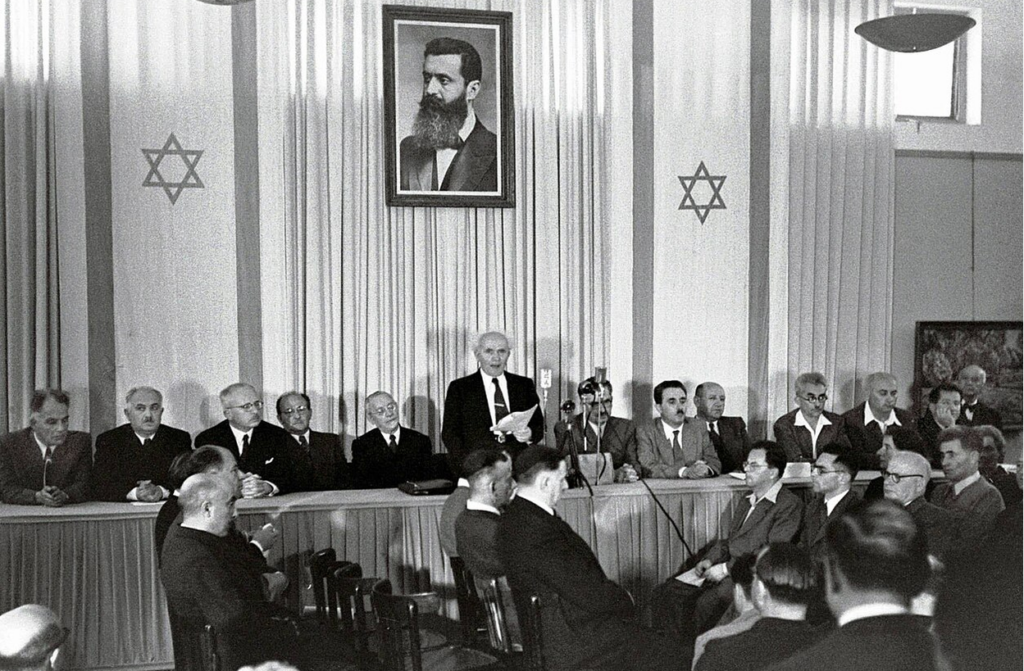
David Ben-Gurion proclaiming Israel’s establishment beneath a large portrait of Theodor Herzl.
The manufacturing of broad societal consent for genocidal acts represents a new point of departure for the Zionist project. True, that partly came in response to the genuine shock and horror of what happened on Oct. 7. It is, though, thoroughly rooted in how Zionism as practiced by the state looked to address the Palestinian question. Two truths can simultaneously be held. Firstly, that at no stage since the state’s establishment in 1948 did the Zionist project in practice have a place for Palestinian rights – there was no golden era. And yet, secondly, it is true that other paths were still possible that could have ameliorated the harshness of the Israeli-Palestinian reality. What we have witnessed these past years is unprecedented in its extremism and inhumanity. Yes, it was Labor Zionism that enacted the Nakba, prevented the return of even internally displaced Palestinians within Israel, imposed a military government on them inside Israel’s then borders that remained until 1966, and then launched the post-67 settlement enterprise.
Despite all of this, and the shortcomings of the Oslo process in failing to address historic injustice, that effort could have represented a significant gear shift in the ability of Zionist state practice to acknowledge and make good on certain Palestinian collective rights. Although Oslo was largely premised on terms convenient for Israel, and dictated by Israel, its realization would have constituted a remarkable achievement in gaining Palestinian, regional, and global recognition for a Jewish ethnonationalist state; Israel prevented a two-state outcome based on a 78% to 22% territorial divide (in its favor) from coming into being. The way Israel managed the unraveling of Oslo, how it seized the opportunity presented by 9/11, and the way it framed the withdrawal from Gaza all reinforced a maximalism in the public psyche. Oslo, in a way, was a test. Its negation was a painful demonstration that the project of state-centric Zionism had become too hard-wired in its refusal to compromise, too entrenched in zero-sum existential positions when it came to the question of Palestine. The journey from that Israeli rejectionism to the contemporary killing fields of Gaza is perhaps shorter than many have recognized.
The zombie of the Oslo two-state model still appears, notably in the corridors of diplomacy. The zeitgeist of Israeli society has, though, moved on. Israeli zealotry and overreach (and the lack of basic realism) could be leading to the denouement of a short-lived third Jewish commonwealth. If so, that collapse threatens to take with it many more innocent Palestinians and others in the region and to fracture and possibly upend global Jewish well-being.
It is understandable but also misplaced to attribute all of this to a visceral response to the horrors of October 7. Societies experience appalling trauma. For Israel to have sustained for so long such a fervent and relentless level of war-making and indiscriminate destruction of civilian life, it was necessary to draw on deeply planted seeds of settler-colonial contempt for Palestinians. In October 2026, Israel has arrived at a place where not a single Zionist party running in this election offers any meaningful critique of what has been done or any project for a different future with the Palestinians.
If that is to change, if openings for realignment are to be teased out, then one must understand the nature of contemporary Israeli society. A reasonable starting point could be Israel’s withdrawal in August 2005 from what is now the decimated territory of Gaza.
How We Got Here

The accusation so often leveled is that Palestinians failed to capitalize on a golden opportunity for a new start. Let’s interrogate that. Out of approximately 430,000 Israelis (including those in occupied East Jerusalem) then residing illegally as settlers beyond the Green Line, the unilateral Gaza disengagement entailed the relocation of a mere 9,000 persons. The withdrawal was from a territory that comprised just 6% of what would constitute a future Palestinian state (were it to be premised on the 1967 borders), and a mere 1.5% of what was British Mandatory Palestine in 1948.
Simultaneously, Israel entrenched its presence in the West Bank and prevented Palestinians in Gaza from accessing the outside world via maritime ports on the Mediterranean (which Israel prevented) or its airspace (which Israel continued to control). Within a short time, and after the wrong party prevailed in Palestinian elections (albeit forming a unity government with Israel’s “peace partners”), Israel imposed a full-scale siege on Gaza, which has lasted until today. At the time, a key architect of the disengagement – Prime Minister Ariel Sharon’s chief of staff Dov Weissglas famously noted: “The disengagement plan is the freezing of the peace process… [Disengagement] supplies the amount of formaldehyde that is necessary so there will not be a political process with the Palestinians.”
The liberal Oslo camp was already largely hollowed out in Israeli politics – weakened by the violence of the second intifada and by the limitations of its own commitment to peace and equality. In subsequent years, political leaders of this Zionist center-left made no attempt to argue that Hamas, also a political parliamentary movement, should be integrated into a conflict resolution process – something that happened with countless resistance movements (containing both political and armed wings) in virtually every liberation struggle throughout history. The blockade imposed on Gaza, the collective punishment of the civilian population, and the multiple rounds of destruction and killing of Palestinians there that preceded October 2023 were a matter of political consensus.
When the non-Netanyahu camp briefly assumed power for 20 months after the March 2021 election, it continued on the same journey of entrenching Israel’s presence in the West Bank, including settlement expansion; it found novel ways to criminalize Palestinian human rights NGOs; and it resumed extrajudicial assassinations of Palestinians in the West Bank, while of course maintaining the siege of Gaza. This should be unsurprising given that the government of opposition to Netanyahu was headed by former director of the settler Yesha Council (Yesha stands for Judea, Samaria and Gaza) Naftali Bennett and listed among its leaders the racist rabble-rouser Avigdor Lieberman and his parliamentary faction. That this government was enthusiastically endorsed and joined not only by Labor but also by the left Zionist standard bearer Meretz party is testimony to the depths to which the Zionist center-left had already plummeted.
When that coalition unraveled, and Netanyahu returned to power, his new coalition (the most extreme to date) ushered in an attempted dramatic overhaul of Israel’s judiciary and system of checks and balances. The country was swept up in a massive liberal protest movement continuing for several months until October 2023 – one which managed to ignore the biggest affront to Israel’s sense of its democratic self: the occupation and apartheid regime ruling over the Palestinians.
Meanwhile, during that same two-decade period, the hard-right was asserting ideological leadership, offering a long-term strategy that gained momentum over time. They soon realized that their initial goal of ensuring that settlement withdrawal could never be repeated after Gaza was too limited an ambition. The establishment, including the judiciary and the officer class in the military, was increasingly populated by ideologues of “Greater Israel” (sadly, the old establishment had never proven very committed to human rights and international law). When October 7 came, the “total victory” zero-sum discourse was waiting in the wings, ready to spring into action and metastasize, as the Greater Israel camp identified a moment of opportunity.
There was immediate chatter in its ranks, often public, that the attack itself was a sign of messianic times, the ushering in of an era of miracles, portending the extension of Jewish sovereignty across the entire biblical Land of Israel. This was a vision invoked by the leaders of the Jewish Power and Religious Zionism factions within the governing coalition, as well as rabbinical chaplains in the Israeli military, and media commentators (the mobilization of a pro-genocide media is a story in itself).
The instrumentalization of antisemitism, long deployed by Israel’s leaders to silence critics overseas, was now directed inwards to instill in Israel’s Jewish population a false thread of connectivity to historic trauma. It should have come as no surprise that an Israel, which already in 2008 calculated the calorific intake subsistence-level for Palestinians in Gaza to stay just above starvation level, would then apply that formulation to push the people below that threshold. Rank-and-file soldiers competed with ministers over who could post the most gratuitous gloating at the suffering of Palestinian civilians. They openly asserted the intention of mass slaughter and ethnic cleansing. From the president down, any distinction between Palestinian civilian and member of the armed resistance was denied.

Four votes taken in the Israeli parliament during the last three years are particularly instructive. In a vote opposing any Palestinian statehood in February 2024, not a single Zionist Knesset member (MK) dissented. In another declarative vote in July 2025 to support annexation of the West Bank, of the Zionist MKs, only four (the Democrats MKs) opposed. When, in October 2024, the Knesset endorsed shuttering UNRWA facilities across the occupied territories (a vital supply organ to sustain Palestinian life), again not a single Zionist MK voted against the move. Another vote in May 2026 to establish a special military tribunal that will override Israel’s normal legal procedures (including on how confessions are extracted) and will allow for death sentences against those accused of taking part in October 7, again passed with a total Zionist MK consensus.
All of this goes a long way in explaining how an agenda of eradication became so widespread and unchallenged. Any explanation would be incomplete without also acknowledging what one might call the gap between The Hague and the horrors — between international law, the rulings of the international justice system and their non-implementation by third parties. By January 2024, the International Court of Justice had already ruled on urgent provisional measures that Israel needed to take based on that case brought by South Africa regarding violations of the Genocide Convention. Israel demurred.
However, most of Israel’s trade, including arms trade, participation in international sporting and other competitions, and overall normal bilateral relations were maintained by most of Israel’s allies. While some of that is now being revisited – measures, for instance, announced by the UK government that should be welcomed – those remain insufficient and are, of course, too late for many tens of thousands. The U.S., for most of this period under the Biden administration, carries the lion’s share of blame, but all of Israel’s key allies – not least Germany – are complicit. The signal this impunity sent to ordinary Israelis is that they could get away with it.
And so three years later, Israelis head to an election, notable more for what is not on the ballot than for what is. As the editor of Haaretz Aluf Benn recently noted, Israel is still fighting wars on multiple fronts and endlessly relitigating October 7, yet “candidates aren’t talking about ending the war.” The prevailing public mood remains one in which there is a consensus of anger against those who expose what has been done to Palestinians in the last three years rather than any questioning of the perpetrators – a reality stunningly brought to the surface by the widespread reaction around the recent NAZA documentary.
Israel’s treatment of the Palestinian civilian population is of course not on the ballot, nor is its permanent war across the region, including the occupation zones in Lebanon and Syria. Not even Palestinian statehood or curtailing of settlements are agenda items for any of the Zionist political parties (these issues do all appear in the political programs of the Joint List of three Arab parties and to a lesser extent in that of the United Arab List.) Yair Golan and members of his Democrat list come closest to tinkering with lifting the veil on the genocide consensus, while the new opposition hope, Lieutenant General (Reserve) Gadi Eisenkot, shrinks away from anything that might resemble a palpable alternative and has sprinkled his parliamentary list with characters closer to the right. Other opposition leaders, Bennett and Lieberman, not infrequently offer a degree of belligerence to match that of Netanyahu. All have endorsed the banning of Arab parties and candidates.
And yet even that thin gruel merits a second look against the backdrop of what has already been undertaken and what is being promised by the four parties of the ever-more fascistic Netanyahu far-right bloc.
There are three parties now likely to enter parliament to the right of Likud: Itamar Ben-Gvir’s Jewish Power, the merger of Religious Zionism-Zehut, led by Bezalel Smotrich and Moshe Feiglin, who knowingly and intentionally paraphrased Hitler in calling for the total ethnic cleansing and Jewish resettlement of Gaza, and the new Amcha Yisrael party of Brigadier General (Reserve) Ofer Winter, who is no less committed to the same policies. Along with the Likud, they are attempting to outbid each other in their eradicationist zero-sum intentions regarding the Palestinians.
If the opposition bloc achieves power, and especially if it relies on the United Arab List, and ideally the Joint List in some way, then some of the worst excesses of the last years may be curtailed. It is, though, an awfully long road back – one that, according to what can be seen in this election, won’t seriously begin without consequential pressure and genuine accountability.

Daniel Levy is a Zeteo contributor, political commentator, and the president of the U.S./Middle East Project. He has served as an Israeli negotiator in peace talks and is a former adviser in the Israeli Prime Minister’s Office.