By Major General (Ret.) Paul D. Eaton
Photos: Wikimedia Commons
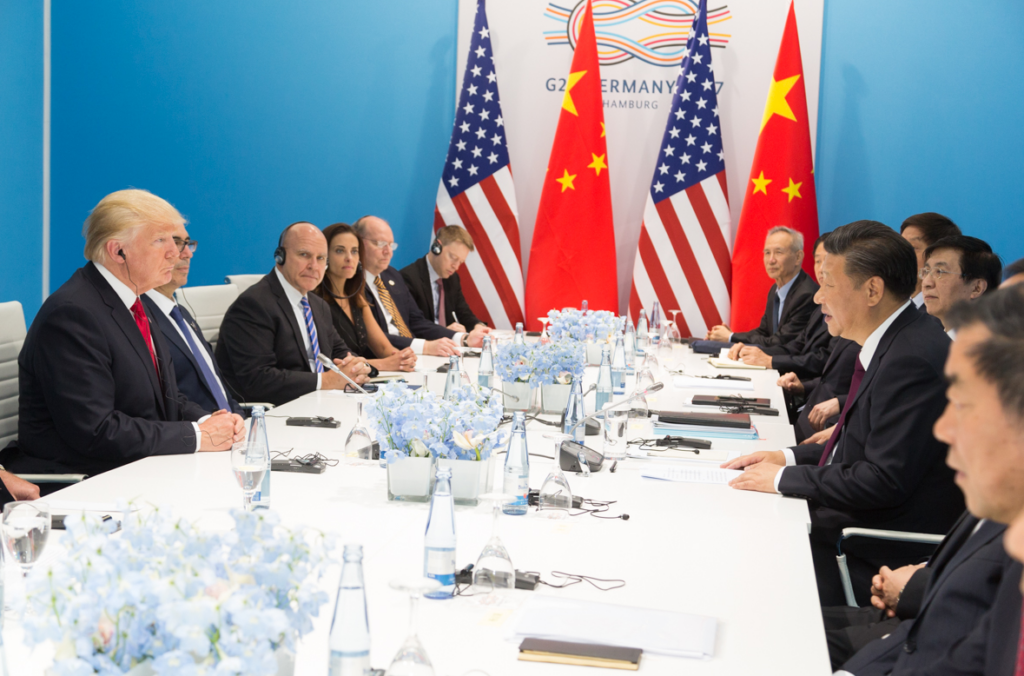
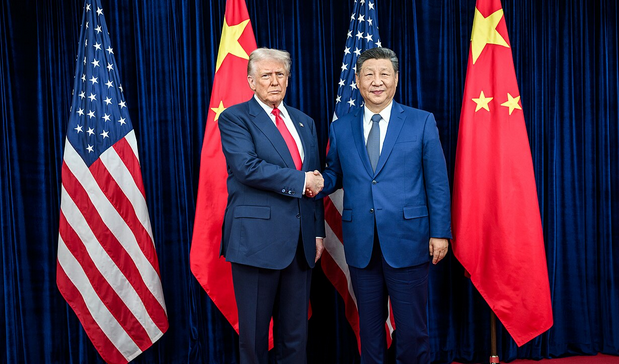
When President Trump boarded Air Force One in Beijing Thursday and told reporters that he had spent his summit with Xi Jinping talking “a lot about Taiwan,” including a “great detail” review of the $14 billion arms package the United States has been preparing to send to the island, he ended a piece of American foreign policy that nine consecutive presidents had managed to keep intact. Ronald Reagan put the policy in writing in 1982 as part of what came to be known as the Six Assurances. Here they are. Note the second one, in particular:
- The U.S. has not agreed to set a date for ending arms sales to Taiwan.
- The U.S. has not agreed to consult with the PRC on arms sales to Taiwan.
- The U.S. will not play any mediation role between Taipei and Beijing.
- The U.S. has not agreed to revise the Taiwan Relations Act.
- The U.S. has not altered its position regarding sovereignty over Taiwan.
- The U.S. will not exert pressure on Taiwan to enter into negotiations with the PRC.
In 1998, I was in China for military-to-military relations. Repeatedly, Chinese generals pressed us for our plans for Taiwan. It is impossible to understate how hard the Chinese try to find out more. We said nothing. Presidents also said nothing. And for forty-four years, Republicans and Democrats kept that line. Trump erased it on a plane ride home.
For those of us who fought in war, this is a particular concern. What does it mean for the men and women in uniform? The answer reaches well beyond the question of Taiwan policy or even the broader American relationship with China. What is really at stake is the survival of a way of doing foreign policy that the post-1945 generation built specifically to keep American troops out of avoidable wars.
Whither NATO?
The Beijing summit didn’t happen in isolation. Recently, the Pentagon began withdrawing approximately 5,000 American troops from Germany, with the President openly suggesting further reductions are on the way. As an aside, that number struck me because in 1976, I was part of a 5000-man combat unit in Germany, as a NATO show of force.
This week, the 1st Cavalry’s 2nd Brigade, based at Fort Hood, which had been preparing to rotate roughly 4,000 soldiers to Poland and other positions along NATO’s eastern flank, had its deployment canceled outright. Each one of these decisions weakens American deterrence in Europe, and the decisions are coming faster than the alliance can absorb them.
The case for NATO does not require a graduate seminar. Before 1945, Europe produced two world wars in thirty years and pulled American troops into both of them at staggering cost. After 1945, with American forces stationed forward and the guarantee of Article 5 standing behind them, Europe has not seen another great-power war on its soil. That record is the work of deterrence. Moscow has understood, for three generations now, that any move against a NATO member would mean war with all of them, with American soldiers already in position to make the point.
When you remove the soldiers, you weaken the point, and we have already seen what that begins to look like. In September of last year, Russian drones and aircraft violated the airspace of Romania, Poland, and Estonia, all members of the alliance the President now treats as optional. NATO had to stand up a new mission called Eastern Sentry simply to manage what amounted to a probing operation by the Kremlin. Putin tests where he can test, and every erosion of the American posture is another invitation to test further.
Beijing has been watching all of this.
What Xi Sees
When Xi Jinping sat down across from Trump on Thursday, he opened the meeting by invoking what political scientists call the Thucydides Trap, asking whether the United States and China could avoid the pattern that produced the Peloponnesian War in ancient Greece. The framework casts the current period as a contest between a rising power and a declining one, with war the historically common outcome unless both sides manage the dynamic carefully. The role Xi assigned to the United States in that analogy was clear enough that Trump himself acknowledged it on Truth Social the next day, writing that the Chinese leader had “very elegantly” referred to the United States as a declining nation, but then said he was talking about Joe Biden (Xi was not).
That is the framing the President walked into. And then, hours after consulting with Xi about the Taiwan arms package, Trump told the press on the way home that “the last thing we need right now is a war that’s 9,500 miles away.”
Whether he meant to or not, the President had just agreed with the central premise of Xi’s opening statement. In the Thucydides framework, a declining power keeps the peace by refusing to be drawn into the rising power’s miscalculations. Trump told Xi he would not be drawn into anything. Combined with what Xi has been watching in Europe, and with the now-broken forty-year-old promise about Taiwan arms, the takeaways from the summit were not subtle.
The American president treats deterrence in Europe as something he is willing to bargain away, and he treats commitments to Pacific allies as a topic for direct consultation with Beijing. On top of that, he is publicly signaling to China that he does not want the war his predecessors spent seventy-five years deterring. The reasonable read from the Chinese side is that Xi can do a great deal of what he wants, and the United States will mostly stay out of his way.
Troops Pay The Price for Trump’s Weakness
Families of those serving today have to sit with what that posture invites. American sailors on destroyers in the Taiwan Strait are 9,500 miles from Washington. So are the Marines on Okinawa and the families stationed at Yokosuka, along with every uniformed American whose duty station puts them within range of a conflict over the island. They are the war the President just told Xi he wants to avoid. If Xi takes that statement as permission to miscalculate, the result could be a catastrophic war.
American servicemembers built the deterrents in Europe and the Pacific across seventy-five years of rotations and quiet, often unglamorous deployments, accumulating the kind of credibility that adversaries eventually learned not to test.
That credibility is what the President is spending every time he treats American commitments as personal collateral in a negotiation with a rival. Veterans know how this story tends to end, because we have been on the receiving end of it before. Wars that could have been deterred get fought anyway, and the bill arrives in flag-draped coffins and in the kind of moral damage that does not show up on any Pentagon ledger. At some point, the country has to decide whether the work of three generations of American service is going to be honored or auctioned off.
Thursday in Beijing was not an encouraging sign.