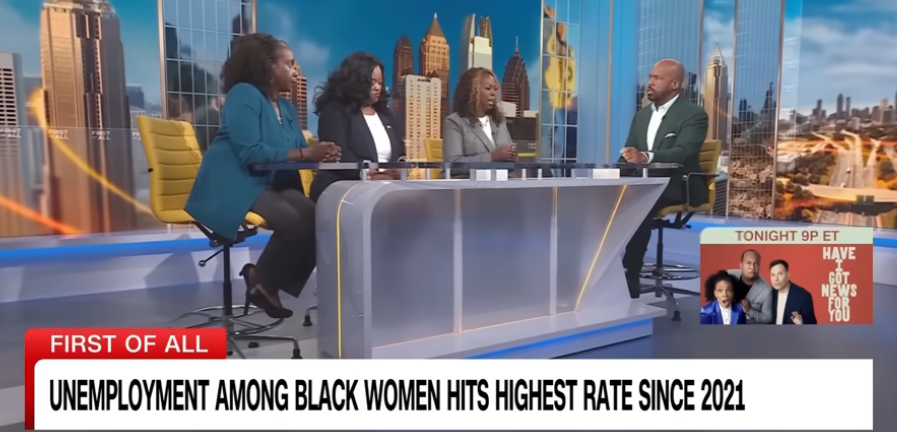
By Economic Policy Institute
Photos: Instagram\YouTube Screenshots
For the last five years, I’ve given the same answer in response to questions about any one-month increase in the Black unemployment rate. Given the relatively small sample size used to calculate the number each month, we shouldn’t make too much of a single month’s increase but focus on longer-term patterns and see if the upward trend continues over the next few months. Well, as of August 2025, the Black unemployment rate has risen for three consecutive months and now stands at 7.5%. This post details three major conclusions I have drawn from this and supporting data:

- There has been a clear deterioration in the labor market for Black workers this year: the unemployment rate is rising and employment is falling.
- The decline in Black workers’ employment appears to be concentrated among Black women while Black men’s employment rates appear more stable.
- Since January 2025, overall women’s employment has fallen most in professional and business services, manufacturing, and federal government—suggesting likely culprits for the decline in Black women’s employment.
An important signal that the rising Black unemployment rate may actually be more than a temporary blip in a notably volatile data series is that the share of employed Black adults between the ages of 25 and 54 is down compared to the last couple of years. After peaking at a historic annual high of 77.9% in 2024, the average so far this year is 76.6%. Until now, the rate had risen every year since 2021.
Another developing news story that has garnered increasing attention is the reported 300,000 Black women losing jobs and/or leaving the labor force in recent months. While a number that big certainly makes headlines, employment levels from the monthly household survey—especially those based on a small demographic slice of the monthly survey sample—should always be used with caution. While I’m not convinced that 300,000 is the most accurate accounting of the situation, Black women are uniquely experiencing a decline in employment that is not observed among other groups of women or Black men.
A clearer and more reliable indicator of how Black women are doing in the labor market is their employment-to-population ratio (EPOP). As Figure A shows, Black women’s employment has dropped sharply this year, but there has been a longer downward trend that started in early 2024. This stands in stark contrast to the trend for white women whose EPOP has changed little over the same time while Hispanic women have seen a slight increase.

Figure A
Black women’s employment has fallen since 2024, but the sharpest declines have come in 2025Employment-to-population ratio for women by race and ethnicity, January 2023–August 2025
| Black | White | Hispanic | |
|---|---|---|---|
| Jan-2023 | 59.7% | 55.7% | 58.5% |
| Feb-2023 | 59.7% | 55.8% | 58.4% |
| Mar-2023 | 60.8% | 55.6% | 58.3% |
| Apr-2023 | 61.1% | 55.9% | 58.6% |
| May-2023 | 60.4% | 55.9% | 58.9% |
| Jun-2023 | 59.5% | 56.2% | 58.8% |
| Jul-2023 | 59.7% | 56.2% | 59.0% |
| Aug-2023 | 59.7% | 56.2% | 59.1% |
| Sep-2023 | 59.9% | 56.2% | 59.0% |
| Oct-2023 | 60.2% | 56.0% | 58.7% |
| Nov-2023 | 60.6% | 56.0% | 58.7% |
| Dec-2023 | 60.2% | 55.5% | 58.5% |
| Jan-2024 | 59.9% | 56.0% | 58.2% |
| Feb-2024 | 60.6% | 56.0% | 58.4% |
| Mar-2024 | 59.5% | 56.0% | 58.4% |
| Apr-2024 | 59.8% | 56.2% | 58.9% |
| May-2024 | 59.6% | 56.0% | 58.8% |
| Jun-2024 | 58.8% | 55.8% | 58.3% |
| Jul-2024 | 59.5% | 55.8% | 58.3% |
| Aug-2024 | 59.7% | 56.1% | 59.4% |
| Sep-2024 | 59.0% | 56.1% | 59.2% |
| Oct-2024 | 59.5% | 55.7% | 58.3% |
| Nov-2024 | 58.6% | 55.7% | 58.6% |
| Dec-2024 | 59.0% | 55.7% | 58.9% |
| Jan-2025 | 59.2% | 55.9% | 58.8% |
| Feb-2025 | 59.3% | 55.8% | 58.9% |
| Mar-2025 | 57.8% | 56.0% | 59.3% |
| Apr-2025 | 57.5% | 56.1% | 59.6% |
| May-2025 | 57.8% | 55.7% | 59.1% |
| Jun-2025 | 57.3% | 55.9% | 58.6% |
| Jul-2025 | 57.2% | 55.8% | 59.0% |
| Aug-2025 | 57.3% | 55.5% | 58.9% |

Note: Race and ethnicity are not mutually exclusive, i.e. white alone, any ethnicity, Black alone, any ethnicity, and Hispanic, any race. Data are for those 20 and older and are seasonally adjusted.
Source: Author’s analysis of Bureau of Labor Statistics’ Current Population Survey public data.
Similarly, Figure B shows that the EPOP for Black men in the same age group has been much more stable over the last three years. Since the decline for Black women is not reflected in other group trends by gender or race alone, there appears to be something happening in the labor market that has been particularly damaging to Black women. Below, I explore possible explanations based on analysis of payroll employment data.
Figure B
Black men’s employment has remained more stable than Black women’s Black annual employment-to-population ratio by gender, 2023, 2024, and 2025 (year-to-date)
| Year | 2023 | 2024 | 2025 (Jan-Aug) |
|---|---|---|---|
| Black women | 60.10% | 59.50% | 57.90% |
| Black men | 65.00% | 65.00% | 64.50% |


Note: Data are for those 20 and older and are seasonally adjusted.
Source: Author’s analysis of Bureau of Labor Statistics’ Current Population Survey public data. READ MORE…
To Support our independent investigative journalism contributions are welcome via Cashapp to: $BlackStarNews
Also support Black Star News by buying merch from our brand new Black Star Store!