By Bruce Altschuler
Everyone knows that since the start of the war with Iran, Americans have been paying much more money for gas and other energy. That money has to be going somewhere and, in case we didn’t know where, Donald Trump has revealed the not so hidden secret.
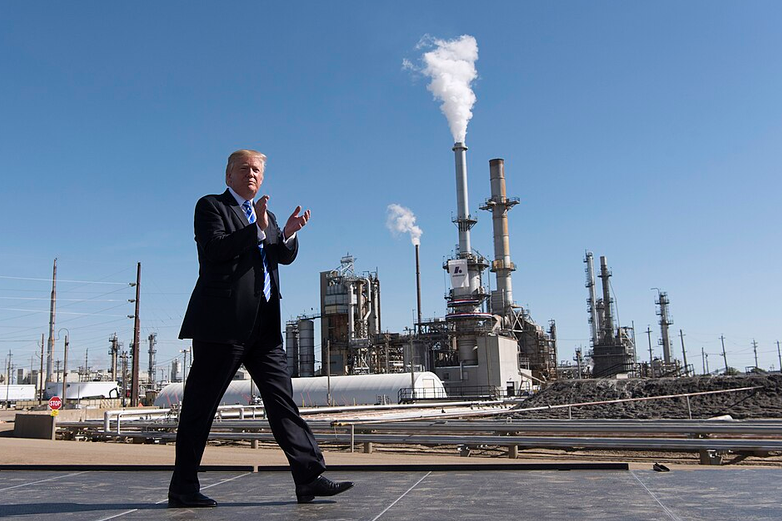
At a campaign rally in Perry, Georgia, he admitted, “I don’t give a damn. I’m gonna say it. We’re making a freaking fortune.”
Who is this “we”? It is certainly not the average American who has to pay at the pump. One obvious answer is the energy companies. According to the Oil & Gas Journal, during the second quarter of this year, American oil and gas companies saw revenues rise to $439 billion and net income to $62 billion, nearly triple the $22 billion in profits they earned in 2025.
When Trump says “we,” however, he is including himself. According to a report by the Congress’s Joint Economic Committee, the value of Trump’s oil and gas stocks has increased this year by as much as $35.9 million to a total that may be as high as $81.6 million with 94% of this year’s purchases, possibly as much as $17.5 million, having taken place since the war began on February 28. During that same period, the average American family has spent an additional $856 on gas, for a total of $101 billion.
We cannot count on Trump’s constant predictions that a dramatic decline in gas prices is around the corner. Just before the July 4th holiday, he wrote online, “Just as I promised, Oil Prices are plummeting FAST and Gas prices at the pump are dropping too,” but that was, at best, a mirage. By early September, he had changed that to “Right after the election, oil prices are going to be tumbling downward,” a prediction he qualified by adding, “I think it’s going to take a little bit longer than the midterm.”
As of this writing gas is averaging $4.37 per gallon, $1.18 more than a year earlier.
What should we do about this? Congress needs to end the Iran War, but this would require cutting off funds rather than simply passing more War Powers Resolutions (this is exactly how the war in Vietnam was finally ended). In the meantime, money is flowing from the pockets of consumers to the profits of fossil fuel companies—and from the taxpayers to Pentagon war profiteering corporations.
A major part of the solution is an excess profits tax on the money energy companies are raking in. The revenues from this tax could be used to compensate consumers for the high cost of gas, diesel oil and other associated price increases. Some of it could also be used to make up for cuts in government programs for health care, education, children’s nutrition and a variety of other community needs whose funds have been diverted to the military.
This is not a new idea. The 1980 Crude Oil Windfall Profit Tax raised $80 billion before it was repealed in 1988 when oil prices fell sharply. A British windfall profits tax on North Sea oil and gas is projected to raise $10.8 billion this year, double that of 2024-25.
There are currently two bills pending in Congress. One, sponsored by Sen. Sheldon Whitehouse and Rep. Ro Khanna, would impose a 50% tax per barrel on the difference between the 2025 average price of $69 and the current average ($102 on Oct.28). Rep. Brad Sherman’s Iran War Oil Price Crisis Windfall Profits Tax Act would levy a 100% tax on the amount over $75 but would expire when the war ends and the price falls below $75. Both would refund the money directly to consumers with an estimate of $216 to a single taxpayer for the first should prices reach $100 per barrel. Although these companies argue that the money is needed to increase investment, there has been little increase in such spending since the war began.
When such clear historical solutions are available, we need elected officials who can make it happen and media that listens to them.
Dr. Bruce Altschuler, syndicated by PeaceVoice, is emeritus professor of political science.