By Team Zeteo & Stephen Wentzell
Photos: Wikimedia Commons
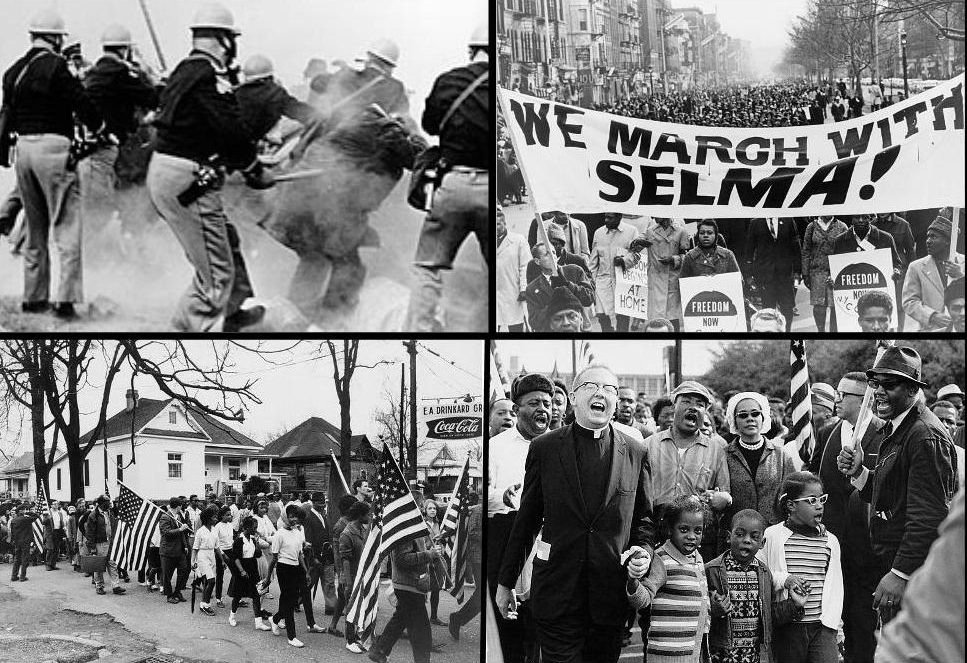
Thursday marks the 61st anniversary of the passage of the Voting Rights Act, the landmark law that prohibited racial discrimination in voting. The Act safeguarded the right to vote for Black Americans who had long been subjected to racist literacy tests, poll taxes, harassment, and intimidation for simply trying to register and cast their ballots.
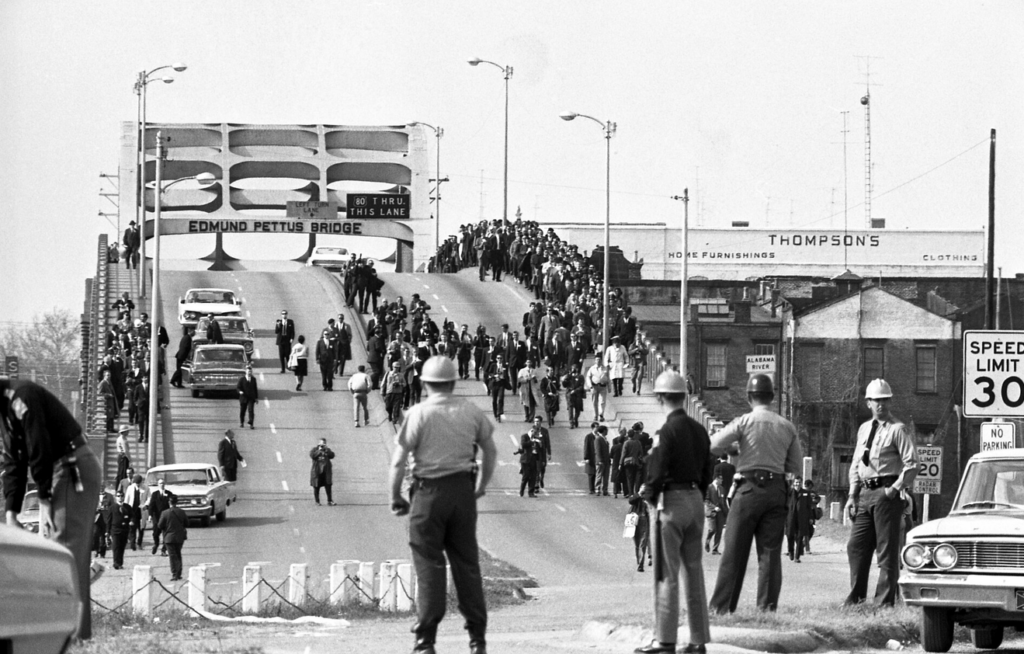
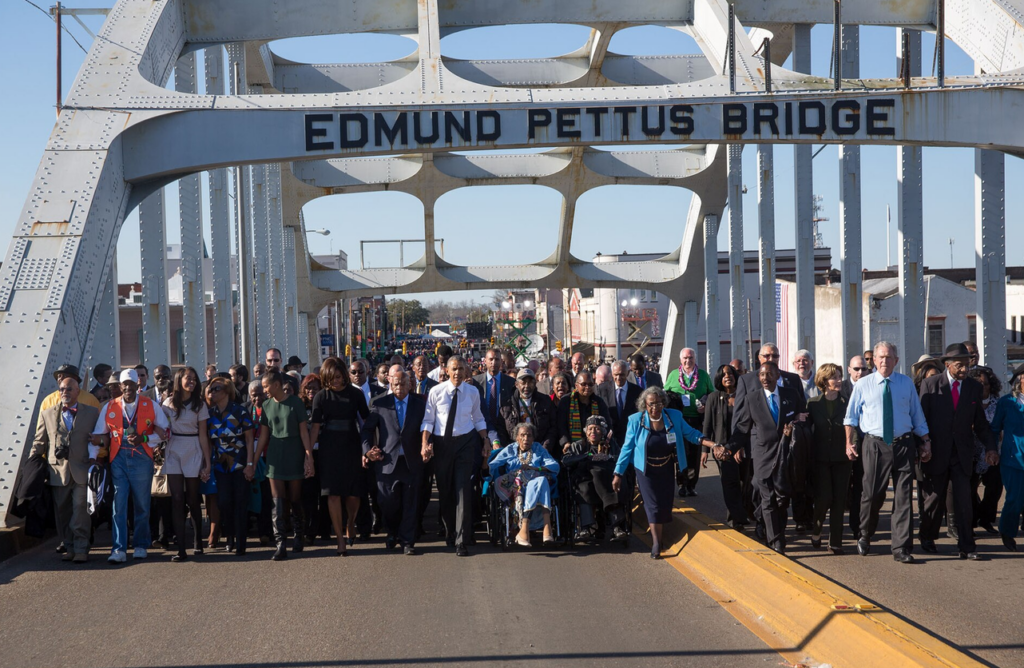
The historic legislation was passed five months after the events of “Bloody Sunday,” when civil rights marchers were brutally attacked by police while crossing the Edmund Pettus Bridge on their way to Montgomery, Alabama, to demand voting rights for Black Americans.
More than six decades later, the future of the law is in jeopardy, thanks to a far-right Supreme Court that further gutted key provisions of the Voting Rights Act earlier this year.
Now, more than a dozen House districts led by Black Democrats are at risk of being eliminated, and Republican efforts to promote voter suppression, like the SAVE America Act, threaten to further dismantle voting rights for Black and brown voters across the country.
The Legacy of the Voting Rights Act
When President Lyndon B. Johnson signed the Voting Rights Act into law on August 6, 1965, he called the day “a triumph for freedom as huge as any victory that has ever been won on any battlefield.”
The results were almost immediate. In 1965, less than one-third of Black Americans were registered to vote, but by 1967, more than half were registered, including a majority of Black Americans in nine of the 13 Southern states.
In the years following the VRA’s passage, major U.S. cities like Cleveland elected their first Black mayors, and at the national level, Edward Brooke became the first Black U.S. senator elected since Reconstruction. In New York, Shirley Chisholm became the first Black woman elected to Congress, and later, the first to run for president.
One study from the Department of Economics at Oxford University found that the number of Black elected officials in local governments in the South more than quadrupled between 1962 and 1980 as a result of the Voting Rights Act. During the same time period, public infrastructure spending per person doubled in Black communities across the South.
Stasha Rhodes, executive director of United for Democracy – a coalition of 160 organizations, labor unions, and advocates calling on Congress to rein in the unchecked powers of the Supreme Court – called the Voting Rights Act the culmination of Black people organizing, marching, bleeding – and in many cases, dying – in order to earn the right to vote.
Rhodes pointed to organizers like Fannie Lou Hamer, John Lewis, Diane Nash, Amelia Robinson, and Dr. Martin Luther King Jr., along with thousands of local people whose names never made the history books, who “helped turn the constitutional promise of voting rights into something Black Americans could actually enforce.”
“I think it did more than allow people to cast a ballot,” Rhodes told Zeteo. “It helped Black communities translate their votes into political power and electing Black representatives, and getting a real voice over schools and hospitals and public investment and the decisions that shape people’s lives.”
Congress would go on to amend the Voting Rights Act five times, most recently in 2006, when lawmakers reauthorized a 25-year extension of the law. But less than a decade later, the nation’s highest court would begin issuing a series of rulings gutting the landmark legislation.
How the Supreme Court Gutted the VRA
It all began in 2013, when a 5-4 decision declared Section 4(b) of the VRA unconstitutional, eliminating the “preclearance” requirement, which mandated that states with a history of racial discrimination obtain federal approval before making any changes to their voting laws.
“It ushered in this era of people moving in with new legislation and policies that made it more difficult for people of color to participate in elections,” said Dr. Kareem Crayton, Vice President of the Brennan Center for Justice’s DC office.
The majority justified the move by arguing the preclearance requirement was no longer necessary because, as Chief Justice John Roberts wrote, “Our country has changed.”
Justice Ruth Bader Ginsburg didn’t buy what the majority was selling. In her dissent, she wrote, “Throwing out preclearance when it has worked and is continuing to work to stop discriminatory changes is like throwing away your umbrella in a rainstorm because you are not getting wet.”
Thirteen years later, the Supreme Court further gutted the Voting Rights Act in a decision that set the stage for Republicans to redraw congressional maps to favor their candidates while significantly diluting the political power of Black voters.
The case, Louisiana v. Callais, began after civil rights groups sued Louisiana back in 2022 over the lack of representation in its congressional map. At the time, just one of six congressional districts in Louisiana were majority-Black, despite Black residents making up about one-third of the state’s population.
After adopting a new map, which included a second majority-Black district, a lawsuit was filed by white voters who argued the move was unconstitutional.
The Supreme Court ultimately agreed, with Justice Samuel Alito calling Louisiana’s new congressional maps an “unconstitutional racial gerrymander.” The move flipped the idea of prohibited racial gerrymandering on its head, as Alito invoked it to block a map designed to give Black constituents more representation, in a radical departure from its intended meaning: which is, creating maps that dilute Black voting power. As The Guardian reported, Alito’s ruling relied on misleading data “copied almost verbatim” from a brief provided by Trump’s Justice Department.
Rhodes noted that in Callais, “efforts to preserve Black political power are treated as constitutionally suspicious, while maps that diminish Black power receive extraordinary deference.”
The 6-3 decision effectively nullified Section 2 of the Act, in particular a key provision that authorized majority-minority congressional districts in an effort to prevent racial vote dilution. After the 2020 census, one-third of all districts in the country were majority-minority districts.
In her dissent, Justice Elena Kagan warned that if other states follow Louisiana’s lead, Black and brown citizens there “will no longer have an equal opportunity to elect candidates of their choice,” adding that “minority representation in government institutions will sharply decline.”
Dr. Carol Anderson, professor and author of the books One Person, No Vote: How Voter Suppression Is Destroying Our Democracy and White Rage: The Unspoken Truth of Our Racial Divide, called the Voting Rights Act the “most powerful, effective piece of legislation that Congress had ever passed.”
For Anderson, the ruling was yet another example of the Supreme Court “systematically denying Black citizenship.”
The Aftermath of Callais
The day after the Supreme Court gutted the Voting Rights Act, Louisiana’s Republican Governor Jeff Landry signed an executive order suspending the state’s congressional primaries just two days before early voting was scheduled to begin, citing Callais. The move, which allowed state Republicans to draft new congressional maps, nullified more than 40,000 mail-in votes that had been cast before the executive order was signed.
One month later, the Supreme Court cleared the way for Alabama to use a congressional map in the 2026 midterm elections that had been found to be racially discriminatory by lower courts, a move Justice Sonia Sotomayor wrote in her dissent “disregards both democratic values and the rule of law.” The majority claimed that the district court’s analysis “departed from” the Callais decision, and sent it back for review.
And in July, federal judges in Tennessee approved a new congressional map that carved up a majority-Black district in Memphis, splitting it among three districts that will now all lean Republican.
There are as many as 15 House districts represented by Black Democrats that are at risk of being eliminated following the Callais decision, according to NPR.
Following the Callais decision, Derrick Johnson, President and CEO of the NAACP, said the Supreme Court betrayed Black voters, America, and democracy. In an interview with Zeteo, he referred to the Voting Rights Act as “a crucial component to ensure we had a true representative democracy.”
“We are witnessing in real time, not only this administration, but members of Congress, and unfortunately, the Supreme Court, willing to do anything to subvert democracy and prevent eligible individuals from engaging in the electoral process,” Johnson told Zeteo.
While much of the focus of the Callais ruling has been on its ramifications for congressional maps, Skye Perryman, president and CEO of the non-profit Democracy Forward, is also concerned about its impact at the state and local level, something she called an “underreported and unemphasized consequence” of the decision.
According to the Voting Rights Initiative at the University of Michigan, Section 2 cases have more commonly challenged local election practices than state election practices. Crayton noted that upwards of 70% of all Section 2 cases come from local jurisdictions like school districts, city councils, and county commissions – “where voters are closest to the people that they elect.”
Perryman says the post-Callais moves in former Confederate states represent an effort to “resuscitate discriminatory and Jim Crow-like laws and patterns and maps that seek to undermine and dilute and even silence Black and brown voters.”
The Future of Voting Rights
With a weakened Voting Rights Act in place during a time of widespread voter-suppression efforts by the White House and Republicans alike, Crayton noted that the Callais decision proves the Supreme Court isn’t going to protect Black Americans at the polls.
“It removes any doubt that this particular court is going to be the savior on voting rights matters,” Crayton said, adding that bipartisan calls for reforms to the Supreme Court “are long overdue.”
Meanwhile, Anderson is closely watching another piece of legislation Trump is determined to pass – the SAVE America Act – which threatens to disenfranchise millions of voters by requiring a restrictive list of acceptable photo IDs to vote, along with proof of citizenship, despite the pro-Trump Heritage Foundation finding non-citizen voting is almost non-existent, with just 24 instances of non-citizens casting ballots in U.S. elections between 2003 and 2023. She warns the bill, which also requires states to turn over its voter rolls to the Department of Homeland Security, isn’t about saving America at all, but about “entrenching one-party rule.”
“This is a horrific way to sound innocuous – just like the poll tax, just like a literacy test – but is a way to wipe out millions of African-Americans from the ballot box,” Anderson said, adding that voters need to make districts “safe for democracy” and “not safe for authoritarianism” and “Jim Crow 2.0.”
With the 2026 midterm elections on the horizon, and the next presidential election not far behind, Anderson adds that voters need to cast their ballots for candidates who are willing to put in the work to protect voting rights, citing the failure of Democrats to pass bills restoring and strengthening the Voting Rights Act during the Biden administration.
Between a barrage of partisan gerrymandering by the Republican Party to hold onto the House and efforts to eliminate mail-in voting, to trying to introduce requirements like photo identification and proof of citizenship, the Supreme Court’s gutting of the Voting Rights Act is only just the beginning when it comes to voter suppression.
“It’s not a Black issue, it is a democracy concern,” the NAACP’s Johnson said. “We should make sure that every eligible person is able to cast a ballot and prevent extreme conservatives from continuing to chip away at our constitutional rights.”
Zeteo’s Stephen Wentzell contributed reporting to this story.