Photos: YouTube Screenshots
By Tom Oniro Elenyu
In what seems like Yoweri Museveni “submitting relentless self-determination” to swoop poverty, the president mops the countryside preaching yet another poverty alleviation initiative. But poverty alleviation, a precursor for poverty eradication and eventual elimination; is very, very stubborn: Once poor, the level of vulnerability in society remains so high.
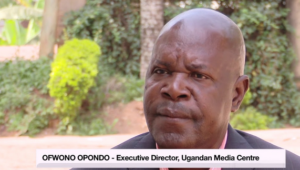
“In our society, poverty is very high,” Ofwono Opondo told government-run Uganda Broadcasting Corporation radio’s News Hour Program on 15 May 2020. He was fielding questions on why the distribution of food to the vulnerable in Kampala city and its metropolis during the first lock down moved at the speed of a badly injured snail.
“There are people who don’t have doors—there are people who live under buveeras (polythene bags); there are people who live under trees; there are people who live under abandoned cars, etc,” said the government spokesman, he who benefits from the status quo, for the first time ever his antennae seemingly pulsing on the plight of the majority poor Ugandan community.
Nonetheless, Museveni portrays Uganda as a country on a path to a wealthy future with citizens bedding their way to prosperity. The president, it is said, does not grieve over his government’s failures but selectively evangelises his achievements with verbal prosperity gospels even though a record over 70% Ugandans are stewing and hanging on a cliff of abject poverty. This, despite the pedagogue president rallying Ugandans to make money for the pocket—and not only for the stomach—by engaging in commercial agriculture. The president then deflects criticism and scrutiny of his unyielding verbal prosperity gospels by using the opposition as raw materials for excuses.

The 26 February 2022-launched Parish Development Model (PDM) brings to nine; the number of Presidential Poverty Alleviation Initiatives his 1986 government establishment has initiated. It all started in 1996 with Entandikwa or start-up capital; which was some kind of a revolving fund. Etandikwa died a natural death, and was buried in an unmarked grave.
Just as opaque as Entandikwa was, Prosperity-for-All was still-born and quickly evaporated as methylated spirit would.
And typically absolving critics of government creating new problems without actually solving old ones, Program for the Modernization of Agriculture (PMA) was inaugurated before anyone could prosper. PMA preached valley dams for semi-arid areas in the country but money allocated for sinking and constructing dams was pilfered. Farmers expected to abandon hand hoes for tractors but up until this day, peasants have hoes stapled on their roughed-up palms. Tractors are for the affluent few. PMA also promised irrigation schemes which never were. Peasants survive on rain-fed agriculture, and in circumstances of prolonged droughts, famine stares the population at angle Theta.
Analysts infer that Uganda’s biggest enemy is implementation, wasteful expenditure and endemic corruption; not lack of resources but lack of accountability. With larceny in their hearts, greedy government officials are always scavenging for what and where to pinch and have a cut. Thus, enlarging governance failures and widening the poverty gulf in the country.
Moreover, through an Act of Parliament, National Agricultural Advisory Services (NAADS) was enacted in 2004. “Extension workers help rural farmers [peasants] move from rural to modern agriculture but what is NAADS all about?” once wondered former minister Wilberforce Kisamba-Mugerwa.
With NAADS in place, banana wilt, coffee wilt, cassava mosaic and other crop pests and diseases decimated entire household economies; partly because government did not purposefully invest in agricultural Research and Development. What should have been a progressive agricultural advisory services program was therefore squandered. Worse still, Ugandans equate NAADS to the much-feared Genetically Modified Organisms. Fruit sellers, for example, are tasked whether their products are NAADS or local varieties.
After the 2011 general elections, the women and youth livelihood funds; an Affirmative Action kitty of some sort, were dangled. They are no longer heard of except in the latter case that some leaders are on the run for failure to refund the money to the Consolidated Fund.
Then boom: Wasteful expenditure kicked off when Museveni appointed his younger brother, Gen Salim Saleh as Chief Coordinator of Operation Wealth Creation (OWC). Brig Proscovia Nalyweso deputized Saleh in that Butalangu, Nakaseke District-held Heroes’ Day celebrations on 9 June 2013. Soldiers at the Commissioned Officer ranks of Major man OWC at district levels. On 26 January 2014 celebrating the National Resistance Movement (NRM)’s 28th Anniversary in Mayuge District, Eastern Uganda, Museveni declared that since civilian NRM cadres could not be trusted with “delivering and sharing” the national cake, the Uganda People’s Defence Forces (UPDF) were drafted in to implement hegemonic economic programs like OWC/NAADS in the distribution of seeds, seedlings and other agricultural inputs and implements; including breeding livestock to peasants.
Museveni’s announcement “trusting” gunmen with agriculture-related matters accelerated uproar against the militarization of State corporations and institutions.
According to the proprietor of the Independent news magazine, a Museveni-critic-metamorphosed-disciple, Andrew Mwenda; “OWC was created by [presidential] fiat; not by law. OWC should be formalized, institutionalized and legalised,” he told Capital Radio’s political accountability program, The Capital Gang, on 5 December 2020.
But is it prosperity or poverty for all? OWC has been branded ‘Operation Poverty Creation’; in some quarters cynically maintaining that Museveni’s programs on poverty alleviation do not come across believably; that he wants everyone included in his imagination disguising it as “wealth creation”.
“You [Salim Saleh] are the only one who is satisfied with what you are doing [as OWC],” opposition MP Semujju Ibrahim Nganda told Gen Saleh on Capital Gang on 14 November 2020. “The only reason Salim Saleh is not in prison is because Gen Museveni [elder brother] is president. That OWC is an illegal outfit.” According to Semujju, “the moment OWC was created; Salim Saleh siphoned money in billions”. “You are lucky you’re not in jail because your brother is president. Between 400-500 billion [Uganda] Shillings (about US$116-145 million) is siphoned through an illegal outfit every year!” the former newspaper journalist charged at the General. By Financial Year 2020/2021, however, OWC’s slash fund had fattened to a succulent US$203 million. It only keeps ballooning.
“Heads of wealth; heads of OWC [Salim Saleh and other OWC commanders] are the only wealthy people [in Uganda],” Semujju went on.
But uncharacteristic of an African General, Saleh politely replied: “OWC is no longer UPDF alone; we’ve academia, agencies, etc.” He added; “Our operation is eyes on; hands off…We don’t handle resources. NAADS handles the money. We handle the logistics and the distribution. We only get facilitation like motorcycles. I just get an allowance from NAADS,” he claimed. In November 2020, two committees of Parliament investigated OWC on how they allegedly feasted on money for “wealth creation”, and instead bought themselves vehicles.
A perennial exponent of government failures, Ofwono Opondo surprised many when he admitted, thus; “OWC is a new nomenclature that came-in in 2014. They’ve not achieved the desired goals as government had planned.” OWC degenerated into the distribution of seeds and seedlings during dry spells without any active options for irrigation whatsoever.
Meanwhile, Museveni who had blessed his soldiers with performance; and conferred success upon them in advance; withdrew the benediction on 31 December 2021. “I decided to remove the OWC from the distribution of seedlings. ‘Why?’ Some commanders had gone into the business of having beds for seedlings—they had become businessmen on personal basis in an effort in which they were supposed to be neutral,” he said in his New Year speech. “Arguments about favouritism were becoming ubiquitous…was becoming a frequent complaint in public meetings. The soldiers would, sometimes, take seedlings; dump them at the Sub-County [headquarters], and leave them there; not bothering whether they’ll be planted in gardens or left to dry and be lost,” he said of the hitherto ‘incorruptible and trusted soldiers’.
On 6 February 2022, commemorating Tarehe Sita (6 February 1981) when he launched his bush war, Museveni picked one OWC commander to testify on their ‘success’ but the soldier stammered into silence without testimony to adduce. He was ordered to sit down.
No sooner had OWC miscarried than Emyooga [a local dialect for a savings group] program was floated in January 2020. “Emyooga is doing very important fall-back position,” said Finance Ministry’s Permanent Secretary and Secretary to the Treasury, Ramathan Ggoobi, recently. “[In] Emyooga, we’ve found it reaching the base of the pyramid,” said Ggoobi; assuring thus: “I want to tell you that our next target next year is full monetization of the economy by bringing all people into the money economy.”

At the dawn of 2022, however, Micro-finance minister, Haruna Kasolo, while on a monitoring tour, realized that some Emyooga managers were lending to borrowers at 12% interest rate instead of the known 8%. And some Emyooga groups are still waiting for money allegedly being hoarded by their leaders.
PDM was adopted as a delivery mechanism for transitioning households out of the subsistence economy.
However, though it is not always easy to put good ideas into practice, verbal prosperity gospels only offer verbal solutions with no solutions at all. Thus, lending credence to skepticism that Museveni’s poverty alleviation programs are big on rhetoric but weak on deliveries.
But if PDM could be the ultimate poverty fumigator welded to a sincere government, then ordinary Ugandans would indeed all prosper.