By Camila Lourdes Galarza &Tomi McCluskey
Photos: Drop Site News|YouTube
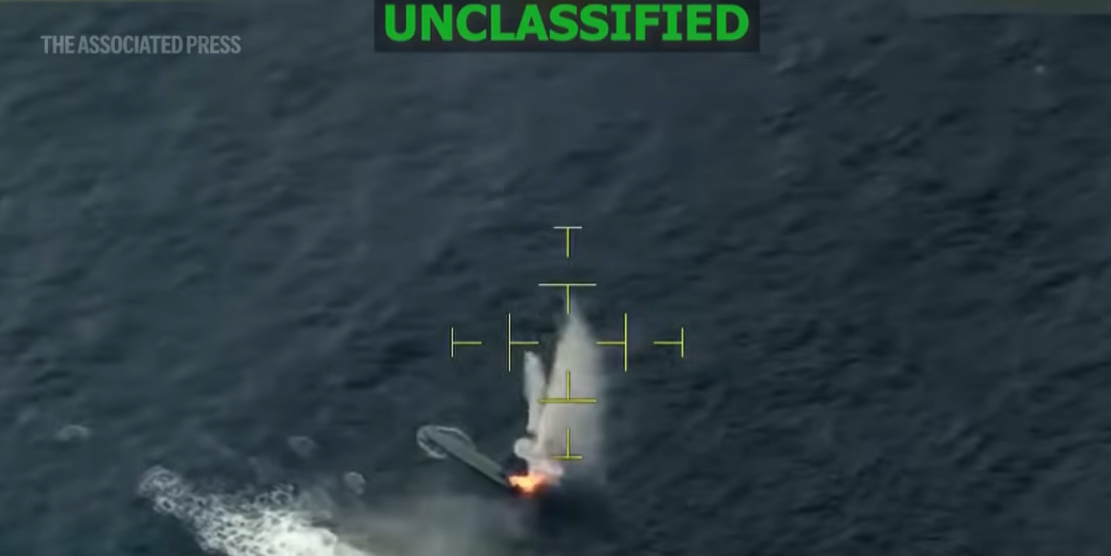
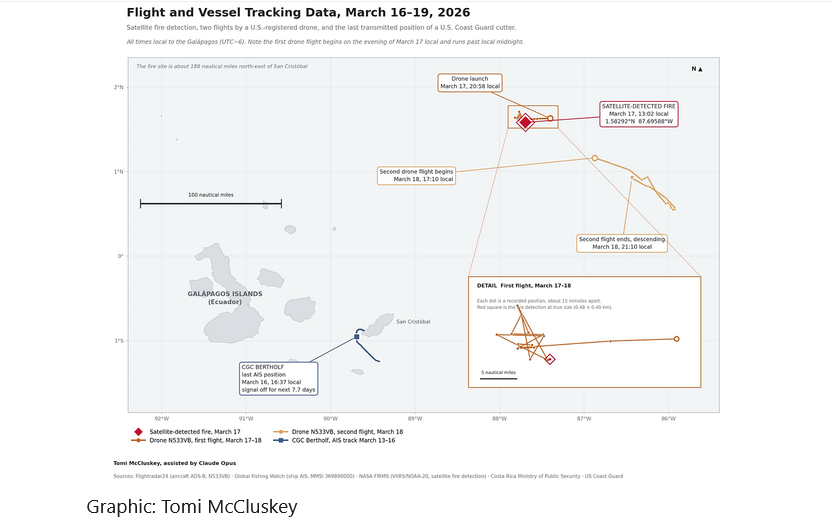
QUITO, Ecuador—In the hours after a mysterious attack on an Ecuadorian fishing boat near the Galápagos Islands on March 17, a drone registered to U.S. defense contractor Shield AI was hovering just 500 meters from the burning vessel, La Negra Francisca, according to a review of flight tracking data by Drop Site News. This represents the first known vehicle to arrive at the site of the strike.
The unattributed bombing of three Ecuadorian fishing boats in January and March, and the subsequent abduction and torture of 36 fishermen, was first reported by Drop Site in April. Last week, The Washington Post, building on Drop Site’s ongoing investigation, reported that the attacks were part of a covert CIA operation.
According to flight and vessel tracking data from Radar 24 and Global Fishing Watch, the drone was a V-BAT model, primarily used for intelligence, surveillance, and reconnaissance, but capable of carrying a weapons payload and switching its signal on and off to avoid detection.
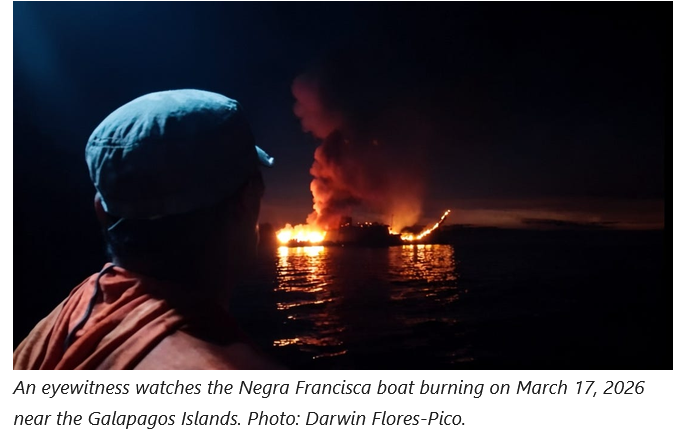
The Shield AI drone matches the fishermen’s descriptions of the drones that circled their boats before the bombing, and bears the same red and green lights eyewitnesses reported seeing as they photographed the explosion.
Shield AI did not respond to a request for comment.
The CEO of Shield AI, Brandon Tseng, has publicly stated that the U.S. Coast Guard and Navy are using V-BAT drones “to interdict and destroy billions of dollars’ worth of drugs that were headed for the United States of America.” In 2024, the U.S. Coast Guard signed a $198 million contract with Shield AI for V-BAT drones; in April 2026, Shield AI announced it had received an $800 million contract for V-BAT drones from the U.S. Navy.
No drugs were found on any of the three fishing boats investigated by Drop Site—the Negra Francisca, Don Maca, and Fiorella—all of which were searched and cleared by Ecuadorian coast guard personnel prior to the strikes.
Last month, Drop Site published NASA thermal imagery consistent with an explosion at coordinates 1.5822°N, 87.6958W°, recorded at 1:02 p.m., the time fishermen say they were hit, and in the location where their transponder stopped broadcasting.
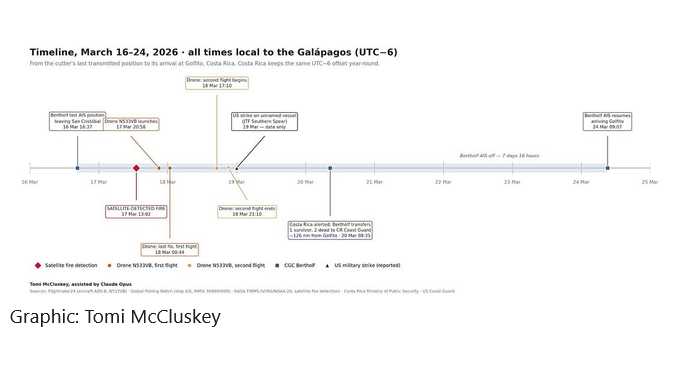
Tracking data suggests that the drone launched from a nearby boat on March 17, seven hours after the strike on La Negra Francisca and then circled near the site, its signal disappearing and reappearing. Ascending and descending patterns of movement indicate that the drone may have been landing on a boat and then resuming its flights.
Drop Site previously reported that vessel tracking data showed a U.S. Coast Guard cutter leaving a Galápagos military base a day before the Negra Francisca bombing—despite claiming it only deployed the cutter as a post-incident rescue effort. The Coast Guard vessel’s signal went dark and later appeared in Central American waters 24 hours before the fishermen were placed in El Salvador’s custody.
Video recordings, taken by eyewitnesses to the bombing, show the U.S. Coast Guard patrolling in the aftermath of the airstrike. Drop Site asked the U.S. Coast Guard in June to account for the cutter’s movements after its signal went dark. The Coast Guard responded that it “does not disclose cutter movements during law enforcement missions for operational security.”
In June, the U.S. Coast Guard told The Guardian it deployed its Bertholf cutter for a search-and-rescue operation after receiving a Mayday alert, contradicting prior statements by the U.S. Southern Command, which oversees maritime operations in the Pacific, that it had no knowledge of any U.S. involvement in the incidents. To date, the U.S. Coast Guard has not acknowledged using drones in its purported rescue efforts.
The U.S. Coast Guard, U.S. Southern Command, and the Central Intelligence Agency did not respond to questions for this article.
While flight tracking data is recorded in UTC, dating the drone activity as March 18, in Galápagos time (UTC-06:00) both the strike and the subsequent drone activity occurred on March 17.
Shield AI, a San Diego-based defense contractor, builds fighter jets and drones powered and piloted by artificial intelligence. The company was founded in 2016 with $1 million in seed funding from the Pentagon’s Defense Innovation Unit and the Naval Special Warfare Command. The Israeli military has reportedly used the company’s self-piloting drones for close quarters combat. V-BAT drones are also used by the Ukrainian military to identify Russian targets, as part of larger drone strike operations.

Video of the burning fishing boat La Negra Francisca, taken by Darwin Flores-Pico, after the March 17, 2026 attack.
Last week, the New York Times and the Washington Post corroborated much of Drop Site’s original investigation of the attacks. In addition, the Times reported that a patrol plane flew from a military base in El Salvador in the direction of the three boats prior to each of the attacks. The Post identified that plane as FENIX 701, a Cessna business jet equipped with surveillance equipment operating out of Ilopango International Airport, which served as a hub for CIA operations during the Contra War against the Sandinista government of Nicaragua. The plane is registered to a company with virtually no digital footprint that lists its address as a mailbox inside a Virginia UPS store.
The FENIX 701 stopped broadcasting its signal well before reaching any of the boats and returned to base hours before the actual strikes, according to flight data.
The fishermen, like the airplane, eventually wound up in El Salvador. As Drop Site previously reported, men from the Negra Francisca and Don Maca boats were taken hostage by “gringo” gunmen in U.S. military uniforms who they say hooded, handcuffed, and starved them for eight days aboard their U.S.-flagged ship before turning them over to El Salvador’s navy hundreds of miles away from home.
Since September 2025, the U.S. military has carried out over 66 strikes on vessels in the Caribbean and the eastern Pacific, killing at least 221, as part of Operation Southern Spear. The Trump administration has been boastful and unapologetic about this extrajudicial killing spree, which raises the question of why it would also run a covert CIA operation alongside it, as the Washington Post reported. There is precedent for such parallel operations, however. In April, for example, it was revealed that CIA agents were secretly working joint counter-narcotics raids with local agents in Mexico’s Chihuahua state without informing President Claudia Sheinbaum—despite her administration’s bilateral efforts with U.S. forces.
“We certainly do have cases in which one part of the U.S. government is doing something covertly while another part is doing something overtly,” Vincent Bevins, author of “The Jakarta Method,”a historical examination of the CIA’s Cold War operations, and editor of North South Notes, told Drop Site.
“That covert operation might be doing the same thing in a different way. It might be doing something similar and related,” Bevins added. “Even, at cross purposes, to some extent, with the official government line or official government policy….There are also cases where the only explanation is institutional chaos or poor planning.”
A Community Under Siege
In June, Alexandra Bravo, a prosecutor investigating the U.S. strikes, was shot dead in the coastal city of Manta, the home port of the three fishing boats. U.S. troops have been deployed in Manta since December 2025, and the return of a de facto U.S. military base there—originally outlawed by the 2007 constitution and again ratified by 60% of Ecuadorian voters last November—evokes painful memories for residents who have not forgotten why it was banned in the first place: the U.S. publicly and brazenly sinking fishing ships off the coast of Manta.
Ecuador is under its 23rd martial law decree, which allows authorities to raid homes and wiretap communications without a warrant, and grants diplomatic immunity to all U.S. forces. President Daniel Noboa justifies the stripping of civil liberties as a necessary part of his “war on narcos.”
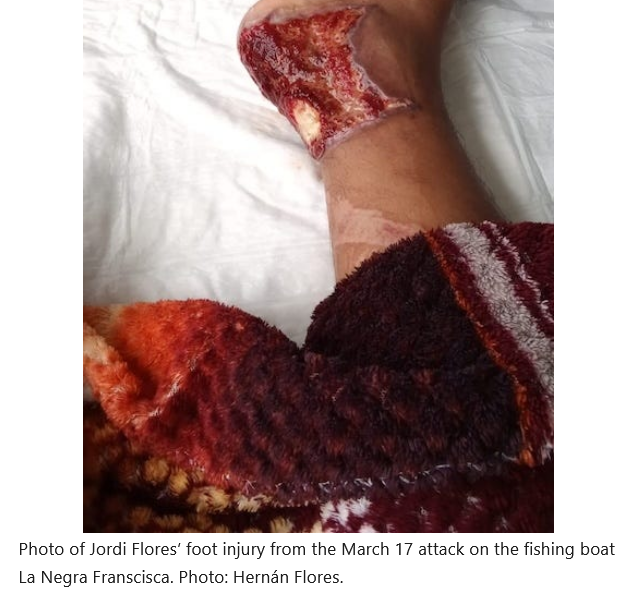
The strikes and subsequent abductions left Jordi Flores, a young crewmember aboard the Negra Francisca, with a severe foot injury and unable to work. Erik Coello, a crewmember aboard the Don Maca, which was also struck in March, suffers from 70% vision loss. And the families of the Fiorella, which vanished in January, have been crushed by grief for their missing sons, husbands, and fathers.
Maria Mero, whose husband Gabriel Aladino Mero Delgado and brother Jefferson Ariel Mero Cueva both disappeared on the Fiorella, told Drop Site that her mother-in-law died awaiting her son’s return, falling into a deep depression and ceasing to eat in the weeks leading up to her death. Maria’s young daughter was hospitalized from the anxiety of going seven months without seeing her father. Gabriel’s disappearance also left a void in the family’s finances. Without him, Maria said, the ordinary necessities of life—groceries, her electricity bill, their daughter’s school uniform—are completely unaffordable.
“If the CIA or the United States or the El Salvador patrol or the president is reading this,” Maria said, “please, I beg you, return my husband, my brother, and all the people who are with them.”