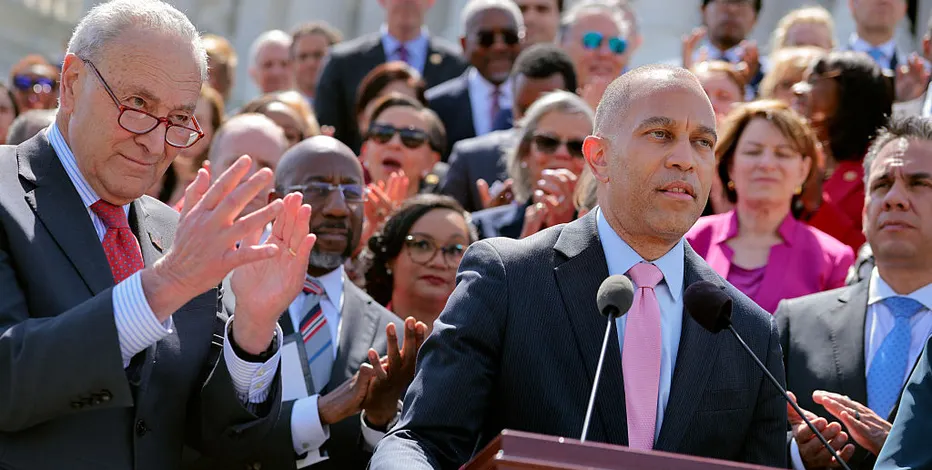
Democrats are stirring up controversy and scrutiny by using the nearly century-old “Rule of Five.” That rule, enacted in 1928 under Section 2954, allows any five senators on the Senate Homeland Security and Governmental Affairs Committee to demand documents from federal agencies. They had yielded those to compel the Justice Department to release files on Jeffrey Epstein.
On July 29, 2025, Senate Minority Leader Chuck Schumer, together with seven other Democrats, officially requested Attorney General Pam Bondi for the release of “all documents, files, evidence, or other materials in the possession of the DOJ or FBI related to United States of America v. Jeffrey Epstein.” They made clear that courts would enforce the request if the DOJ says no.
Will the Rule Be Enforceable: or Just Symbolic?
The rule gives Democrats legal standing on its face. The 2025 request met the statutory requirements of more than five signatures and relevance to the committee’s jurisdiction. That sets them up to take legal action if the DOJ stonewalls.
But courts have only hinted at Section 2954’s enforceability. In 2017, House Democrats won a D.C. The case never went to the Supreme Court. With so little case law, the courts now have a big decision: affirm a minority-party tool or back away from oversight precedent. Arnold & Porter says the Department counsel argued that enforcing such requests violates constitutional norms.
Political Stakes: Democrats Play Transparency; Republicans Manage Chaos
Democrats use public pressure to their advantage. A YouGov poll shows 82% of Americans want full disclosure of Epstein documents. That includes many Republicans, giving Democrats cross-party political cover.
Meanwhile, House Republicans are divided. The Oversight subcommittee passed a bipartisan request to subpoena the DOJ for Epstein files, but Chair James Comer hasn’t issued the subpoena. Reporters are asking if GOP leadership supports transparency.
House Democrats and some Republicans are calling on Comer to move fast. They want a 30-day response window. GOP resistance and internal delays show the party is not united on the issue.
Ghislaine Maxwell’s counsel is demanding immunity and pre-submitted questions, which the committee rejected. That standoff highlights the broader fight over openness.
In the Senate, Republicans seem less united. Some, like Tillis, support the release. Others call it political theater. But Democrats frame it as accountability and corner the GOP as defenders of secrecy.
What Happens Next: and Why It Matters
August 15, 2025, is the DOJ’s response deadline. If they comply, Democrats win a big oversight victory. That sets a precedent for minority power in oversight.
If they resist, litigation is imminent. Courts will have to decide if Section 2954 requires production. Judges will either empower future oversight or reinforce executive deference.
Politically, Democrats will highlight the move. They’ll show voters they’re fighting for truth and transparency. They’ll say Epstein files expose elite corruption and demand accountability across party lines.
Republicans will have to choose between defending Trump and supporting institutional checks. That crossroads will test GOP unity and create internal divisions.
Looking ahead to the 2026 midterms, this will be a big story. Democrats will cast Republicans as blocking victims’ rights and hiding corruption. That could swing independent or moderate voters.
And winning in court could redefine minority power in Congress. Future oversight efforts will rely on Section 2954 as a legitimate tool. A judicial rejection will remove one lever of congressional leverage and reinforce executive discretion.
Also read: Perseid Meteor Shower Tonight – Best Time & How to Watch
Historical Use of Oversight Rules in Political Battles
The House “Rule of Seven” inspired the Senate’s “Rule of Five.” Lawmakers in both chambers use them when traditional oversight stalls. These rules give minority parties leverage when the majority leadership blocks information requests.
In 1974, after Watergate, lawmakers used similar statutory authority to get documents from federal agencies. That got them tapes and memos. During the Reagan era, Democrats used the law to get the Iran-Contra records. In 2001, House Democrats wanted census data to challenge redistricting plans.
The 2017 Trump D.C. hotel lease case showed how these rules create legal fights. Even partial wins can get agencies to comply. Public Perception and Media Framing
Public opinion matters. News coverage determines whether voters see these moves as accountability or partisan games. Mainstream outlets like The Washington Post and The Hill frame the Rule of Five as a transparency fight. Conservative media calls it a political attack on Trump.
Social media amplifies both narratives. Hashtags like #EpsteinFiles and #RuleOfFive are trending on X and TikTok with millions of views. Influencers and political commentators break down the legal mumbo jumbo, while activists demand bipartisan support for disclosure. That online pressure gets lawmakers across the aisle.
Pollsters say transparency issues cross party lines. If Democrats stay on message, they can frame this as a victim-centered fight. Missteps or overreach, and they can be seen as an election tactic rather than a moral imperative.