By Economic Policy Institute
Photos: YouTube\Wikimedia Commons
The public has supported raising taxes on the ultrarich and corporations for years, but policymakers have not responded. Small increases in taxes on the rich that were instituted during times of Democratic control of Congress and the White House have been consistently swamped by larger tax cuts passed during times of Republican control. This was most recently reflected in the massive budget reconciliation bill pushed through Congress exclusively by Republicans and signed by President Trump. This bill extended the large tax cuts first passed by Trump in 2017 alongside huge new cuts in public spending. This one-step-forward, two-steps-back dynamic has led to large shortfalls of federal revenue relative to both existing and needed public spending.
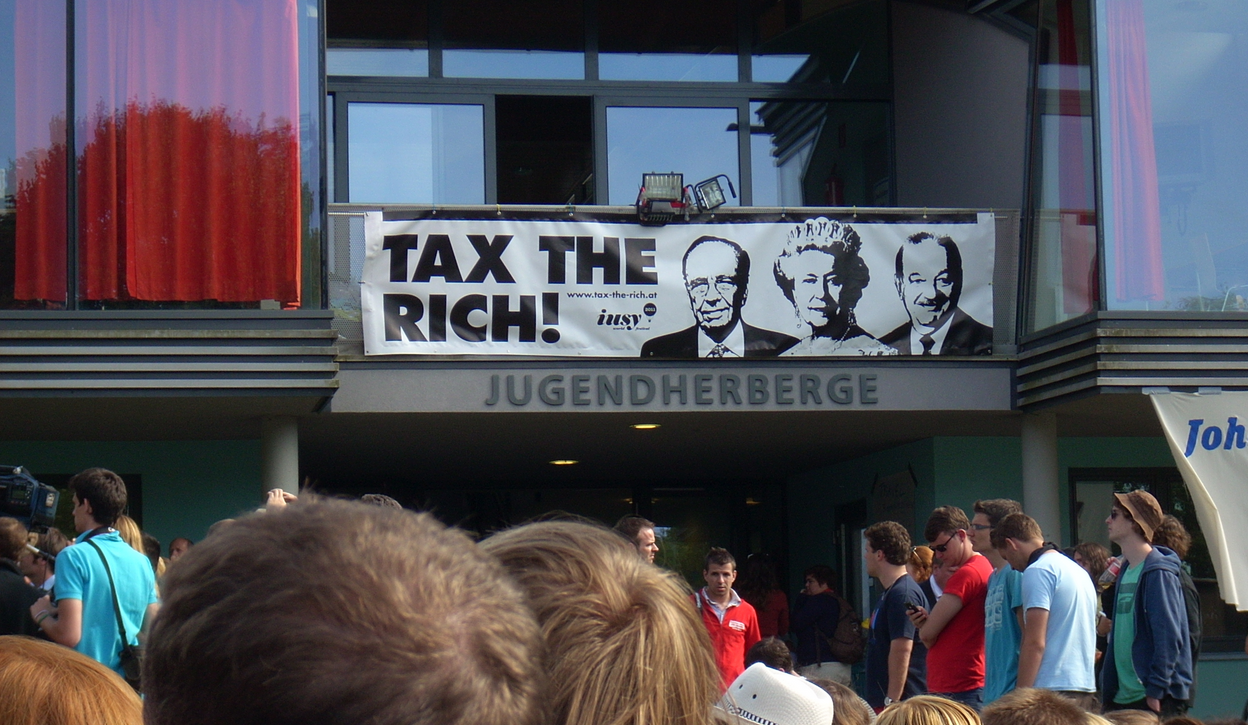
Raising taxes on the ultrarich and corporations is necessary for both economic and political reasons. Economically, preserving and expanding needed social insurance and public investments will require more revenue. Politically, targeting the ultrarich and corporations as sources of the first tranche of this needed new revenue can restore faith in the broader public that policymakers can force the rich and powerful to make a fair contribution. Once the public has more faith in the overall fairness of the tax system, future debates about taxes can happen on much more constructive ground.
Policymakers should adopt the following measures:
- Tax wealth (or the income derived from wealth) at rates closer to those applied to labor earnings. One way to do this is to impose a wealth tax on the top 0.1% of wealthy households.
- Restore effective taxation of large wealth dynasties. One way to do this would be to convert the estate tax to a progressive inheritance tax.
- Impose a high-income surtax on millionaires.
- Raise the top marginal income tax rate back to pre-2017 levels.
- Close tax loopholes for the ultrarich and corporations.
Introduction
The debate over taxation in the U.S. is in an unhealthy state. The public is deeply distrustful of policymakers and doesn’t believe that they will ever put typical families’ interests over those of the rich and powerful. In tax policy debates, this means that people are often highly skeptical of any proposed tax increases, even when they are told it will affect only (or, at least, overwhelmingly) the very rich. People are also so hungry to see any benefit at all, no matter how small, that they are often willing to allow huge tax cuts for the ultrarich in tax cut packages if those packages include any benefit to them as well. The result has been a continued downward ratchet of tax rates across the income distribution.1 This is a terrible political dynamic for U.S. economic policy, given the pressing national needs for more revenue.
As countries get richer and older, the need for a larger public sector naturally grows.2 Yet the share of national income collected in taxes by the U.S. government has stagnated since the late 1970s. This has left both revenue and public spending in the United States at levels far below those of advanced country peers.3 This stifling of resources available for the public sector is not only inefficient but has led to frustration over its inability to perform basic functions. The political root of this suppression of resources for the public sector is a series of successful Republican pushes to lower tax rates for the richest households and corporations. This attempt to use tax policy to increase inequality has amplified other policy efforts that have increased inequality in pre-tax incomes, leading to suppressed growth in incomes and declining living standards for low- and middle-income households and a degraded public sector.4
In recent decades the dominant strategy for many on the center–left to combat the public’s tax skepticism is to pair tax increases with spending increases for programs that lawmakers hope will be popular enough to justify the taxes. This strategy has worked in the sense that some tax increases have been passed in the same legislation that paid for valuable expansions of income support, social insurance, and public investment programs in recent years. But this strategy has not stopped the damaging political dynamic leading to the sustained downward ratchet of tax revenue and the tax rates granted to the ultrarich and corporations.5
Part of the problem with a strategy of trying to attach tax increases to allegedly more popular spending increases is that it takes time for spending programs to become popular. The Affordable Care Act (ACA), for example, was not particularly popular in the year of its passage but has survived numerous efforts to dislodge it and has seemingly become more popular over time. Conversely, the expanded Child Tax Credit (CTC) that was in effect in 2021 and cut child poverty in half only lasted a single year, so there was little organic public pressure on Congress to ensure it continued.
In this report, we suggest another strategy for policymakers looking to build confidence in the broader public that tax policy can be made fairer: Target stand-alone tax increases unambiguously focused on ultrarich households and corporations as the first priority of fiscal policy. The revenue raised from this set of confidence-building measures can be explicitly aimed at closing the nation’s fiscal gap (the combination of tax increases or spending cuts needed to stabilize the ratio of public debt to national income).6 Once this gap has been closed with just highly progressive taxes, the public debate about the taxes needed to support valuable public investments and welfare state expansions should be on much more fruitful ground.
This approach takes seriously the work of scholars like Williamson (2017), who argue that the U.S. public is not rigidly “anti-tax.” Indeed, this public often views taxpaying as a civic responsibility and moral virtue. Yet they have become convinced that too many of their fellow citizens are not making a fair and adequate contribution. Part of this perception rests on underestimating the taxes paid by the poor and working people, but a good part of this perception also rests on the accurate impression that many rich households and corporations are not paying their fair share. Policy can change this latter perception, particularly if the policy is explicitly identified with ensuring that the rich and corporations—and only the rich and corporations—will see their taxes increase.
The rest of this report describes a number of tax policy changes that would raise revenue from the rich and corporations with extremely small (often zero) spillover into higher taxes for anybody else. It also provides rough revenue estimates of how much each could raise. It is not exhaustive, but it demonstrates that the nation’s current fiscal gap could certainly be closed with only taxes on the very rich. Making this policy agenda and target explicit could go a long way to restoring trust and improving the quality of the debate about taxes…READ MORE