By Theogene Rudasingwa
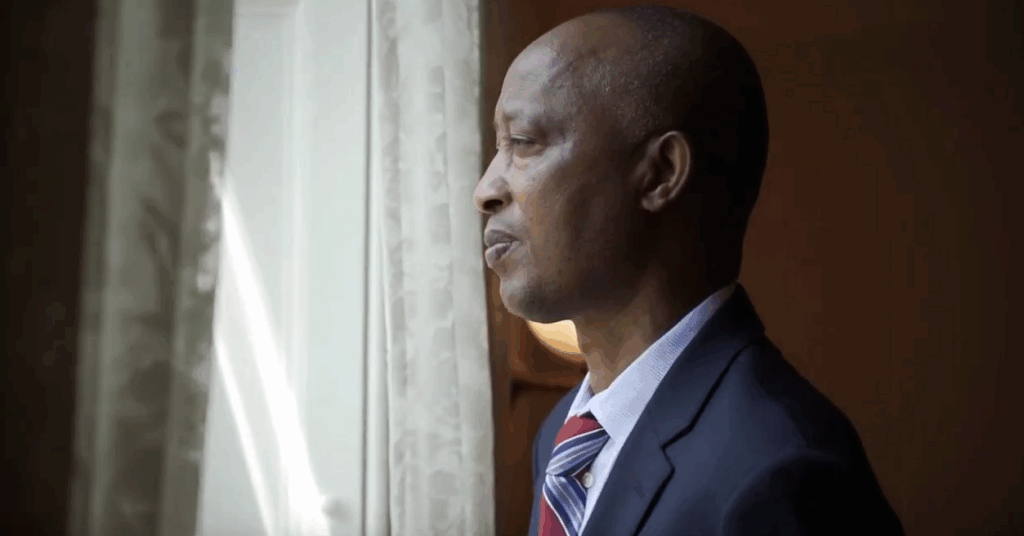
Photos: YouTube Screenshots
The following open letter was written by former Rwandan Ambassador Theogene Rudasingwa to African leaders and Africans worldwide on Africa’s challenges.

His Excellency Mahamoud Ali Youssouf,
Chairperson,
African Union Commission,
Addis Ababa, Ethiopia
(Copied to: Heads of State and Government of African Union Member States;
The President of the African Development Bank;
The Executive Secretary of the United Nations Economic Commission for Africa)
All Citizens of Africa
Your Excellency,
Distinguished Leaders of Africa,
Fellow African Citizens Worldwide,
I write to you as an African son, shaped by this continent’s history, memory, wounds, and hopes. I write with humility, respect, and deep affection for the nations and peoples whose destinies we are all sermoned to co-create. My purpose is to contribute thoughtfully to the ongoing dialogue on Africa’s development trajectory and to share reflections on where the continent stands at this critical moment in world history.
This letter is not a lament. Africa is not fallen, nor is it unfinished. Instead, we are in the midst of a long historical transition: from colonial subjugation to self-definition, from dependency to sovereignty, from trauma to restored humanity, and from fragmentation to continental unity. Yet, despite the progress we have made, there remain deep structural impediments preventing us from realizing our full civilizational potential.
I wish to address four interrelated challenges that define Africa’s current position in the world:
- Our limited presence in the highest levels of global scientific achievement.
- Our modest record of world-changing inventions in the modern era.
- Our low continental investment in research and development.
- Our small share in global trade and value-added production.
These issues are symptoms of a deeper structural problem: Africa has not yet developed the systems and institutions that turn human potential into transformative knowledge, innovation, and prosperity. This isn’t a failure of intelligence, culture, or capability. It’s the result of extractive political economies, ongoing fractured national agendas, and the lack of a unified continental development plan centered on knowledge, science, and human well-being.
I. Africa’s Limited Presence in Nobel-Level Scientific Achievement
Since 1958, African nationals have received only five Nobel Prizes in scientific fields—primarily in Chemistry and Physiology/Medicine, and none in Physics or Economic Sciences. This is often misinterpreted as evidence of a talent deficit. It is not. The African mind is as expansive, subtle, and beautiful as any mind that has ever been formed.
The issue is not cognitive capacity but rather the lack of conditions that foster high-level scientific work. Achieving Nobel-level discoveries requires long-term research stability, well-funded laboratories, interdisciplinary academic communities, and generations of scholars working continuously. These conditions are scarce across our continent. The tragedy is not that Africa produces too few geniuses; it is that our geniuses often have to leave Africa to realize their potential.
The young African who aims to explore the cosmos, decode molecular pathways, or develop mathematical physics models often must uproot themselves physically, emotionally, and culturally to thrive intellectually. This phenomenon is what scholars refer to as “brain exile,” not just “brain drain.” As a result, African achievement is often recognized only on foreign soil and under foreign flags.
II. The Gap in World-Changing Inventions
When we examine the most influential inventions since 1900—spanning digital computing, telecommunications, pharmaceuticals, energy systems, aerospace engineering, agricultural biotechnology, and medical diagnostics—it becomes clear that Africa’s contributions are underrepresented.
Again, the cause is structural. To invent is to move through a pipeline:
Idea → Prototype → Testing → Manufacturing → Market Scaling → Global Adoption
Africa struggles not with the first step, but with everything that comes after it.
We have inventors without laboratories, engineers without fabrication networks, ideas without certification pathways, youth without capital, and markets fragmented by borders we did not draw.
Until Africa develops the infrastructure for innovation—such as shared research facilities, regional manufacturing hubs, standards and testing systems, and investment funds that accept risk—our creativity will continue to flourish but not reach scale.
III. Research and Development: The Foundation of Civilizational Progress
Africa invests roughly 0.5% of GDP in research and development.^1
The global average is three times higher, with top innovation nations investing between 4% and 5%.
Research is not just a technical activity; it is a matter of civilizational self-determination.
To produce knowledge is to shape your own future.
When research is underfunded:
- universities become certification centers rather than discovery centers,
- science is reduced to memorization rather than experimentation,
- development policy becomes reactive rather than generative.
Without R&D systems, countries cannot create their own cures for diseases, build their infrastructure, sustainably feed their populations, or protect themselves technologically. R&D is a matter of strategic sovereignty.
IV. Africa’s Limited Role in Global Trade
Africa accounts for only about 3% of global trade—less today than in the 1960s. This is mainly because we export raw materials and import finished goods, a pattern established during colonial times that has remained essentially unchanged. No country or region has ever become wealthy without industrialization, robust regional value chains, and a strong internal market. Intra-African trade currently accounts for between 14% and 18%, compared to around 70% in the EU and approximately 60% in Asia. Economic fragmentation hampers scale, specialization, efficiency, and bargaining power.
The African Continental Free Trade Area (AfCFTA) is an exceptional framework, but it will only succeed if it is paired with a continental-scale industrial strategy and shared scientific infrastructure.
The Root of All Four Challenges
These challenges are not separate—they are one problem seen from four angles:
Africa has not yet built the institutions that transform knowledge into power, power into prosperity, and prosperity into shared wellbeing.
We inherited schools designed to produce clerks, economies built to export raw materials and import finished goods, borders meant to divide and weaken, and political cultures shaped by trauma and survival rather than confidence and imagination.
We have not yet established the African institutions of the future—places where the mind can expand, inquiry is revered, youth are motivated to create, innovation is supported rather than punished, and power serves life instead of consuming it.
A Call for a Continental Renaissance of Knowledge, Healing, and Innovation
Africa now stands at a historic threshold.
We are the youngest continent in the world.
By 2050, we will be one-quarter of humanity.
By 2100, we will be one-third.
The center of gravity of humanity is shifting toward Africa.
The question is whether our future will be defined by others, or by us.
This requires courage, clarity, and new forms of leadership.
We must now:
1. Treat research and knowledge-production as strategic priorities
Not optional; not donor-driven; not decorative.
2. Establish shared continental research sanctuaries
Calm spaces for long thinking, grounded in African philosophical traditions and global scientific rigor.
3. Build regional manufacturing ecosystems
So inventions can become industries, not exhibitions.
4. Use AfCFTA and regional trading blocs to create integrated African value chains
Trade inward first; then outward with strength.
5. Create continental youth enterprise funds
To turn training into livelihoods, and livelihoods into dignity.
6. Restore moral leadership grounded in Ubuntu
So power serves life, not dominance.
Conclusion: Africa Is Rising, but Not Yet Ascended
Your Excellencies,
Fellow Citizens,
The world is changing. Old centers of power are uncertain. New technological and ecological challenges pose a threat to humanity itself. Africa has something profound to offer the future—not just resources and markets, but a different way of being human: relational, ecological, spiritual, communal, and wise.
Our task is to prepare the structures through which Africa may speak its voice, heal its wounds, and contribute to the world with dignity.
We are not asking the continent to begin a new journey.
We are asking it to continue the journey it began long ago, when Africa gave humanity language, agriculture, metallurgy, astronomy, philosophy, and the spiritual intuition that life is shared.
Africa’s future greatness will not mirror Europe, America, or China.
It will be Africa returning to its roots—and presenting its renewed humanity to the world.
With deep respect and unwavering hope,
Dr. Theogene Rudasingwa
Email: [email protected]
Endnotes
- UNESCO Institute for Statistics. “Global Investments in Research and Development.” (2023).
- UNCTAD. Economic Development in Africa Report. United Nations Conference on Trade and Development (2022).
- African Union Commission & AfCFTA Secretariat. “Status of Intra-African Trade and Integration Progress.” (2023).
- World Bank. “Africa’s Pulse: Analysis of Issues Shaping Africa’s Economic Future.” (2022).
- United Nations Economic Commission for Africa (UNECA). “The Future of Africa’s Industrialization.” (2021).
- African Development Bank. “African Innovation Outlook.” (2020).
- Kwame Nkrumah. Africa Must Unite. (1963).
- Julius K. Nyerere. Ujamaa: Essays on Socialism. (1968).