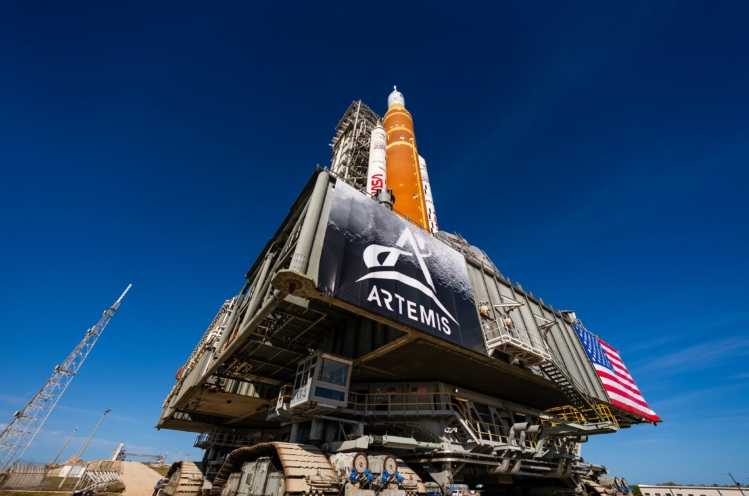
NASA’s ambitious plan to return humans to lunar orbit has hit a significant technical setback. The Artemis II mission, which was scheduled for a high-profile launch in February 2026, is now facing a delay after engineers detected a persistent hydrogen fuel leak in the Space Launch System (SLS) rocket.
What is NASA Artemis II Program?
NASA’s Artemis II mission is the first crewed flight in the Artemis program, aimed at returning humans to the Moon’s vicinity for the first time since Apollo 17 in 1972. It involves launching 4 astronauts aboard the Orion spacecraft atop the Space Launch System (SLS) rocket from Kennedy Space Center’s Pad 39B. The 10-day mission follows a free-return trajectory around the Moon, testing Orion’s life support, propulsion, navigation, and high-speed reentry systems at distances farther from Earth than any previous human spaceflight, while gathering data on radiation shielding and deep-space operations to support future landings and Mars exploration.
Originally targeting early February 2026, it faced a mandatory delay after engineers detected a persistent hydrogen fuel leak at the SLS core stage umbilical during a wet dress rehearsal fueling test, which terminated at T-minus 5:15; NASA has now shifted to no earlier than March 6-9 with March 11 as an option, allowing time for analysis, repairs, and a retest to prioritize crew safety.
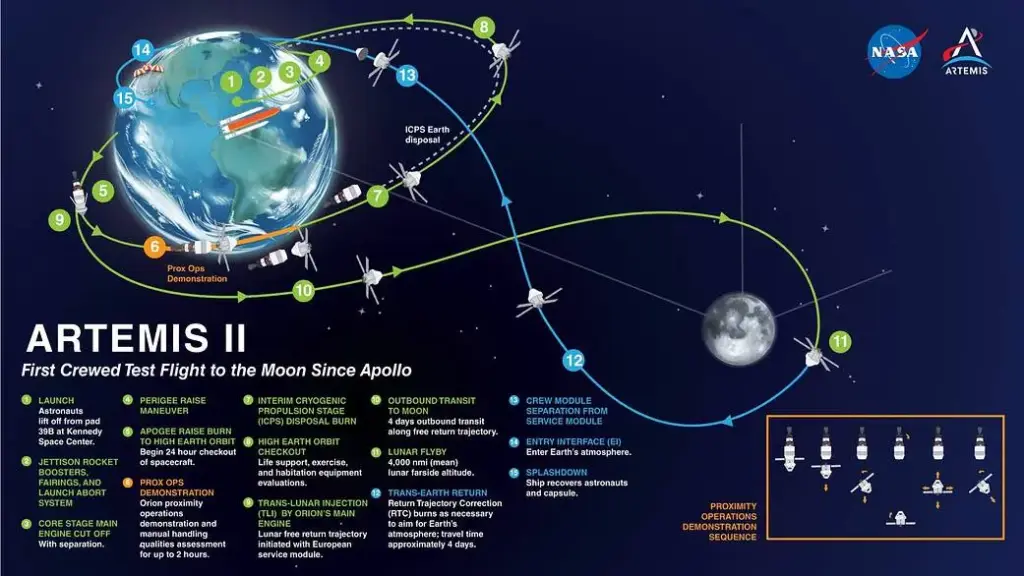
NASA Artemis II: New Launch Date
NASA’s Artemis II mission, the first crewed flight of the Artemis program, has shifted its NASA Artemis II: Launch Date to no earlier than March 6, 2026, following a hydrogen fuel leak detected during the wet dress rehearsal on February 2. The new dates could be March 6, 7, 8, 9, and 11, with backup windows in April including the 1st and 3rd through 6th, allowing time for engineers to analyze data, repair the SLS core stage umbilical interface, drain propellants safely, and conduct a second rehearsal at Kennedy Space Center’s Pad 39B to ensure crew safety for astronauts Reid Wiseman, Victor Glover, Christina Koch, and Jeremy Hansen. This delay prioritizes mission success for the 10-day lunar orbit test, validating Orion systems before Artemis III’s planned 2027 landing.
Artemis II: Key Delay Reasons
Reasons for NASA Artemis II Delay includes multiple technical issues uncovered during the February 2, 2026, wet dress rehearsal at Kennedy Space Center’s Pad 39B.
- Liquid Hydrogen Leaks: Engineers detected a persistent leak at the tail service mast umbilical quick disconnect on the SLS core stage during liquid hydrogen loading, when the tank hit 55-77% capacity in fast-fill mode. This echoed Artemis I problems, as hydrogen’s small molecules challenge seals despite prior upgrades like nitrogen purges and valve checks.
- Automatic Shutdown: A spike in leak rate during slow-fill triggered the ground system’s automated sequencer to abort at T-minus 5:15, just before terminal countdown, prioritizing safety over proceeding.
- Valve Issues: The Orion capsule required retorquing a recently replaced hatch valve, adding to closeout delays alongside communication dropouts and camera faults.
- Cold Weather Impacts: Subfreezing temperatures postponed tanking start by hours, complicating cryogenic handling and equipment response.
What Actually went wrong?
This video on YouTube explains the reasons for the launch delay:
NASA Artemis II: Mission Significance
NASA Artemis II marks humanity’s return to deep space beyond low Earth orbit for the first time in over 50 years, since Apollo 17 in 1972, validating systems for sustainable lunar exploration and Mars missions. It achieves historic milestones by including the first woman, first person of color, and first non-U.S. citizen (Canadian Hansen) beyond low Earth orbit, while rigorously validating Orion’s life support, propulsion, navigation, communications, and heat shield during extreme reentry at 25,000 mph, alongside SLS rocket performance.
Beyond technical proofs essential for Artemis III’s 2027 lunar landing and Gateway station buildup, the crew’s experiments on radiation exposure, immune function and Earth-Moon observations from space will guide sustainable Moon bases and Mars missions, strengthening global ties via Artemis Accords CubeSat contributions. This proving ground ensures safe, repeatable human exploration architecture for the coming decades.
Final Words: NASA is close to big space wins again
Artemis II Mission is a big deal for NASA as it is the first time people will fly to the Moon since 1972. Four astronauts will go around the Moon but not land. This tests the Orion spaceship and big SLS rocket to make sure they work safely far from Earth. It includes the first woman, first Black astronaut, and first Canadian on such a trip. The info helps plan Moon bases and trips to Mars later. And now a fuel leak delayed launch from February to March 2026. Despite the hydrogen leak setback delaying NASA Artemis II to March 2026, this mission paves the way for humanity’s sustained return to the Moon and beyond, proving NASA’s hardware works for crewed deep-space flights. Success here unlocks Artemis III landings and Mars ambitions, blending historic firsts with cutting-edge tech for a multi-planetary future.