By Shuaib Almosawa & Jeb Boone|Drop Site News
Photos: Wikimedia Commons
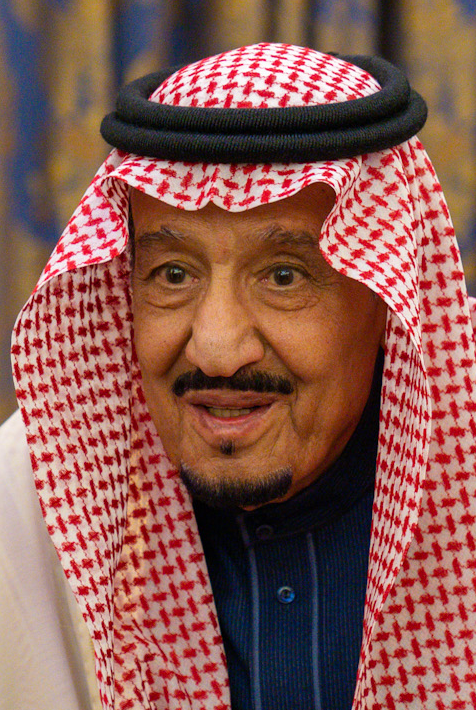
SANA’A, Yemen—In January 2012, Saudi Arabia’s then-defense minister, Salman bin Abdulaziz (below), issued a directive advising a shadowy Saudi government committee to widen Yemen’s northern war. In broad terms, the plan entailed engineering a rift between northern Yemen’s Shia majority and Salafi Sunnis when one previously had not existed.
The order came at a time when Yemen’s internal power structures were in disarray following a 2011 popular uprising against the longtime rule of Yemeni president Ali Abdullah Saleh. Saudi Arabia, which shares a 812-mile border with Yemen, had long managed delicate relations with its southern neighbor and now looked with growing concern at the chaos unfolding within the country. By 2012, Yemen’s army had splintered into rival factions both camped inside the capital city, Sana’a. Saleh had stepped down after 33 years of power and his former vice president Abd Rabo Mansur Hadi stood prepared to take the reins through a single candidate election—hardly the legitimate figure the fractured political landscape demanded.
Worst of all for Saudi Arabia, its old rival Ansarallah—which was based in Yemen’s northern highlands with a stronghold in the city of Saada—stood poised to take advantage of the chaos.
Known as the Houthis, Ansarallah grew out of a revival movement among Yemen’s Zaydis, followers of a branch of Shia Islam that ruled the northern highlands for a thousand years until 1962. Zaydism sits closer in doctrine to the four orthodox Sunni legal schools than to the Twelver Shiism of Iran, and in the early 2000s most Zaydis hadn’t yet joined the Houthi cause.
Salman’s plan was essentially twofold: to arm the Yemeni tribes fighting the Houthi movement, most of them ultra-conservative adherents of the Salafi school of Islamic jurisprudence and educated in the kingdom’s own Wahhabi current; and to drive a wedge between Ansarallah and the wider Zaydi community.
A January 2012 cable directed to a secretive special government committee handling Saudi Arabia’s relationship to Yemen stamped “Extremely Secret, Very Urgent” with Salman’s signature at the bottom outlines the plan: “The Special Committee of the Council of Ministers should discuss and study supporting Yemeni tribes hostile to the Houthis if they fail to commit to reconciliation with Ahl al-Sunnah [Salafists] in Saada, enabling multiple fronts against them, fostering discord between Houthis and Zaydi followers, while ensuring the fighting does not appear as a Sunni-Shia sectarian war in Yemen or that the Kingdom is behind it.”

A January 2012 cable to the Special Committee of the Saudi Council of Ministers signed by Saudi Arabia’s then-defense minister Salman bin Abdulaziz.
Salman did not want it to appear sectarian because a war between Ansarallah and Saudi Arabia framed as a purely sectarian conflict, Sunni vs. Shia, would drive northern Yemen’s majority Zaydi Shia population toward support for Ansarallah out of a sense of religious duty or alignment with the cause.
The kingdom’s proxy fighting force in northern Yemen at the time, the Salafist Sunni tribes, were just one part of their plan. In order to isolate Ansarallah from Yemen’s wider Zaydi Shia community, fighting needed to look like a local quarrel. If violence appeared to be carried out by Saudi-backed Sunnis against local Shia communities, the Houthis would quickly become the defenders of the sect rather than a local nuisance.
Salman’s plan to “foster discord” between the Houthis and other Zaydis meant drawing a sectarian line in Yemen where none yet ran. Saudi Arabia would fund the fight from one side of that line and keep its name off it.
But this attempt to carefully curate the narrative would ultimately go on to fail when Saudi Arabia launched an air war backed by the U.S. against Ansarallah in 2015 that began decimating Saada soon after Salman was appointed king.
The secret cable is part of a trove of classified Saudi cables obtained by Drop Site News. The cables were issued by the Special Committee of the Saudi Council of Ministers, the agency that has run the kingdom’s Yemen policy since 1962. Riyadh created the committee the year republican officers backed by Egyptian president Gamal Abdel Nasser toppled Yemen’s thousand-year-old Zaydi imamate, and charged it with managing “all matters related to Yemeni affairs.” The committee reports directly to the Saudi Prime Minister’s Office and the Saudi ambassador in Sana’a sits as a member. Its name does not appear in any official media in either country.
For more than half a century the special committee has been the kingdom’s primary instrument in Yemen. It helped organize strategy toward Yemen and kept individual files on Yemen’s tribal sheikhs, religious leaders, military commanders, and politicians in government and opposition alike. It also ran allowances—monthly stipends paid out to keep powerful Yemenis loyal to Riyadh. The secret cables date from 2010 to 2012. They record payments and informant reports, the wars the committee funded, and the terms it set for the men on its books.
Single pages from the set of cables obtained by Drop Site have been previously published by Wikileaks and by local media in Yemen, corroborating the larger tranche’s authenticity. Drop Site contacted several Saudi government offices to ask for comment on the cables but did not receive any response.
This is the first in a series of reports based on the Saudi Special Committee Cables by Drop Site News. We are publishing the cables in both Arabic and English here.
The cables help shed light on Riyadh’s machinations in Yemen at a time when Saudi Arabia and Ansarallah appear to be hurtling toward open conflict once again. An attack by Saudi Arabia on Sana’a earlier this month sparked retaliatory strikes by Ansarallah followed by a declared naval blockade on Saudi Arabia in the Bab al-Mandab strait. The latest developments threaten to completely upend a four-year-long ceasefire that could ultimately play a role in intensifying the U.S. war with Iran. The roots of the conflict between Ansarallah and Riyadh can be found in part in Saudi Arabia’s attempts to foment internal strife within Yemen.
The Plan to Open Multiple Fronts Against Ansarallah
The same January 2012 cable names two men tasked with carrying out Salman’s plan. The cable claimed Sheikh Mohammed al-Imam, who ran a Salafi institute in the city of Dhamar, “prepared 300 armed men to target Houthi positions” to relieve pressure on the Salafis of Dammaj who were battling the Houthis, though the claim could not be independently verified. Located in the Saada governorate of northwest Yemen, Dammaj was the base of Saudi-influenced Salafi seminary built in the Zaydi heartland in 1979, and by 2012 it had become the symbolic front line of the war. The cable also said that a serving Yemeni army officer, the artillery brigade commander Hussein Khiran, smuggled the fighters their ammunition.
It is not clear from the cables that Drop Site obtained whether these specific actions were taken, but Saudi Arabia did back, arm, and fund Salafi fighters to battle Ansarallah.
The cable also said that Ansarallah leader Abdulmalik al-Houthi sent envoys to two estranged Zaydi figures, Mohammed Abdulazim and Abdullah al-Razami, to plead for fighters. “We now cannot resist the Wahhabis,” Abdulmalik al-Houthi reportedly said, referring to the Salafi tribes. “If you do not support us we will hand Saada over to them, because we cannot continue.” Abdulazim refused the request, while Al-Razami sent seventy men, according to the cable.
A separate cable records the money. Saudi Prince Mishal bin Abdullah, then governor of the border province of Najran, signed an Interior Ministry cable dated May 7, 2012 under the subject line “Regarding the Houthis and the Sunnis.” The cable states that Mishal’s office received an installment of five million Saudi Riyals (about $1.3 million) and passed the money to the Dammaj and Aahim fronts before requesting a second installment of funds. The cable also reports that the kingdom’s men armed and supplied the Aahim front in the province of Hajjah and were arranging to open a third front in Rahub. It also endorses a plan by a Salafi sheikh named Musleh bin Hamad Fanis Al-Athla to build a new branch of the Dammaj institute, calling it “a good thing” that “helps weaken the Houthi movement.”
Saudi Arabia had been financially backing anti-Houthi Yemeni border tribes for years. Before Salman’s 2012 plan to engineer a rift in the north, a special committee cable dated March 15, 2010 signed by King Abdullah authorized the immediate release of 50 million Saudi riyals (around $13 million) to arm, supply, and financially support the tribes battling Ansarallah along the border.
A March 2012 report from the General Intelligence Presidency (GIP), a powerful Saudi intelligence agency, signed by intelligence chief Muqrin bin Abdulaziz describes former president Ali Abdullah Saleh secretly funding the Houthis as a counterweight to Salafi forces. By the report’s account, he steered some 12 billion Yemeni riyals (roughly $55.8 million) their way over an undisclosed time period, because the movement “poses an obstacle to the Salafi current in Yemen.” While Saleh did support the Houthis at various times, the Saudi intelligence assessment claiming billions of Yemeni riyals could not be independently verified and may have been exaggerated by informants in a bid to prompt Saudi to provide more funding to counter it.
Saudi Arabia armed one side. Saleh backed the other. The Zaydi north absorbed the war that both were funding and the damage was catastrophic. Fighting in Dammaj continued from October 2011 to January 2014 and spread to other Houthi strongholds in Saada, Hajjah, Amran and al-Jawf. Casualty numbers and damage reports appear throughout the Saudi cables, quoting Houthi commanders and often citing “large [casualty] numbers from both sides.”
The Red Cross documented more than 100 dead in the first siege of Dammaj in late 2011, among them four children. A report from Yemen’s health authorities counted 199 killed, 29 of them children, and 594 wounded in the final hundred days alone. When a ceasefire was implemented in January 2014, three hundred buses evacuated roughly 10,000 people, evacuating foreigners and those who sought to escape what was understood to be another round of inevitable fighting.
In early 2014, the Houthis overran Dammaj and expelled the Salafi students Riyadh had paid to protect. By September 2014 they had taken over the capital, Sana’a.
The covert war escalated into a full blown conflict in March 2015 when a Saudi-led coalition of Gulf nations, with American military, intelligence and logistical support, began a years-long bombing campaign of northern Yemen. While Salman wanted to ensure the fighting did not appear as a Sunni-Shia sectarian war, the kingdom did ultimately play on sectarianism to rally Salafist Sunnis to join its campaign against Ansarallah.
The bombing campaign lasted eight years across over 25,000 strikes, nearly a third of which struck civilian sites. The accompanying naval and air blockade contributed to the world’s largest cholera outbreak in history, and what the UN for years called the world’s worst humanitarian crisis. By the end of 2021, the UN put the war’s toll at 377,000 dead, most of them from hunger and disease.
Ansarallah, the movement Salman’s ministry once hoped to fracture, has remained in control of most of Yemen for the past decade. It has fired sporadic missiles at Israel in solidarity with Gaza and targeted commercial ships in the Red Sea, most recently declaring a blockade on all Saudi vessels through the Bab al-Mandab strait. The cables show how Saudi Arabia tried to sideline and weaken Ansarallah by sowing division in northern Yemen only to escalate into an all out war that also ultimately failed to drive the Houthis from power. The Special Committee still operates as Saudi Arabia’s secret body that is running the kingdom’s policies toward Yemen.
Shuaib Almosawa is a freelance journalist based in Yemen’s capital Sana’a.