
By Clayton Steward & Justin Perkins|Drop Site News
Photos: Clayton Steward|Wikimedia Commons
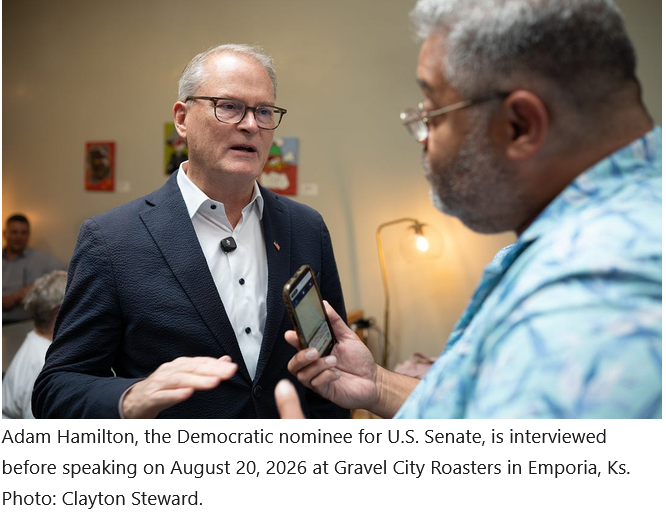
Adam Hamilton, pastor and founder of Church of the Resurrection in the Kansas City suburbs, the largest United Methodist congregation in the United States, walked into a coffee shop in Emporia, Kansas, in late August. With a population of 24,000, Emporia is roughly the same size as Resurrection’s membership. But instead of preaching, Hamilton was there to make his case for why he can flip a seat for the U.S. Senate from the Sunflower State, a feat more than 90 years in the making.
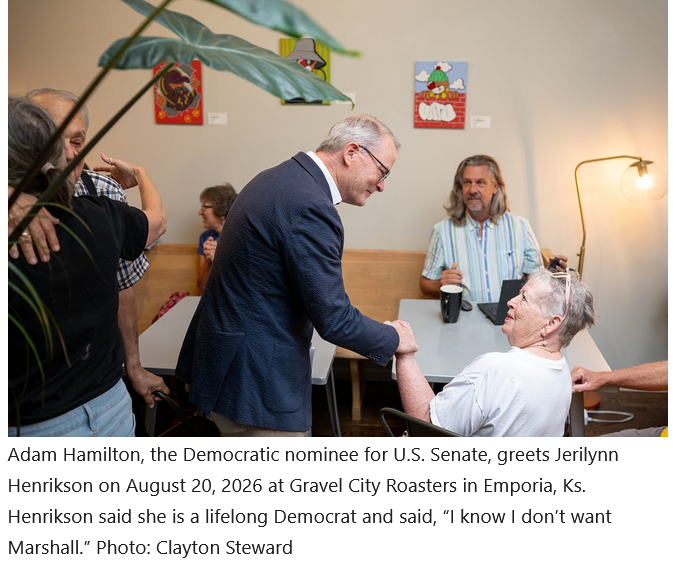
Hamilton told the crowd of about 40 people his campaign is rooted in his faith and experiences as a pastor but clarified that he is not running to force people to be Christian or United Methodist. Instead, he is motivated to uphold the U.S. Constitution and fight for individual rights.
He shared a conversation he had with his wife many times last year.
“Somebody’s got to do something,” he told her while Trump’s cabinet implemented One Big Beautiful Bill policies and cut funding to groups such as the U.S. Agency for International Development (USAID). “After about eight months of saying somebody’s got to do something, she finally turned to me in January this year and she said, ‘Maybe you need to do something.’”
Religion and politics collide
A man in a Navy hat raised his hand at the meet and greet in Emporia. He explained the day before he had met with his friends of 30 years at the coffee shop Hamilton’s stop was being held at.
“They’re Republican, I’m a Democrat. We get along. We have coffee. We go places together and talk and talk,” he said. The man had told his friends about coming to Hamilton’s campaign stop.
“They said, ‘He’s woke.’ I said, ‘Well, wasn’t Jesus woke?’ ”
Hamilton’s 36-year career as the pastor of a mainline Protestant congregation puts him in an unusual position as a first-time Democratic candidate. In a race with sharp political divisions and an enduring rural-urban divide, he is attempting to bridge a wide coalition of voters based on the ethics of his theological commitments.
And since he won the ten-person Democratic primary in August, Republicans have sought to wield Christianity against him. They say he is “too woke” for Kansas and have even called him a heretic for suggesting God would not condemn people who are not Christians.
This messaging came to a head September 14, when Vice President J.D. Vance appeared at a campaign rally in Olathe, Kansas, to support Hamilton’s Republican opponent, Sen. Roger Marshall.
Vance accused Hamilton’s church of supporting a group of devil worshipers because of their sponsorship of the Kansas City PrideFest this year. The pride event included the satirical drag queen performance group Our Ladies of Perpetual Indulgence, which Vance labeled an “anti-Christian hate group.”
The vice president also cherry-picked two 2020 sermons, one in which Hamilton talked about the Black Lives Matter movement and white privilege, and another where said Christians need to repent for their destruction of the environment and acknowledged “maybe changing your diet” as one action.
“Democrat pastor Adam Hamilton thinks it’s a sin to be white and a sin to raise cattle and eat meat, but he’s okay with supporting groups that spit on god-fearing Americans and mock everything that we hold dear,” Vance told the audience. “Ladies and gentlemen, that is not Christianity. That is left-wing radicalism dressed in the skin suit of our religion.”
In a video response released on September 16, Hamilton said Vance’s comments were part of the “broken politics” that define Washington. As he has done on the campaign trail, Hamilton presented his D.C. outsider status as the fix.
“These attacks on our faith,” he said, “are false and are a sad attempt to distract from the real hardship facing Kansans.” He did not address Resurrection’s support of the KC PrideFest, although the church’s website features a dedicated page for its LGBTQ ministry, which says, “Resurrection is an LGBTQ friendly church.”
Hamilton’s response to the vice president instead highlighted Resurrection’s food and health care assistance programs, which the church claims has aided more than 45,000 people.
“Trying to demean or marginalize the faith of other people, that’s just wrong,” he said. “It’s also against the Christian teachings to love, serve and care for one another.”
In a 2021 podcast called Changing My Position, Hamilton put his position on sexuality more clearly. He said that he had spent conservatively “20,000 hours studying the Bible.” As a result, he found, “What is crystal clear is that the driving ethic of the Christian faith is love, and we’re going to love and welcome people here, gay or straight.”
His campaign now depends on whether or not voters resonate with that ethic extending to the political arena. “I lead from the center,” he told the group gathered in Emporia. “I pastor a church with 9,000 Republicans, 9,000 Democrats and 7,000 independents. I love those Republicans.”
“Doc” Marshall
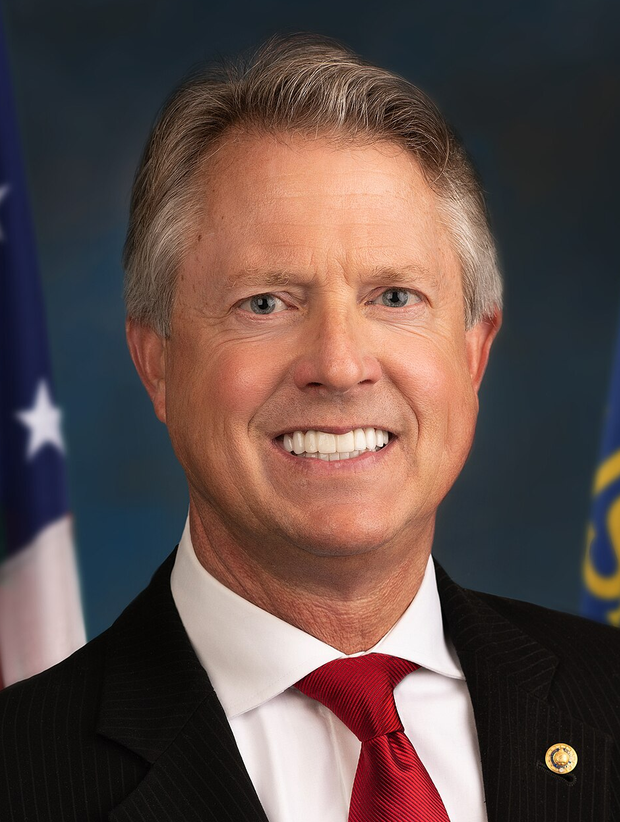
In a debate before hundreds at the Kansas state fair September 12, Hamilton’s incumbent Republican opponent Roger Marshall (above) launched a similar line of attack.
Born in El Dorado, Kansas, Marshall practiced medicine as an obstetrician-gynecologist in Great Bend, Kansas, in Barton County, for more than 25 years. Marshall was first elected to Congress in 2016 to serve Kansas’ rural 1st Congressional District until he was elected to the Senate in 2021. Endorsed by Trump, Marshall contrasts his rural bona fides against Hamilton’s suburban background.
“My opponent is too woke, he’s too weak and he doesn’t stand for anything,” Marshall said. He blamed the Democratic party for having “strangled the ag industry,” saying that if Hamilton had his way, “he’d go put a plastic bag over the mouths of these dairy cows back here,” motioning to the livestock building on the fairgrounds.
Despite his spar with Hamilton, Marshall spent much of the debate struggling against the crowd. Videos recorded of the debate showed Marshall’s answers overwhelmed by jeers and boos from the crowd.
Days earlier, the New York Times reported that Marshall and his OBGYN practice had sued more than 700 patients over their inability to pay for care. Eighty-one of those cases resulted in arrests, including a couple who were arrested on Easter weekend for being unable to pay a $4,561 bill for an emergency hysterectomy.
The Times found Marshall routinely charged patients an 18% annual interest rate on unpaid bills ranging from $101 to several thousand dollars. Patients also had their paychecks and bank accounts garnished. Most of the patients sued lived in rural Barton County, including many who lacked insurance.
At the state fair, Marshall attempted to defend his billing record, saying “those were common, common business practices. We would go a year before we would ever send somebody over.” But the crowd was not buying it and erupted in chants of “shame on you!”
A vital seat for Democrats
Kansas has not sent a Democrat to the U.S. Senate since 1932, when George McGill was elected during the Great Depression. But voters have elected some high-profile Democrats in recent years, including two-term Gov. Laura Kelly and four-term U.S. Rep. Sharice Davids.
Hamilton believes he can join them by pushing a platform of broad appeal: lowering costs, strengthening consumer protection laws, stopping D.C. corruption and combating the tariffs and health care cuts championed by President Donald Trump in the One Big Beautiful Bill.
If Democrats hold all their current senate seats and can flip four held by Republicans, they can retake the Senate in November.
While Marshall remains the favorite, recent polls show an unexpectedly tight race for Republicans. A September poll by Emerson College Polling/Nexstar Media gives Hamilton a two-point lead over Marshall. It is the first independent survey of the cycle to show Hamilton leading.
“This poll finds Democrats with their best chance to win their first Senate seat in Kansas since 1932, in part driven by Democrat Hamilton’s appeal to independent voters, leading by 15 points,” said Spencer Kimball, executive director of Emerson College Polling, in a statement accompanying the survey. The poll of likely voters also found 8% are undecided, with 4% supporting Libertarian David Graham. About half of respondents identified the economy as their top issue.
In August, Cook Political Report shifted the Kansas race in Hamilton’s favor from “solid Republican” to “lean Republican.”
A July poll by GBAO Strategies in Washington D.C. found Marshall’s close affiliation with President Trump hurt his favorability. Over half of the polled individuals said they do not want a “yes man” for Trump elected as their next senator.
In a sign of shifting party divisions, former Kansas GOP Governor Bill Graves endorsed Hamilton in late September, saying Marshall simply amounted to a “yes-vote” for the Trump administration. At the same time, Hamilton urged former Vice President Kamala Harris to stay out of his campaign, saying in an interview with MS NOW, “We are a different kind of Democrat.”
Flipping a key seat requires not only campaign stops, endorsements and good polling numbers, but also money. Hamilton told the Emporia coffee shop crowd it will take $20 million to run a successful campaign. The crowd let out cheers when he asked if they had heard of a guy named Talarico.
“You’re a cheap date in Kansas,” a New York donor told Hamilton when comparing his $20 million goal to Talarico’s $160 million goal.
Hamilton has raised just over $4 million, largely from individuals, according to FEC filings. Marshall has raised more than $6 million including $2.7 million in support from PACs ranging from the Mississippi Farm Bureau and the health care industry to the Teamsters Union PAC.
Who will represent rural Kansas?
“I was raised in Johnson County,” Hamilton told the crowd in Emporia. “I’m really sorry about that,” poking fun at his childhood in suburban Kansas City. It’s a much different Kansas experience than much of Kansas where rolling hills are dotted with pump jacks, cattle, late summer wildflowers, and wind turbines this time of year.
Hamilton feels like he is gaining the pulse of rural Kansas after an estimated 40 campaign stops across the state before Emporia.
“Our ag industry is the number one industry in the state,” he said in an interview with Barn Raiser. “If you as a senator are not caring about ag and the ag industry and the people in rural America, you’re not doing your job.”
For his part, Marshall spent most of August traveling across 59 Kansas counties speaking with farmers, ranchers, doctors, manufacturers, small business owners and families as part of his “120 Stops to Strengthen Rural Kansas” tour.
He is concerned about the high costs for fuel and fertilizer as well as the impacts tariffs have on farmers and ranchers. The decision to lift tariffs and import foreign beef had not been announced at the time of that interview.
Hamilton is also concerned about the state of rural hospitals. Kansas leads the nation in rural hospitals that are at risk of immediate closure due to the passage of the One Big Beautiful Bill last year. Marshall championed his vote for the bill at the time, which made nearly $1 trillion in cuts to Medicaid through 2035. In 2025, United Methodist Health Ministry Fund estimated that Kansas stood to lose nearly $4 billion in federal and state Medicaid funding.
The bill also provided a one-time $50 billion distributed over five years in the Rural Health Transformation Program. Kansas received $221 million for the program’s first year, far short of the funds needed to offset the Medicaid cuts.
In 2024, over 240,000 Kansans were uninsured, a statistically higher rate than the rest of the country.
In a statement released after his rural Kansas tour, Marshall said, “We’ve got a lot to be proud of—from cutting taxes for working families and growing Kansas manufacturing to delivering real resources for our rural hospitals.
Will a politics of human decency outweigh party loyalty among voters?
Hamilton believes so. At a campaign stop in Greensburg, he recalled one woman who told him, “I want somebody who’s going to help me not hate my neighbors anymore,” he told the crowd in Emporia.
Short-haired, elderly women held down the front row of chairs while Hamilton spoke. They occasionally responded to a question posed by Hamilton, regularly giving a classic Midwestern shake of the head in support or disgust.
Among those in the front row was former English teacher, Sharol Cutrell. After Hamilton spoke, she told him she didn’t vote for him in the primaries.
“I would vote for him today,” she told Barn Raiser. “Everything I believe, he’s right in line with. And we need somebody like that, somebody neutral, who’s for people who don’t have as much as we do.”
Cutrell had concerns about voting for a megachurch pastor in the primary, a sentiment shared by others in the coffee shop that morning. Seeing him in person made her believe he is the right nominee for the challenge.
When introducing themselves to Hamilton, many folks gave a brief outline of their family tree, starting with their abolitionist and settler roots in Kansas. A sunflower was incorporated into the design of the banner on the Lyon County Democrats office across the street.
In November voters will choose between two fifth-generation Kansans: a MAGA-backed Republican doctor and a Democrat mainline Protestant pastor.
“Keep me in your prayers,” Hamilton said to a woman as he left the event.