By Economic Policy Institute
Photos: YouTube Screenshots\Wikimedia Commons
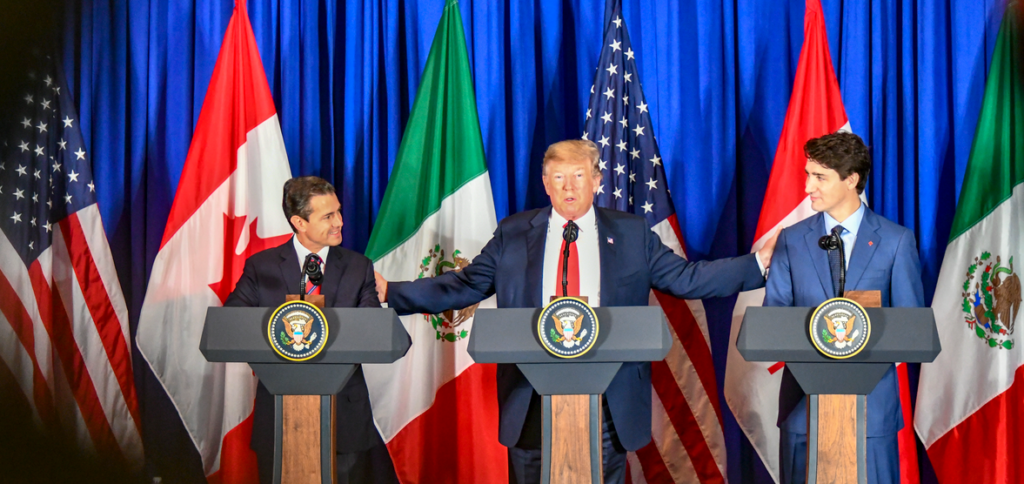
Trump replaced NAFTA with the United States-Mexico-Canada Agreement in 2020. But his USMCA has so far failed to make trade work for North American workers.
Key findings
- The U.S. trade deficit with Mexico and Canada has widened sharply since Trump signed USMCA; it reached a projected $263 billion in 2025, up from $125 billion in 2020.
- Although the agreement sought to revitalize U.S. manufacturing industries, manufacturers across the country shed or furloughed more than 576,000 jobs since he signed the agreement.
- In the critical automotive industry that Trump said he wanted to reshore, imports of motor vehicles and parts from Mexico nearly doubled following USMCA, rising to $274 billion in 2024, up from $196 billion in 2019: Light-duty vehicles imports from Mexico rose 36% while imports of medium- and heavy-duty vehicles increased a whopping 256%.
- Though some USMCA labor reforms are worth preserving and expanding, the overall wage gap in manufacturing still fuels corporate offshoring to Mexico’s low-wage, low-standard environment. Mexican manufacturing wages are just $2.76 an hour—a mere 10% of U.S. manufacturing wages.
- USMCA left a gaping loophole for Chinese manufacturers to exploit duty-free access to North American markets without reciprocal market access for U.S. manufacturers. Chinese firms expanded their direct investment footprint in Mexico by as much as 288% through 2023.
Why this matters
USMCA is now up for its 2026 sunset review, giving all three countries a chance to decide its future. Trump’s version has already failed workers across North America and urgently needs serious reform. Simply walking away would not fix USMCA’s fatal flaws, but would instead saddle workers with another 10 years of deindustrialization under unfair trade rules.
How to fix it
Instead of destabilizing North American trade, Trump and his negotiators should use this opportunity to cement a model that protects workers while preserving the mutual benefits of trade. This requires stronger regional and labor value content rules, closing loopholes to unfairly traded foreign content, and expanding cooperation to enforce strong rules across all three countries.