By Vernon Verdree & Elaine Smith
Photos: YouTube Screenshots
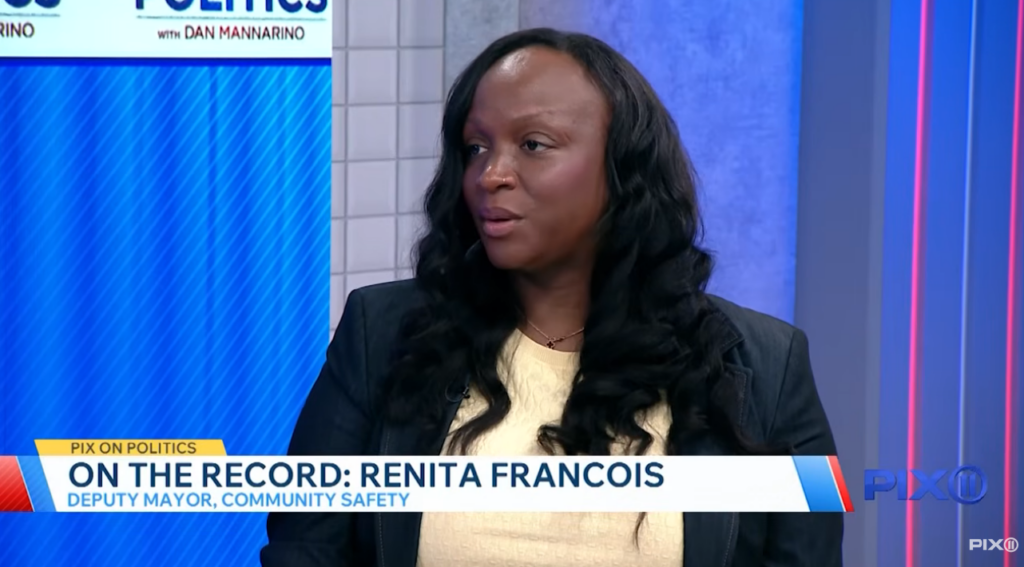
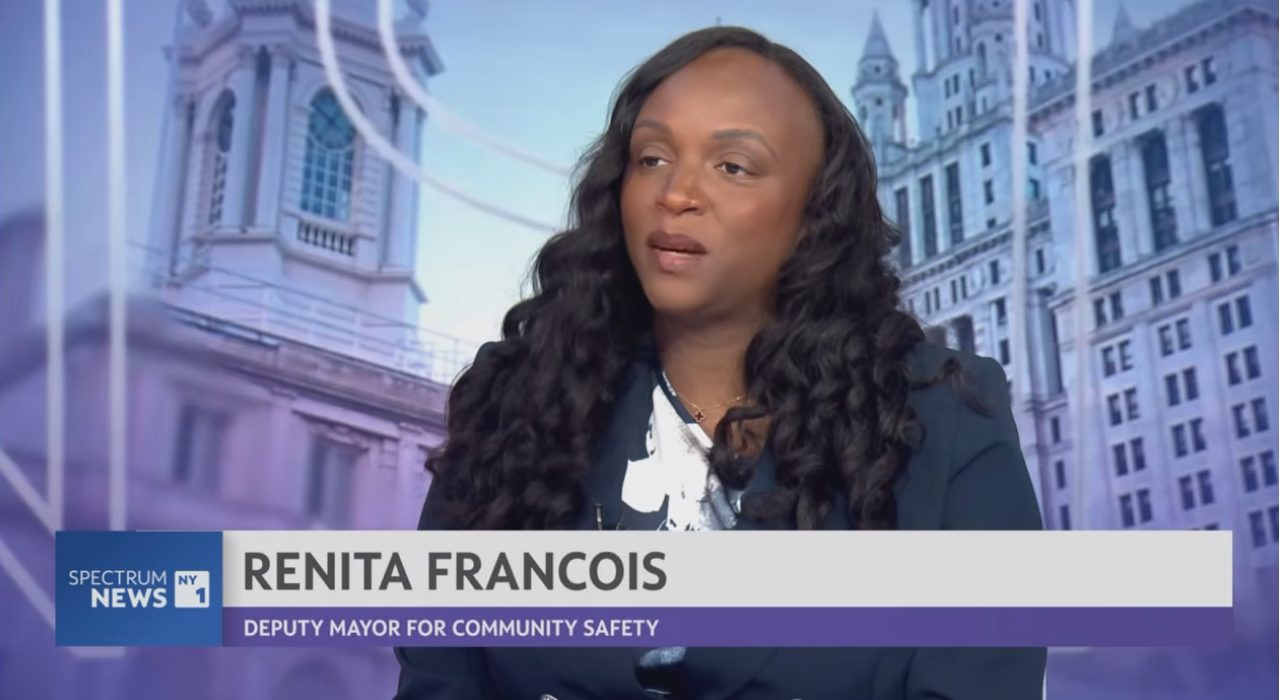
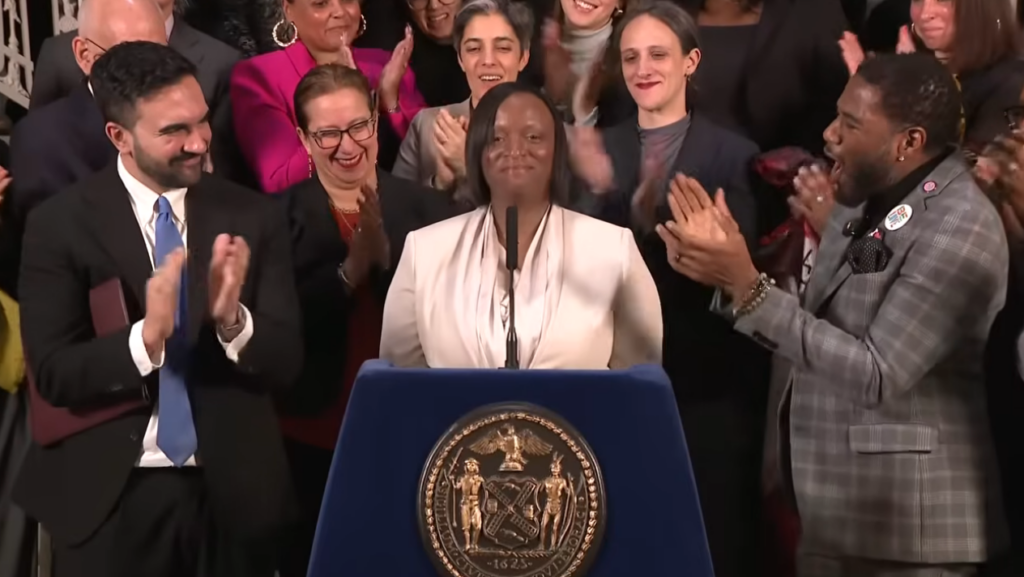
This past Sunday before the start of the 57th Annual African American Day Parade in Harlem, Black Star News ad the chance to speak with NYC Deputy Mayor of Community Safety Renita Francois.
BSN:
Black Star News is here today with Deputy Mayor of Community Safety Renita Francois, here at the VIP breakfast before the African American Day Parade. First, thank you for the opportunity to talk with you. I just had a few questions for you, but I would be remiss if I didn’t say that a majority of the questions are from a colleague of mine, a journalist in Atlanta, Ms. Elaine Smith, who is a supporter of what the Mamdani administration is doing….I gave her your profile, and she said, “Oh, you have to let me ask some questions”, so let’s begin…..
How has your experience working with the prior deBlasio administration, and also with the Tides Advocacy…how has that helped you prepare for this position?
Deputy Mayor Francois:
I mean, I think that, one, the work that I did in the deBlasio administration is very relevant and directly comparable to this work. I was leading neighborhood safety initiatives, and the mayor’s Office of Criminal Justice, and it was really at an early time about this conversation around redefining public safety and reimagining public safety. No one had really been talking like that, or about that, or really thinking about our communities beyond what putting people in jail, or, you know, heavy police presence, or just the investment that our country puts into carceral systems and into, you know, policing and prisons is exorbitant. And what can we do if all of our resources are concentrated in one place? But to get back to the point, I think at that time, when I was in the deBlasio administration, there wasn’t really a lot of focus on the fact that if we want to prevent crime, if we want to prevent violence, or even respond to it, that there are so many things that we could be doing upstream to make that happen. We could be investing in jobs. We could be investing in our young people. We could be making sure that our physical spaces, the actual environment that we live, is well-maintained and isn’t conducive to crime itself. And, one, we could also do the most important thing, which is put residents at the center of that effort and actually listen to people who have been overlooked and marginalized for so long, because those people are closest to the solution. They know their neighborhoods best. They’ve been in them for years. Some of the people, like the honorees that we heard about here today at the breakfast, those folks have had boots on the ground working in their communities for years, and they feel a responsibility to the upliftment and strengthening of their communities. And even if we look at it from a scientific perspective, evidence bears that if we do all of these upstream things, if we build community capacity, we’ll get the outcome that we want, which is reduced violence. So really getting in on the ground level and building that effort from scratch at a time when the country doesn’t really talk to you like that, of course, is super meaningful. Because now, with this administration, we have the eyes of the world looking at us, and what Mayor Mamdani is going to do, and what he’s able to do.
So that was really foundational. And then working at Tides Advocacy, which is now called Beyond Impact, I was supporting organizations—social justice organizations around the country—who are really doing that groundwork of mobilizing people and communities around various issues that prevent them honestly from thriving and living fuller lives And so just having that advocacy perspective, and also the knowledge of government and how it works and how to create change, I think it’s like a perfect marriage of the things that we need to actually make this work. We need the resources and the investment of it, but we also need the participation of regular, everyday New Yorkers and their advocacy to make this a reality.
BSN:
What are some of the biggest issues that you see that are facing the community and the city, and what strategies are you planning to implement to help solve some of them?
Deputy Mayor Francois:
I think that the main issue is under-investment and lack of investment in the resources that we’ve been talking about. So we talk about preventing gun violence, which is a huge priority for me as someone who grew up in South Central Los Angeles in the ’80s and ’90s, in an environment that was riddled with gun violence and particularly because of how it affects our communities, it is a problem that we need to solve. It is not something that we can just resign ourselves to and say this is just part of the experience. It is absolutely not. And I will not, stand by while that just becomes a part of the narrative that this is how our communities operate and function. This is a huge issue that we’re trying to tackle, investing in the community-based organizations, local trusted partners on the ground who know the folks in these communities, who know the people who are closest to these issues. Some of us didn’t become what they call a shooter overnight. It is the environmental conditions, or lack thereof, lack of support, lack of all types of things that bring somebody to the point where they feel like they can pick up a gun, aim it at another person and end their life for whatever reason. We spend a lot of time focusing on the impact of the crisis, but not enough time focusing on what needs to happen to prevent crisis. So that is a priority of this administration, for sure, the lifting of those voices who are most proximate to these issues.
And then on mental health, everyone is, you know, talking about crisis response and how do we guarantee the right responses to the right needs of New Yorkers at the right time. Everything can’t be, you know, call the police. It can’t be an over-utilized net resource to no end. And so when we think about what communities actually need and how we have to empower other people and other folks who have the training and who have the knowledge necessary to solve those issues. Because our public safety infrastructure as we know it today, our police resources, all those things, we need to be very precise about how we use those things. We need to,, our police department needs to respond to the most serious issues of crime. And when it comes to folks’ mental health care, it’s a response and reaction that they’re looking for from government. They’re are looking for compassionate care. They’re looking for trained professionals who can handle calls for their loved ones, who they can call on in time of need and support their loved ones. Support to connect that person to the right type of care that they need, not for them to be arrested or be in some position that is going to lead to a devastating outcome. And obviously, our police officers, they welcome this support. They want this support as well. So as a city, every day as a nation, we have to think about what is the appropriate response and how do we put the infrastructure in place to support the outcome that we want to see, which is people connected to care and receiving a compassionate response when they call on us.
BSN:
Since Mayor Mamdani has assumed office, New York City has seen notable declines in several major crime categories: murder rate going down, robbery rate going down, gun shootings rate going down. This has been an incredible feat. How do you balance public safety with community trust? Because both seem to be trending in the right direction.
Deputy Mayor Francois:
I think that the mayor’s focus on what we call “pothole” politics and actually delivering on the small things that New Yorkers see and look at every day and things that are actually material to our lives helps to build that trust. When people see that they can trust you with small things, that you say you’re going to do something and actually deliver, they start to trust you with these bigger things. So I think that that’s one part of this, especially in our communities where there’s not historically been this trust.
The more jobs we have, the more well-maintained and activated spaces, the more programs we have for our kids, the more opportunities we have for New Yorkers at large, the safer we are, the better off we are. And so actually focusing on what the main thing should be, which is how do we help just uplift New Yorkers and change the material conditions of their lives, that is building trust because we’re doing it in a very visible way. And people can see that, you know, we saved—we’re going to do business. We’ve done it. You know, we let people know that it’s been done. I think that the Mayor in particular is very smart. Having worked in government basically all my life, I know that we don’t know how to tell a story. We don’t know how to tell how we delivered or what we’ve done. And this Mayor, in particular, is very, very attuned with that. He knows that people need to understand and see that you will do, what you say you will do, and that you will deliver for them. And so I think that that’s gone a long way toward building trust between this administration and New Yorkers.
BSN:
As a Black woman in an important highly visible position of power. What surprised you most after taking office here in New York City, the cultural capital of the world?
Deputy Mayor Francois:
I don’t think much has surprised me, but what I will say is I think that, I don’t make it seem like I’m coming from the upper echelons or the political elites or any of that. I have literally worked my way from the ground up, coming from a family of public servants who were, you know, low-income folks in California. My grandmother came over to California from Louisiana, where she cooked jalapeño peppers. We are very humble. I come from humble beginnings. And it’s also the fact that I have dealt with a lot of these issues that I’ve worked with people. I have dealt with gun violence. I have been a young person in an urban city trying to find my way and figure out how I connect to the resources that are out there. And I think that that’s important for people, knowing that you have folks in positions of power who understand your lived experience, who understand you, your background. And I’ve spend a lot of time—even from this listening tour—I spend a lot of time with people, listening to people.
And not trying to talk over them, not trying to push our agenda, but just to hear them so that they can educate me on what I need to do to make sure I’m making an impact and delivering for them. It’s not lost on me that I am a Black American woman in this position and what that means to New Yorkers across the city. And of course, I want to do my best for us, and I want to move the needle for us. I feel like this administration has created the conditions for us to be able to do that. So just being an example of how that’s important, especially when we see at the highest levels of government folks with these lofty titles that just do not live up to the ideals that are supposed to hold, the principles and values that they’re supposed to hold. So I take that really personally. I want people to know when the next generation of Black leaders are coming up, especially Black woman leaders, that people can say they looked at me and they saw that I did what needed to be done, and I did it in the order that it needed to be done in. And so that door is open for another Black woman who is coming up behind me, because I have set the tone that this is how we execute and this is how we deliver. If I’m asleep on the job,maybe somebody coming behind me won’t get a chance, and I can’t—we can’t afford to mess that up.
BSN:
I love your answers because you touched on my final two questions for you, but I’ll ask them anyway. Your administration has so many successes that it’s hard to rank them, but what would you say are two of the most important accomplishments to you so far?
Deputy Mayor Francois:
I think one is just creating this position of Deputy Mayor for Community Safety and the Office of Community Safety. We have never had this level of attention and focus that is basically saying, in order for our communities to be safe, we have to invest, we have to respond appropriately, we have to build this, build a new paradigm essentially, and thought process around how we do safety in this city. The office was created by executive order, but the mandate is to create a department that will last long past this administration, and that will be written and enshrined in the city charter. So it’s like we’re forever saying, we cannot solve the problems that we face concerning violence, concerning crisis, with just the police department…. It is permanently saying, that this is the way we think about it in New York. We have to invest, we have to support the community, we have to understand the community crisis, and we have to think about these issues differently. So I think that that is number one.
And then number two is just, I got to go back to the “pothole” politics. People are just so disillusioned with government, so actually being able to deliver on even the smallest things. Universal childcare is just amazing. I have three children. I know what being able to have the space and the bandwidth financially and physically, emotionally, everything, is to really do what you need to do as a parent, to provide and to thrive and to build a fabric for your family. That is absolutely critical to everybody. And I know it’s especially critical to our community for, you know, working-class people in this city So just the potential that it affords us—the program is for the children, but the potential that it affords the parents and the adults is just phenomenal.
BSN:
What kind of legacy do you want to leave behind with your public service, and what advice do you have for young people looking to get into politics and for young people in general?
Deputy Mayor Francois:
The legacy that I would like to leave… As I said before, I was a young person who grew up in these conditions, and by the grace of God, and with the struggle of my mother, my grandmother, my grandfather. I was able to go to a good school, have great opportunities, and ultimately land here in this position by building a body of work that set me up to be ready for this appointment. And so I think that the legacy that I want to leave is one that says, for young people who come from these communities, who come from struggle, who have dealt with poverty, who have dealt with gun violence, who have felt horrible but not seen, not heard, oppressed, that doesn’t define who you are… It’s because you are still the captain of your life….You are still the driver of your ship, no matter what conditions are taking place around us, and no matter how much history and, you know, even the things that are happening today with this presidential administration, those things do not determine how far we get to go. And so, you know, my legacy would be more of reaching back, opening doors, kicking down doors, opening windows, lifting the trap for young people who come from conditions like me and others. Because the decisions that we make as leaders needs to be driven by the reality, because we’re living up here in a cloud, and the people that we’re serving are living in holes in their experience from us. And so as much as I can create opportunities for exposure for young people in communities, as I said, I’ve been on this listening tour, I’m going out to the streets of some of our communities that are hit hardest by economic downturn or unemployment, and on top of that, violence born out of these conditions. And I’m hearing from young people, directly from them, and I’m once again saying to them that they have access to me, somebody who comes from a place that they come from, a community like their’s, and is ready and willing and able to learn from them and serve them and help them get into positions. That’s what I want to do.
BSN:
Sounds good, Deputy Mayor Francois, Black Star News thanks you for your time.
Continued success, and we look forward to seeing you make the city a better place for us all.
Deputy Mayor Francois:
Thank you. Thank you so much. I appreciate you.