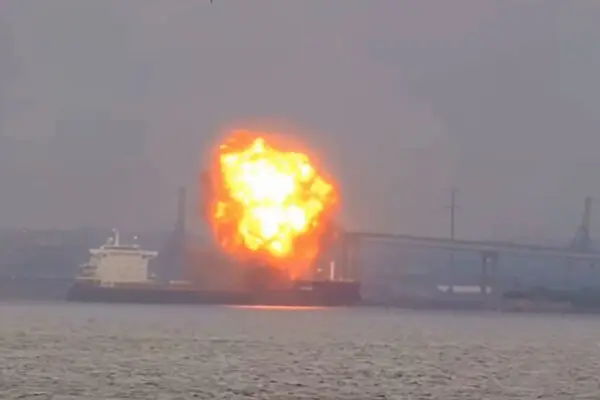
On August 18, 2025, Baltimore Harbor Cargo Ship Explosion faced another maritime disaster at 6:28 p.m. An enormous explosion went off aboard the cargo ship MV W Sapphire. The 751-feet cement carrier had just left with coal for Port Louis, Mauritius. Sirens blared across the harbor. Emergency responders rushed to the scene as residents feared another disaster.
The Explosion Hits a Recovering City
Baltimore Harbor Cargo Ship Explosion still had scars from the 2024 Key Bridge collapse. That killed six workers and shut down trade for months. Just one year later, another blast hit the city. Officials worried this would derail recovery and reconstruction efforts.
Calls went out within minutes. Fireboats and Coast Guard vessels sped to the scene. Authorities told tugboats to push the damaged ship away from populated areas. They successfully anchored it near Fort Howard under Coast Guard supervision.
Residents still healing from past trauma crowded the shoreline. Many thought the demolition crews working on the bridge caused the blast. Instead, they realized another cargo ship had exploded. The fireball rose hundreds of feet. Neighborhoods shook from the shockwave.
Also read: UN Official Tells Security Council “The People Of South Sudan Are Counting On Us”
Eyewitness Accounts
Witness Jay Steinmetz was sailing with his son when he saw the horror. He heard a loud boom, then a massive column of smoke. He thought the bridge demolition crew caused the noise. Only when the ship was on fire did he realize the extent of the danger.
“Holy crap,” he said of the towering smoke plume. Other sailors on the river turned their boats around in panic. Some called mayday on their radios. Others sped to the scene, not knowing what to do. Steinmetz confirmed he heard mayday calls clear as day on his emergency radio.
Social media filled up with footage. Videos showed fireballs, rattling windows and frightened voices. Residents posted videos of their homes shaking. Many thought another infrastructure failure was happening.
Emergency Crews Put Out the Fire
Firefighters were precise. The water cannons had been aimed at the fire in the upward hold where the heat was heterogeneously strong. The tugboats had to seize the vessel and hold it still as the fireboats attacked the fire. Police set up a 4,000-foot safety perimeter from the bridge to Brewerton Angle Channel.
Responders battled for hours before declaring the fire out. They prevented fuel tanks or machinery compartments from igniting. Environmental officials tested water and air samples. No oil or toxins were found. But they were still monitoring for coal combustion hazards. Coal can self-ignite in certain conditions.
Agencies coordinated. Baltimore Police, Coast Guard, Maryland Department of the Environment and federal investigators worked together. Leaders praised the teamwork. They credited drills and training after the Key Bridge collapse for the quick response.
The Ship and Its Cargo
The MV W Sapphire was a bulk cargo ship under foreign ownership. Its latest load was coal bound for Port Louis. Experts said coal is a fire risk if not stored or ventilated properly. Investigators couldn’t rule out spontaneous combustion.
Officials said the blast started near the forward hold. Flames spread fast. But the ship’s structure held long enough for rescue. Engineers called it lucky. A full structural failure could have sunk the ship in the harbor and blocked trade again.
International shipping records showed the vessel had made several global voyages. Reports of minor equipment issues before, but the details are unclear. Investigators will review logbooks, cargo manifests and crew statements now.
Crew and Survival
All 25 on board survived. Explosions often kill. This time, the crew and pilots were alert. They followed evacuation drills and secured the compartments. No one was evacuated as conditions allowed the crew to stay safe.
International standards credited. Crew from multiple countries showed discipline under pressure. Pilots guided tugboats to safety, with no uncontrolled drift. Emergency preparedness, drilled since last year’s collapse, saved lives and limited damage.
Medical teams checked all sailors once anchored near Fort Howard. Doctors found no serious injuries. Authorities are housing the crew while investigations continue. The outcome is a relief after all the shock.
Investigations Begin Now
Investigators have a long road ahead. The Coast Guard is leading the investigation, with federal, state and international experts. They will look into mechanical failure, coal combustion, electrical sparks or crew error. They will also see if maintenance issues before the incident played a role.
Engineers have already collected physical evidence from the ship’s damaged hold. Interviews with the crew will establish timelines. Data recorders, like airplane black boxes, may hold key information on systems during the explosion.
Officials promise transparency. They will release findings to the public quickly. They know residents demand answers after last year’s tragedy. Port communities can’t afford more uncertainty or mistrust.
Also read: Hatteras Island Evacuation Ordered as Hurricane Erin Nears
Conclusion: A Warning and a Chance
The Baltimore cargo ship explosion hit the city at a weak moment. Flames erupted, but no one died. Emergency crews responded quickly. They contained the disaster before it spread.
This is a wake-up call for global shipping and local infrastructure. Authorities need to improve cargo safety, vessel oversight and harbor protections. Communities deserve better after multiple maritime disasters.
Baltimore has another test, but its people are resilient. They rebuild, recover and demand accountability. Flames may go out, but lessons last.