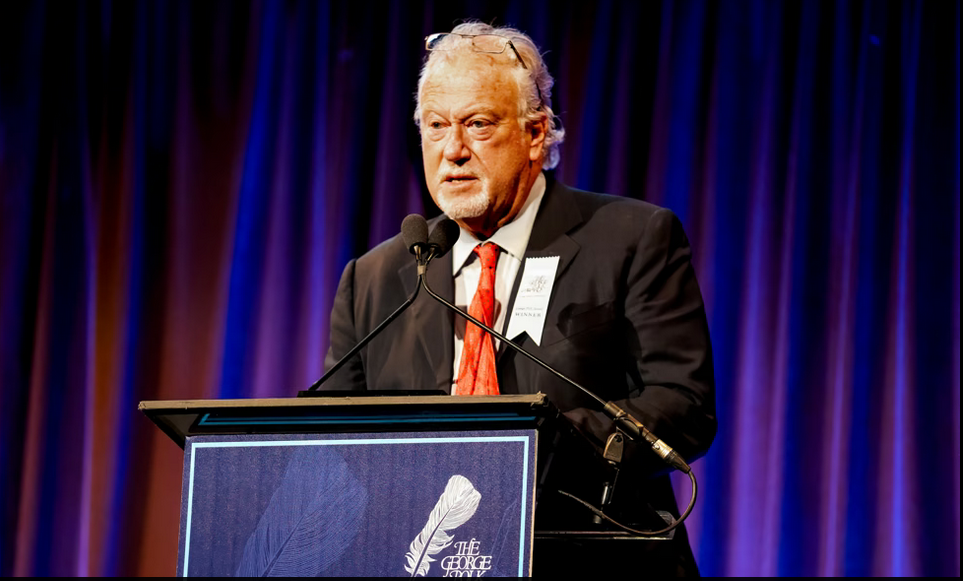
Journalist and filmmaker Melvin Mcray captures Jon Lee Anderson’s acceptance of the Sydney Schanberg Prize, at the 2026 Polk Awards, for his reporting on the Congo War.
By Melvin McCray
For decades, the war in the Democratic Republic of the Congo has unfolded largely out of sight — one of the deadliest, most protracted conflicts on earth. And as Jon Lee Anderson said plainly last week in accepting the Sydney Schanberg Prize at the 2026 George Polk Awards: to most people around the world, it has become “white noise.”
Anderson’s New Yorker investigation — “Can Trump’s Peace Initiative Stop the Congo’s Thirty-Year War?” — is the kind of reporting that forces you to pay attention. He traveled the country’s roadless east, into Goma after its seizure by the M23 militia, to a frontline town where Médecins Sans Frontières treated rival soldiers in carefully separated wards, to a village where a Catholic priest picked through the rubble of his parish and tried to imagine what rebuilding would require.
What he found is not simply a war. It is a structure. “Congo’s current war is over thirty years old,” Anderson said, “but its real origins lie much further back and have as much to do with outsiders treating it as a place of plunder.” That dynamic, he made clear, is unchanged — the current U.S. government now offering its power for peace in exchange for cobalt.
Anderson also raised a warning few want to hear: places left unnoticed and untended eventually demand attention. Iran. Iraq. Afghanistan. “With tragic consequences for all.”
The Sydney Schanberg Prize — established in 2022 by the widow of the legendary New York Times correspondent, Jane Freiman Schanberg, and carrying a $25,000 award — was created for exactly this kind of journalism. Schanberg himself said he wrote about people “outside the power structure” who don’t get city hall or government officials to pay attention to them. Anderson is working in that same tradition.
The estimated death toll in the Congo since 1996: between four and six million people. The rest of the world can decide how long it treats that number as background noise.