By Brigadier General Steven M. Anderson, U.S. Army (Ret.)\VoteVets
Photos: YouTube Screenshots|Wikimedia Commons
On Sunday, the President of the United States announced that the Navy would begin a “complete blockade” of the Strait of Hormuz. He said it on Truth Social. He said it on Fox News. He said any Iranian who fires on our ships will be “BLOWN TO HELL.”
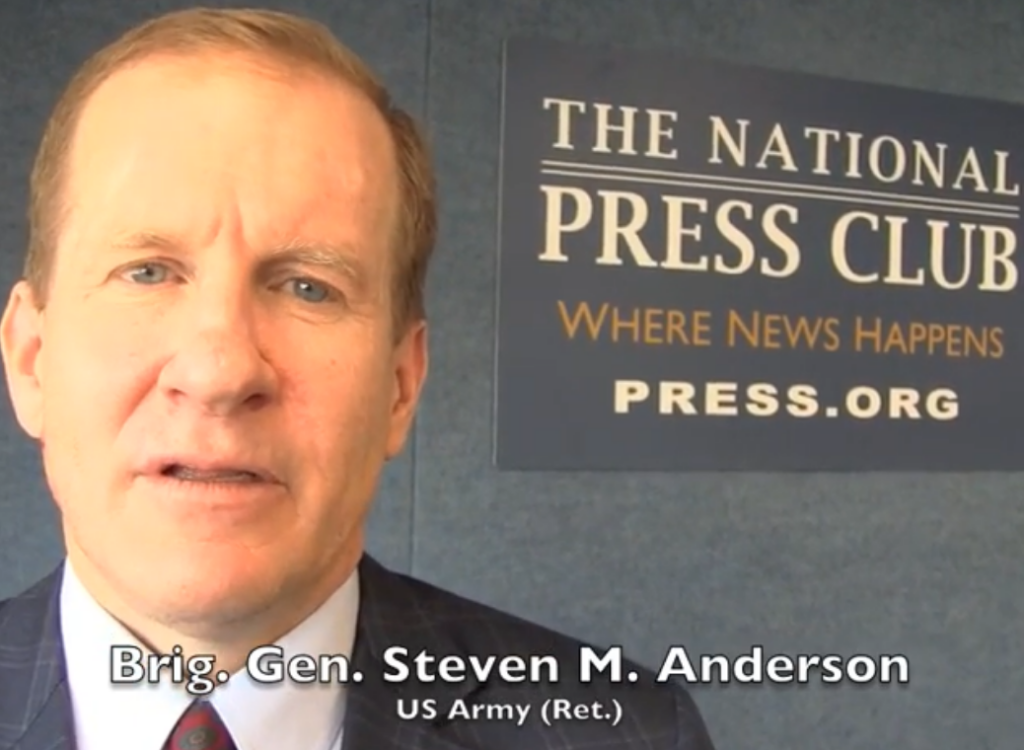
I spent thirty-one years in the United States Army. I served as Deputy Chief of Staff for Logistics for the Multi-National Force in Iraq, where I was responsible for sustaining a thirty-two-nation coalition across one of the most complex supply chains in the history of modern warfare. I know something about what it takes to keep a military operation running, what it costs to sustain one indefinitely, and what happens when leaders commit forces without understanding either of those things.
What the President announced on Sunday is not a strategy. It is a confession. He does not know how to open the Strait of Hormuz. So he is closing it further and calling that strength.
The Move That Should Have Been Made First — Or Not At All
Let me walk through the logic, because it matters.
If you were going to break Iran’s grip on the Strait of Hormuz, that is the kind of operation you launch at the beginning of a war. You do it when you have the initiative, when the element of surprise still exists, and when the enemy has not yet had weeks to fortify, mine, and establish full control of the waterway. You do it as part of a comprehensive strategy that includes defined objectives, an understanding of the costs, and a plan for what comes next.
And you do it with clear eyes about what it actually requires. Because clearing mines is only one piece of the problem, and not the hardest one.
Iran controls three heavily fortified island groups sitting directly on top of the shipping lanes:
- Qeshm, the largest island in the Gulf and the IRGC’s primary military hub, with underground bunker networks, mobile anti-ship missile launchers, and drone bases;
- Larak, positioned to strike ships at the narrowest point of the Strait; and
- Abu Musa, a forward early-warning and missile launch platform that extends Iran’s threat zone deep into the Gulf.
These are not observation posts. They are offensive weapons systems parked on the doorstep of the only shipping lanes that exist. The lanes themselves are roughly two miles wide in each direction — tankers passing through are within range of everything on those islands, with virtually no room to maneuver.
Beyond the islands, Iran has nearly a thousand miles of coastline bristling with mobile anti-ship cruise missile batteries hidden in mountainous terrain, valleys, and built-up areas. Those batteries move. They are difficult to find and harder to destroy permanently. Iran also fields thousands of naval mines, fleets of fast-attack swarm boats, midget submarines, and an arsenal of drones. All of them purpose-built over four decades to turn the Strait into exactly the kind of high-cost fight we are now staring at.
You cannot send minesweepers into that environment. Minesweepers are slow, lightly armed, and defenseless against anti-ship missiles and drone strikes launched from fortified positions a few miles away. Anyone who has studied the 1988 Operation Praying Mantis or the near-sinking of the USS Samuel B. Roberts by an Iranian mine knows what the Strait looks like when it becomes a combat zone. And that was before Iran spent thirty-five years hardening its defenses specifically for this scenario.
This is not theoretical. In 2002, the Pentagon spent $250 million on Millennium Challenge, the largest war game in its history. The Red team (modeled on Iran) was led by retired Marine Lieutenant General Paul Van Riper. When U.S. carrier groups entered the Gulf, Van Riper launched a coordinated assault using cruise missiles from shore batteries and civilian vessels, combined with swarm attacks from explosive-laden speedboats. He overwhelmed the fleet’s Aegis defense systems and sank sixteen warships, including an aircraft carrier, in a matter of minutes. The simulated toll was roughly twenty thousand American servicemembers. That was twenty-four years ago. Iran has spent every year since improving the exact capabilities Van Riper used to destroy that fleet.
To actually secure the Strait at the outset of this war, you would have needed sustained air campaigns to suppress Iran’s coastal missile batteries on the mainland — and amphibious operations to seize those islands. Ground forces. Marines taking fortified positions with underground bunkers built into rock. That is not a mine-clearing operation. That is a significant military campaign with the near-certainty of large numbers of American casualties.
So I am not saying the President should have launched that campaign on February 28th. The costs would have been severe, and the American people deserved a voice in whether those costs were worth bearing.
But here is the critical point: by choosing not to consider those high-cost options, by choosing not to think seriously about what it would actually take to keep the Strait open, the administration dramatically narrowed the range of strategic objectives this war could achieve. If you take the hard things off the table at the start because you haven’t thought them through, you don’t get to be surprised when you can’t accomplish them later.
That is exactly what happened. No defined strategic goals. No metrics for success. No exit strategy. No serious consideration of what it would cost to achieve the outcomes the President kept promising on social media. Just bombs, and bravado, and the assumption that Iran would collapse.
Iran did not collapse.
And the most important of question of all, not answered? What if Iran still stands?
Two Blockades Are Not Better Than One
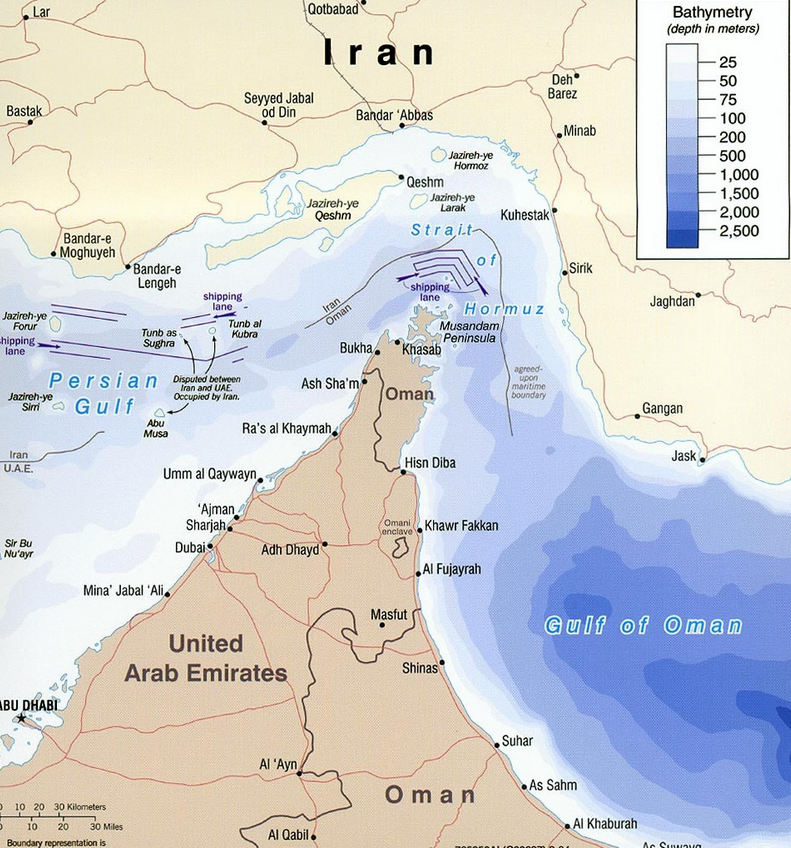

Now consider what the President actually announced on Sunday.
Before this blockade, the Strait of Hormuz was restricted by Iran. The IRGC had established what amounted to a toll system. They were controlling which ships passed through a single corridor, demanding documentation, clearance codes, and escorted passage. A handful of vessels had paid fees in Chinese yuan to guarantee safe transit. The Strait was not open. But some commerce was still moving, however constrained.
The President’s response to Iran restricting the Strait was to restrict it further. He ordered the Navy to blockade all ships entering or exiting Iranian ports. He ordered the interdiction of any vessel that has paid Iran a toll. He announced mine-clearing operations in waters Iran has said it will defend.
Think about that. The stated goal is to open the Strait of Hormuz. The action taken is to add a second blockade on top of the first one. There are now two forces preventing the free movement of ships through the most important energy chokepoint on the planet: Iran and the United States.
As Senator Mark Warner put it on CNN this weekend: he does not understand how blockading the Strait is going to push the Iranians into opening it. He does not see the connection. Neither do I.
Again (and I know I sound like a broken record), this is what happens when a president goes headfirst into a war that hasn’t been thought through, and then reaches a point where he has no good options and picks the one that sounds toughest. The talks in Islamabad failed over the weekend. The Iranians would not capitulate on the nuclear issue. The President needed to project strength. So he announced a blockade that makes the problem he says he wants to solve materially worse.
A Game of Chicken With a Regime That Has Nothing Left to Lose

What the President has set up is a game of chicken. And the relevant question is simple: who blinks first?
On one side, the Iranian regime. They believe they are in a fight for their very survival. They have already absorbed devastating air strikes that destroyed military infrastructure across the country. They have lived under crippling economic sanctions for years. Their economy was broken before this war started, and they are still standing. The IRGC holds the weapons, the money, and the religious authority. For them, control of the Strait is the last card they have. They are not going to fold it because the President posted in all caps.
On the other side, the United States. And here is what the Iranians are calculating right now.
Inflation surged to 3.3% in March, up from 2.4% in February, the highest reading in nearly two years. Gasoline prices jumped 21.2% in a single month, accounting for nearly three-quarters of the total price increase. Gas is above four dollars a gallon nationally. Airline fares rose nearly 15%. Economists are warning that energy costs will ripple into food prices, shipping costs, and consumer goods over the coming months. And that data was collected before the blockade was announced.
Americans are about to book summer vacations and discover what jet fuel prices have done to airfares. They are about to see energy costs filter into every product that moves by truck, which is nearly everything. They are about to feel this in a way they have not yet felt it.
And the midterm elections are approaching.
The Iranian regime knows all of this. They read our newspapers. They watch our cable news. The speaker of Iran’s parliament posted a picture of gas prices near Washington with the caption: “Enjoy the current pump figures.” That is not the behavior of a regime preparing to surrender. That is the behavior of a regime that believes time is on its side.
So here is the question the administration does not appear to have asked: if the strategic goal of this blockade is to force Iran to open the Strait, and Iran does not blink, then what? Is this the best way to achieve the objective? Is there a Plan B? Is there a point at which the economic damage to our own economy outweighs whatever pressure this puts on Tehran?
I do not believe those questions have been asked. But that would be consistent with every other phase of this war, in which the administration failed to ask and answer basic strategic questions before committing American forces and American credibility.
Deeper Into the Muck

In his piece for this publication last week, Major General Paul Eaton warned that this war was not over. He warned that what we were entering was not peace but a phase of forever war: American forces deployed to the region on a semi-permanent basis, on high alert, waiting for the next flare-up. He was right.
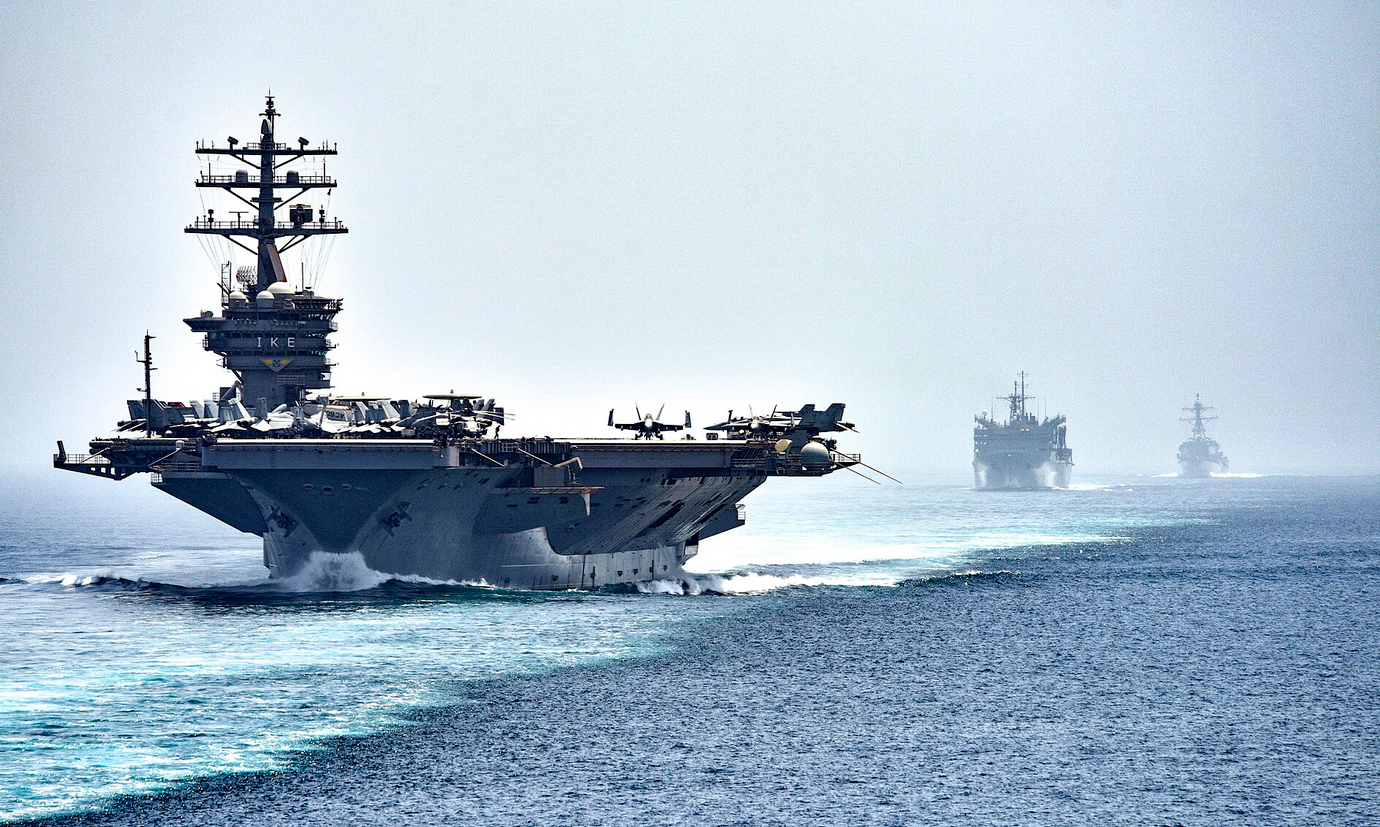
Now add this blockade to the picture. A naval blockade is not a tweet. It is an operation that requires aircraft carriers, destroyers, cruisers, minesweepers, logistics ships, and the personnel to sustain all of it. Those assets have to be on station continuously. They have to be resupplied. Crews rotate. Equipment breaks down. The operational tempo grinds on every ship and every sailor involved.
Those are assets that are not in the Pacific, where China continues to expand its naval presence. They are not in the Baltic, where NATO allies are asking for American commitment. They are sitting in the Persian Gulf, enforcing a blockade that makes the Strait less open than it was before we started — with no defined end point, no conditions for withdrawal, and no strategy for what happens if Iran simply waits us out.
Rather than extricating ourselves from this war, we are sinking deeper into it. Every week brings a new commitment, a new escalation, a new reason we cannot leave. This is the definition of a quagmire, and it is unfolding in real time.
Congress Has to Do Its Damn Job

The President will come to Congress soon asking for money to sustain these operations. The supplemental funding request is coming. It is as inevitable as the sunrise.
It is essential that Congress says no.
Most, if not all, Democrats will do that. But it is essential that Republicans begin breaking away. There are members of that caucus who know this is wrong. There are members who represent districts where the cost of gasoline and groceries is a daily crisis, not a talking point. There are members who told their constituents they would not support endless wars in the Middle East.
Americans did not vote for more forever war in the Middle East in 2024. They did not vote for an indefinite naval blockade that drives up the cost of everything they buy. They did not vote for a game of chicken with a regime that has nothing left to lose.
But that is exactly what they are getting. And the only way out of it is for Congress to finally do its job: exercise its constitutional authority, deny funding for operations that have no strategy and no end, and force this administration to answer the questions it has refused to ask itself.
The Strait of Hormuz was open before this war. It is not open now. And nothing the President announced on Sunday will change that.

Thanks for reading VoteVets’s Substack! Subscribe for free to receive new posts and support my work.